
Personal reflection · Supporting sources checked November 10, 2026
When I think about becoming a better version of myself, a few things come to mind: being more patient, losing weight, keeping my own rules and promises, and continuing to learn. I have ambitions, even though I don’t know every step that will take me there.
You might have a different picture in mind. Perhaps you want to listen more carefully, speak up when something matters, or return to an interest you’ve put aside. If you’re wondering how to become a better version of yourself, it helps to bring that picture into an ordinary situation. What would you do differently the next time that situation comes around?
That question belongs in the middle of everyday life, while dinner needs making, work needs finishing, and people need your attention. For ways to care for yourself alongside those responsibilities, explore our self-care ideas.
Quick Navigation
ToggleWhat Does Becoming a Better Version of Yourself Actually Mean?
Becoming a better version of yourself means choosing qualities that matter to you and practicing them in everyday situations. Patience might mean letting someone finish before you reply.
Keeping a promise might begin with checking your time before you agree. Notice what happened afterward and let it guide your next attempt. You can take responsibility for a choice while treating yourself with respect.
“Better” needs a meaning you recognize in your own life. Being more available to everyone, for example, could sound generous until you realize you’re agreeing to things you cannot manage. You could answer honestly about what you can offer and give those promises your full attention.
What I’m Working On: Patience, Promises, Learning and My Own Goals
My priorities include both the way I want to behave and things I want to work toward. Following through matters to me: I want to stick with my goals and achieve things that are important to me. The examples below offer ways to think about what your own priorities could look like in practice.
Being More Patient in a Real Conversation
Imagine someone is explaining a problem and you think you already know the answer. You could offer your solution right away. Or you could let them finish and ask, “Would you like some ideas, or would it help to talk it through first?” Their answer tells you what kind of attention they would welcome.
You may still feel impatient. You can choose to hear the rest of the story while that feeling is there. If you interrupt, a simple “Sorry, I cut you off. What were you going to say?” gives the other person their turn back.
The next time you catch yourself preparing an answer, see whether there is more of the story to hear.
Keeping Rules and Promises That I Can Stand Behind
The promises I want to keep include the ones I make to myself. Giving a promise some thought before making it is a place to begin.
Suppose someone asks you to help with something tomorrow. Before saying yes, check what is already there. You might be able to offer an hour, suggest another day, or explain that you cannot take it on. “I can help on Saturday morning” gives the other person clearer information than an uncertain “I’ll try” when tomorrow is already full.
The same care applies to your own plans. Be clear about what you have agreed to and why it matters. With a personal rule, ask whether it still serves its purpose as your circumstances change. You can review a rule thoughtfully and be honest about the decision.
Continuing to Educate Myself
Continuing to educate myself is one of my priorities. A question you keep putting aside can be a starting point for your own learning.
Perhaps you keep seeing a term in articles but skip past it because you aren’t sure what it means. Look it up, find a clear explanation, and try describing it in your own words. If it still doesn’t make sense, you have a specific question to take to someone who knows more.
You can also leave a conversation with something new by asking, “How did you learn to do that?” Curiosity has a place in everyday life, whether or not a course or qualification is part of your plans. You might explore a practical skill or return to an interest you’ve missed.
Working Toward a Personal Goal
I want to lose weight to feel better and look better. I also want to follow through on a goal that matters to me. Those are my reasons for including it here, alongside patience, promises and learning.
Your goals may be different. You might want to complete a qualification, make time for an interest, or feel more confident handling a particular responsibility. Give the goal a name that means something to you, and consider what support or information you need to pursue it sensibly. Your worth is already there while you work toward it.
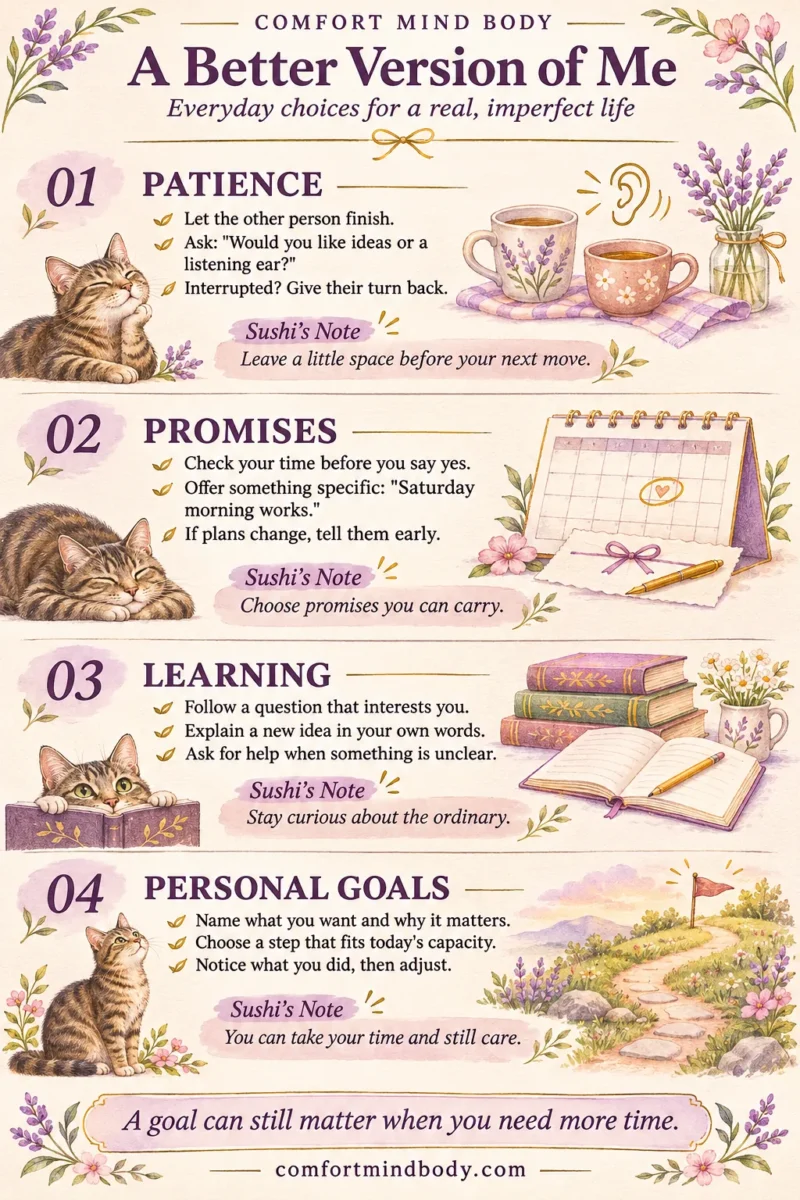
Read the infographic text
Comfort Mind Body · A Better Version of Me
Everyday choices for a real, imperfect life.
01 · Patience
- Let the other person finish.
- Ask: “Would you like ideas or a listening ear?”
- Interrupted? Give their turn back.
Sushi’s Note: Leave a little space before your next move.
02 · Promises
- Check your time before you say yes.
- Offer something specific: “Saturday morning works.”
- If plans change, tell them early.
Sushi’s Note: Choose promises you can carry.
03 · Learning
- Follow a question that interests you.
- Explain a new idea in your own words.
- Ask for help when something is unclear.
Sushi’s Note: Stay curious about the ordinary.
04 · Personal Goals
- Name what you want and why it matters.
- Choose a step that fits today’s capacity.
- Notice what you did, then adjust.
Sushi’s Note: You can take your time and still care.
A goal can still matter when you need more time.
comfortmindbody.com
Let “Better” Fit the Day You Actually Have
I work in hospitality, and I also spend time writing and building this blog.
I’m Ukrainian, with family in Ukraine and a brother on the front lines. That is a heaviness I carry alongside my work and everyday responsibilities. My goals have to fit into that reality, too.
You may also be carrying something that asks a great deal of you. Consider what you have the capacity for today. A goal can still matter when you need to give it more time.
Consider what patience or learning could look like inside a day like that. At work, you might ask someone to explain a point you didn’t understand. During a family conversation, you might set aside what you were about to say and listen to the answer. When another request comes in, you might check what you have already agreed to before replying.
Sometimes an honest limit helps you give someone your attention. “I want to hear about this. Can we talk after dinner?” acknowledges what you are doing now and gives the conversation a time. Choose a time you can reasonably offer, then return to it.
If you’re ready to turn a particular goal into a plan, our guide to changing your life walks through that next step.
Notice the Moment You Handled Differently
A change can be easy to overlook when you are watching for a big result. Look at the situation itself. Did you ask the question you usually keep to yourself? Did you tell someone early that a commitment needed to change? Did you listen long enough to discover that your first assumption was wrong?
Choose a moment you remember and describe what you actually did. “I asked for an explanation when I was confused” tells you more than “I was good today.” It gives you a response you can use again.
You can also notice what made the choice difficult. Perhaps you were rushed, had misunderstood the request, or needed information you didn’t have. That detail helps you decide what to do differently next time. Give yourself credit for recognizing it, even when the conversation or task was untidy.
When You Fall Short, Decide What Needs Repair
Some attempts will go badly. You might speak sharply, forget something you agreed to do, or realize you gave an answer before checking it. Start with the part that affects the other person.
For example, if you promised to bring paperwork and forgot, you could say, “I said I would bring it, and I didn’t. I’m sorry. I can send it this afternoon. Would that still help?” Then make sure the new offer is something you can deliver. The other person may still be disappointed, and you can listen to that without asking them to reassure you.
Afterward, consider what would help you handle a similar situation. That could be checking the details before agreeing, clarifying what is expected, or asking for help sooner. Keep the lesson connected to what happened.
When a mistake keeps replaying as a judgment about who you are, our guide to letting go of negative thoughts offers a separate place to start. You can acknowledge a mistake, make the repair available to you, and continue with the day.
Final Thoughts
I still don’t know every step toward my ambitions. I do know some of the qualities I want to bring to them: patience, a willingness to learn, and care with the promises I make.
For you, a place to begin may be a conversation you want to approach with more care, a request that needs an honest answer, or a question you are ready to ask. Start there and see what you learn about the person you want to be.
I hope you give your ambitions a place in the life you already have, and give yourself credit for the care you bring to it.
Take gentle care of yourself,
Anna
Resources & Scope
This article combines personal reflection with general suggestions for adults. The examples are possibilities to adapt to your circumstances. It does not provide an individual weight-management or mental-health treatment plan.
- The NHS guide to five steps to mental wellbeing offers ideas for learning, connection and everyday kindness.
- The NHS guide to self-esteem discusses recognizing your strengths, being kind to yourself and finding support. Its NHS service information applies to the UK. If how you feel about yourself is persistently distressing or affecting daily life, consider talking with a qualified health professional.