Affiliate disclosure: This post may contain affiliate links. If you buy through them, Comfort Mind Body may earn a small commission at no extra cost to you.
K-beauty and J-beauty skincare differences are easiest to understand when the focus moves away from “which one is better?” and toward routine style, product texture, ingredients, sunscreen habits, and how much experimentation a routine can tolerate.
K-beauty is often linked with hydrating layers, essences, ampoules, toner pads, glass skin, sunscreen, centella, snail mucin, PDRN, spicules, and fast-moving trends. J-beauty is often linked with cleansing oils, watery lotions, elegant sunscreens, soft textures, fewer steps, and long-term consistency.
Neither approach is automatically better.
Korean skincare may be a better fit for someone who enjoys lightweight layers, trend-forward formulas, and targeted products for hydration, dullness, acne-prone skin, or barrier support. Japanese skincare may be a better fit for someone who wants a simpler routine, polished textures, cleansing oils, watery lotions, sunscreen, and fewer product decisions.
The best routine can also borrow from both.
This guide compares K-beauty vs J-beauty by routine style, ingredients, sunscreen, cleansing, skin type, current product trends, and what to avoid when mixing Korean and Japanese skincare.
For the Korean skincare hub, read: Why Do Koreans Have Good Skin? For the Korean routine order, read: Korean Skincare Routine Steps.
Quick Navigation
ToggleQuick Answer: K-Beauty And J-Beauty Skincare Difference
K-beauty is often more trend-forward, layered, and experimental. It often focuses on hydration, glow, barrier comfort, essences, ampoules, toner pads, sun serums, centella, snail mucin, PDRN, spicules, and glass-skin routines.
J-beauty is often more minimal, refined, and consistency-focused. It often focuses on cleansing oils, watery lotions, emulsions, elegant sunscreens, gentle hydration, rice bran, green tea, sake or ferment-inspired products, ceramides, and fewer routine steps.
K-beauty may fit people who like:
- Lightweight hydrating layers
- Essences, serums, and ampoules
- Glass-skin routines
- Centella, cica, heartleaf, snail mucin, rice, or ginseng
- Trend-forward products like toner pads, PDRN, spicules, and collagen masks
- More product experimentation
J-beauty may fit people who like:
- Simple routines
- Cleansing oils
- Watery lotions
- Emulsions and creams
- Elegant sunscreen textures
- Gentle consistency
- Fewer steps and fewer trending products
The best answer for many people is not K-beauty or J-beauty. It is a routine that borrows the most useful parts of both.
Anna’s note: Skin does not care which country a product comes from. It responds to ingredients, texture, frequency, and whether the routine is gentle enough to repeat.
Quick Decision
Choose K-beauty if you like hydration layers, glow-focused routines, and trend-forward formulas. Choose J-beauty if you prefer fewer steps, cleansing oils, watery lotions, and simple daily consistency. Mix both if the routine stays calm, comfortable, and easy to repeat.
K-Beauty And J-Beauty Skincare Differences At A Glance
Swipe left or right to view the full table on mobile.
| Category | K-Beauty | J-Beauty | Best Takeaway |
|---|---|---|---|
| Routine style | Layered, flexible, often trend-forward. | Minimal, refined, consistency-focused. | Choose the style that can be repeated. |
| Hydration | Essences, ampoules, snail mucin, rice toners, hydrating serums. | Watery lotions, emulsions, hyaluronic acid, soft moisture layers. | Both are strong for hydration. |
| Cleansing | Cleansing oils, balms, gentle gels, double cleansing when needed. | Strong cleansing oil tradition and gentle second cleansers. | Oil cleanse only when useful. |
| Sunscreen | Light sun creams, sun serums, dewy or skincare-like textures. | Elegant gels, milks, watery SPF textures, strong daily-use culture. | Use the SPF that can be applied enough. |
| Actives | Toner pads, PDRN, spicules, niacinamide, centella, propolis, acids. | More restrained; often focuses on daily care, lotions, ferments, and sunscreen. | Do not stack too many actives. |
| Sensitive skin | Can help with cica, centella, panthenol, barrier creams. | May suit people who prefer fewer steps and simpler textures. | Ingredient list matters most. |
| Trends | Fast-moving: PDRN, exosomes, toner pads, spicules, collagen masks, devices. | More classic: cleansing oils, lotions, sunscreens, rice bran, ferments. | Treat trends as optional. |
What Is K-Beauty?
K-beauty means Korean beauty, especially skincare, makeup, sunscreen, and routine habits influenced by South Korean beauty culture.
In skincare, K-beauty is often associated with hydration, glow, sunscreen, gentle layering, barrier support, and innovation. Popular K-beauty product categories include cleansing oils, gel cleansers, toners, essences, ampoules, serums, sheet masks, cica creams, sun serums, sleeping masks, toner pads, and trend products.
Common K-beauty ingredients and product themes include:
- Centella and cica
- Heartleaf
- Snail mucin
- Rice
- Ginseng
- Propolis
- Niacinamide
- Hyaluronic acid
- PDRN
- Peptides
- Spicules or reedle-style products
- Toner pads
- Sun serum textures
K-beauty can be useful when a routine needs lightweight hydration, a softer sunscreen texture, calming ingredients, or a more flexible approach to layering.
The main risk is overbuying. K-beauty trends move quickly, and not every toner pad, ampoule, essence, mask, PDRN serum, or spicule product belongs in every routine.
For Korean skincare product examples, read: Best Korean Skincare Products For Glowing Skin.
What Is J-Beauty?
J-beauty means Japanese beauty, especially skincare habits, products, sunscreen, cleansing oils, and makeup traditions influenced by Japanese beauty culture.
In skincare, J-beauty is often associated with simplicity, refinement, prevention, soft textures, sunscreen, cleansing oils, watery lotions, emulsions, and steady consistency.
One important vocabulary note: in J-beauty, a “lotion” often means a watery hydrating step used after cleansing. It is not the same as a Western body lotion.
Common J-beauty product categories include:
- Cleansing oils
- Gentle foaming cleansers
- Watery lotions
- Essences or serums if needed
- Emulsions
- Lightweight creams
- Sunscreens
- Sheet masks
- Rice bran, green tea, sake, or ferment-inspired products
- Ceramide-focused creams
J-beauty may suit people who want fewer steps, reliable textures, elegant cleansing oils, sunscreen, and hydration without chasing every trend.
That does not mean every J-beauty product is gentle. Any product can irritate depending on ingredients, fragrance, alcohol content, actives, skin condition, and frequency.
For Japanese skincare product examples, read: Best Japanese Skincare Products.
Korean And Japanese Skincare Routine Differences
K-beauty and J-beauty routines can look similar, but the emphasis is different. K-beauty often leaves more room for essences, ampoules, toner pads, masks, and targeted serums. J-beauty often leans toward cleansing oil, lotion, emulsion, moisturizer, and sunscreen.
Swipe left or right to view the full table on mobile.
| Step | K-Beauty Version | J-Beauty Version | Can Combine? |
|---|---|---|---|
| Cleanse | Oil cleanser, balm, gel cleanser, or double cleanse when needed. | Cleansing oil followed by gentle cleanser when needed. | Yes. Use one first cleanse only when useful. |
| Hydrate | Toner, essence, snail mucin, rice toner, or hydrating serum. | Watery lotion or skin conditioner. | Yes, but do not layer too many watery steps. |
| Treat | Serum, ampoule, toner pad, PDRN, centella, niacinamide, or active product. | Serum or essence when needed, usually less trend-heavy. | Yes. Choose one main treatment goal. |
| Moisturize | Gel cream, cica cream, barrier cream, or sleeping mask. | Emulsion, gel, cream, or ceramide-focused moisturizer. | Yes. Choose texture by skin type. |
| Protect | Korean sunscreen, sun cream, or sun serum. | Japanese sunscreen gel, milk, essence, or lotion texture. | Choose one sunscreen and apply enough. |
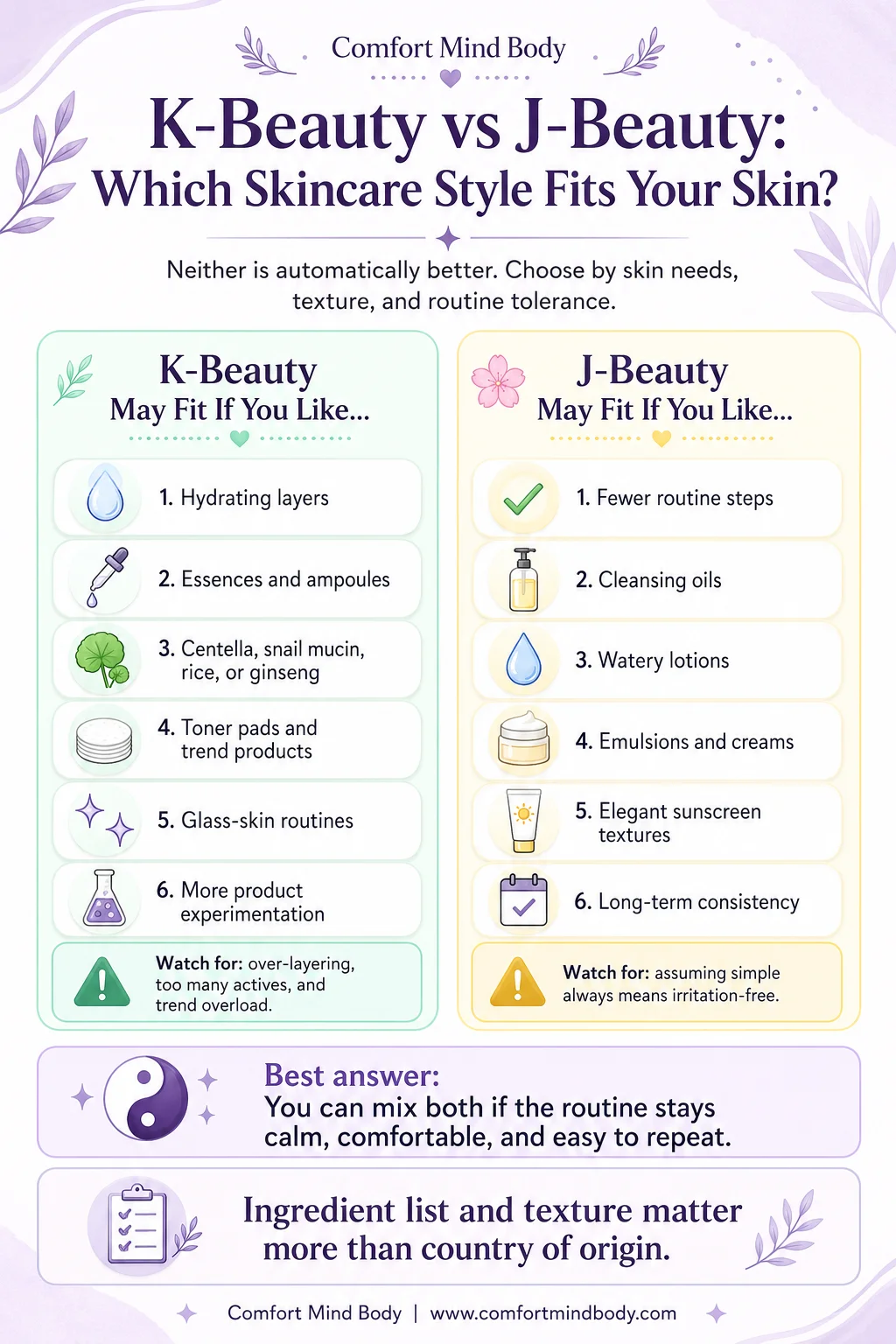
K-beauty and J-beauty have different strengths. Choose by skin needs, texture, and routine tolerance instead of treating one as automatically better.
Ingredient And Texture Differences
K-beauty and J-beauty can both be hydrating, gentle, and sunscreen-focused, but they often highlight different ingredients and textures.
K-beauty often highlights:
- Snail mucin
- Centella and cica
- Heartleaf
- Rice
- Ginseng
- Propolis
- PDRN
- Spicules or reedle products
- Peptides
- Niacinamide
- Toner-pad acids
- Sun serum textures
J-beauty often includes:
- Hyaluronic acid
- Rice bran
- Green tea
- Camellia oil
- Sake or ferment-inspired ingredients
- Ceramides
- Collagen-positioned formulas
- Cleansing oils
- Watery lotions
- Elegant sunscreen gels and milks
The label “Korean” or “Japanese” is not enough to know whether a product will suit the skin. Ingredient lists, fragrance, texture, active strength, and routine frequency matter more than country of origin.
Which Is Better By Skin Type?
Neither K-beauty nor J-beauty is better for every skin type. The best choice depends on the routine goal, product texture, ingredient tolerance, and how many steps the skin can handle comfortably.
Swipe left or right to view the full table on mobile.
| Skin Type | K-Beauty May Help With | J-Beauty May Help With | Best Choice |
|---|---|---|---|
| Dry skin | Hydrating toners, essences, snail mucin, cica creams, sleeping masks. | Watery lotions, emulsions, ceramide creams, soft sunscreen textures. | Both can work. |
| Oily skin | Gel creams, light sunscreens, heartleaf, centella, toner pads if tolerated. | Watery lotions, light emulsions, elegant sunscreen gels. | Choose light textures. |
| Acne-prone skin | Calming serums, gel moisturizers, light SPF, occasional pore pads. | Simpler routines and light hydration layers. | Avoid over-layering. |
| Sensitive skin | Barrier creams, centella, panthenol, cica, gentle hydration. | Fewer steps, lotions, emulsions, ceramide creams. | Ingredient list matters most. |
| Mature skin | Hydration, sunscreen, peptides, PDRN trends, barrier support. | Sunscreen, lotions, emulsions, creams, long-term consistency. | Prioritize sunscreen and comfort. |
| Men’s simple routine | Light cleanser, moisturizer, sunscreen, optional calming serum. | Cleansing oil if needed, lotion, moisturizer, sunscreen. | Keep it repeatable. |
For sensitive or irritated skin, the best choice may be neither a full K-beauty routine nor a full J-beauty routine. A smaller routine with a gentle cleanser, moisturizer, and sunscreen may work better until the skin feels calm again.
For barrier-focused routines, read: How To Protect Your Skin Barrier
Korean Vs Japanese Sunscreen
Both K-beauty and J-beauty are known for elegant sunscreen textures.
Korean sunscreens often have skincare-like, hydrating, dewy, or serum-style textures. Japanese sunscreens are often known for watery gels, milks, essences, and lightweight daily-use textures. Both can be useful if they make sunscreen easier to apply regularly.
The most important sunscreen rules do not change:
- Use sunscreen as the final morning skincare step
- Apply enough
- Reapply when needed
- Follow the product label
- Choose a formula that suits skin type, tone, and daily activity
- Use sunscreen with other sun-protection habits during long outdoor exposure, such as shade, hats, and protective clothing
In the United States, sunscreens are regulated as over-the-counter drugs because they are intended to help prevent sunburn and reduce certain sun-related risks when used as directed.
Korean Vs Japanese Cleansing
Japanese skincare has a strong cleansing oil tradition. Japanese cleansing oils are often used as a first cleanse to remove sunscreen, makeup, and long-wear products.
K-beauty also has many cleansing oils and balms. Korean cleansing balms and oils are often part of double-cleansing routines, especially when wearing makeup or heavier sunscreen.
The useful lesson from both sides is simple:
Double cleanse only when there is makeup, heavy sunscreen, water-resistant sunscreen, or long-wear products to remove.
If skin is not wearing makeup, water-resistant sunscreen, heavy SPF, or long-wear base products, one gentle cleanser may be enough. Over-cleansing can make skin feel tight, dry, shiny-but-uncomfortable, or irritated.
For a basic routine foundation, read: Step-By-Step Skincare Routine
Product Trends: K-Beauty Vs J-Beauty
Trends are useful for understanding what people are comparing, but they should not control the routine.
These product names are examples of categories readers often compare. They are not a ranking, and they are not required for a good routine.
Swipe left or right to view the full table on mobile.
| Category | K-Beauty Trend | J-Beauty Trend | Routine Note |
|---|---|---|---|
| Hydration | COSRX Snail Mucin, Torriden, rice toner, milky toner, ginseng essence. | Hada Labo lotion, Naturie Hatomugi, watery skin conditioners. | After cleansing. |
| Sunscreen | Beauty of Joseon, Round Lab, SKIN1004, Goodal sun serum formats. | Biore, Skin Aqua, Anessa, Shiseido sunscreen textures. | Final AM step. |
| Barrier support | ILLIYOON, AESTURA, Dr. Althea, centella and cica creams. | Curel, ceramides, emulsions, creams. | Moisturizer step. |
| Trend treatments | PDRN, exosomes, spicules, toner pads, Medicube devices. | Minimal routines, refined lotions, ferments, sunscreen and cleansing traditions. | Optional. |
| Cleansing | Cleansing balms, oil cleansers, gel cleansers. | DHC, Fancl, Shiseido-style cleansing oils. | Use when needed. |
Can You Mix K-Beauty And J-Beauty?
Yes. K-beauty and J-beauty can work well together when the routine stays simple.
Useful combinations include:
- Japanese cleansing oil plus Korean sunscreen
- Japanese lotion plus Korean cica cream
- Korean essence plus Japanese moisturizer
- Korean toner pad, occasionally plus a simple J-beauty routine
- Korean serum plus Japanese sunscreen
- Japanese sunscreen plus Korean barrier cream
The key is to avoid mixing too many active products just because they come from different countries. A Korean toner pad, a Japanese exfoliating product, a vitamin C serum, and a retinoid do not all need to be used together.
If the routine starts to sting, peel, clog, or feel confusing, reduce steps first.
What To Avoid When Mixing K-Beauty And J-Beauty
Avoid:
- Assuming Korean skincare is better because it trends more
- Assuming Japanese skincare is better because it seems simpler
- Buying full routines from both at once
- Layering toner, essence, lotion, serum, and ampoule if skin feels sticky
- Using multiple sunscreens too lightly
- Using spicules or acid pads on irritated skin
- Mixing retinoids, acids, toner pads, and vitamin C without a plan
- Ignoring fragrance, alcohol, or other personal triggers
- Choosing products only because they are popular online
For active-ingredient safety, read: Skincare Products You Shouldn’t Mix.
Frequently Asked Questions About K-Beauty And J-Beauty
What is the difference between K-beauty and J-beauty?
Is Korean skincare better than Japanese skincare?
Is Japanese skincare better for sensitive skin?
Can I mix Korean and Japanese skincare?
Which is better for acne-prone skin?
Which is better for dry skin?
Which has better sunscreen, K-beauty or J-beauty?
Is J-beauty simpler than K-beauty?
What should I try first from K-beauty?
What should I try first from J-beauty?
Do I need a 10-step routine?
Final Thoughts: K-Beauty And J-Beauty Can Work Together
K-beauty and J-beauty are not enemies. There are two skincare styles with different strengths.
K-beauty often brings playful innovation, hydrating layers, barrier support, and trend-forward products. J-beauty often brings simplicity, cleansing oils, watery lotions, elegant sunscreen textures, and steady consistency.
The best routine may use one, the other, or both.
Start with skin needs first. Choose the texture second. Add trends last. If skin feels calm, protected, and easy to manage, the routine is doing its job.
Helpful References
- Glamour: What Is J-Beauty?
- Marie Claire: Japanese Skincare After The K-Beauty Boom
- Who What Wear: Best Japanese Skincare
- Who What Wear: Best Korean Skincare
- Vogue: Korean Slow Aging Philosophy
- Health: Korean Skincare Ingredients
- FDA: Sunscreen: How To Help Protect Your Skin From The Sun
- American Academy of Dermatology: Shade, Clothing, And Sunscreen
- FDA: How Cosmetics Are Regulated In The U.S.
Affiliate Disclosure
This article is for general skincare education only and is not medical advice. Product labels, directions, and formulas can change. Persistent acne, painful irritation, spreading rash, sudden skin changes, severe dryness, or skin that reacts badly to most products should be checked by a dermatologist or qualified healthcare professional.
Some links in this article may be affiliate links. This means Comfort Mind Body may earn a small commission if a purchase is made through those links, at no extra cost to the reader. Product mentions are included to help compare product categories, textures, and routine styles, not as medical recommendations.