Last Updated July 2026 • Sources Checked Against Current AAD And FDA Guidance
Choosing sunscreen sounds simple until a shelf presents dozens of SPF numbers, filters, finishes and formats. One formula promises invisible protection, another looks like a serum, and a third arrives as a stick that seems perfect for reapplication. The difficult part is not finding sunscreen. It is finding protection that fits the skin, the day and the amount readers will actually wear.
The highest number, newest filter or most luxurious texture is not automatically the best sunscreen. A useful formula needs appropriate label protection, a comfortable finish and a realistic reapplication plan. A beautiful daily fluid may work well for an office day but lack the water resistance needed for swimming. A convenient stick may help around the hairline yet leave gaps when applied with one quick swipe.
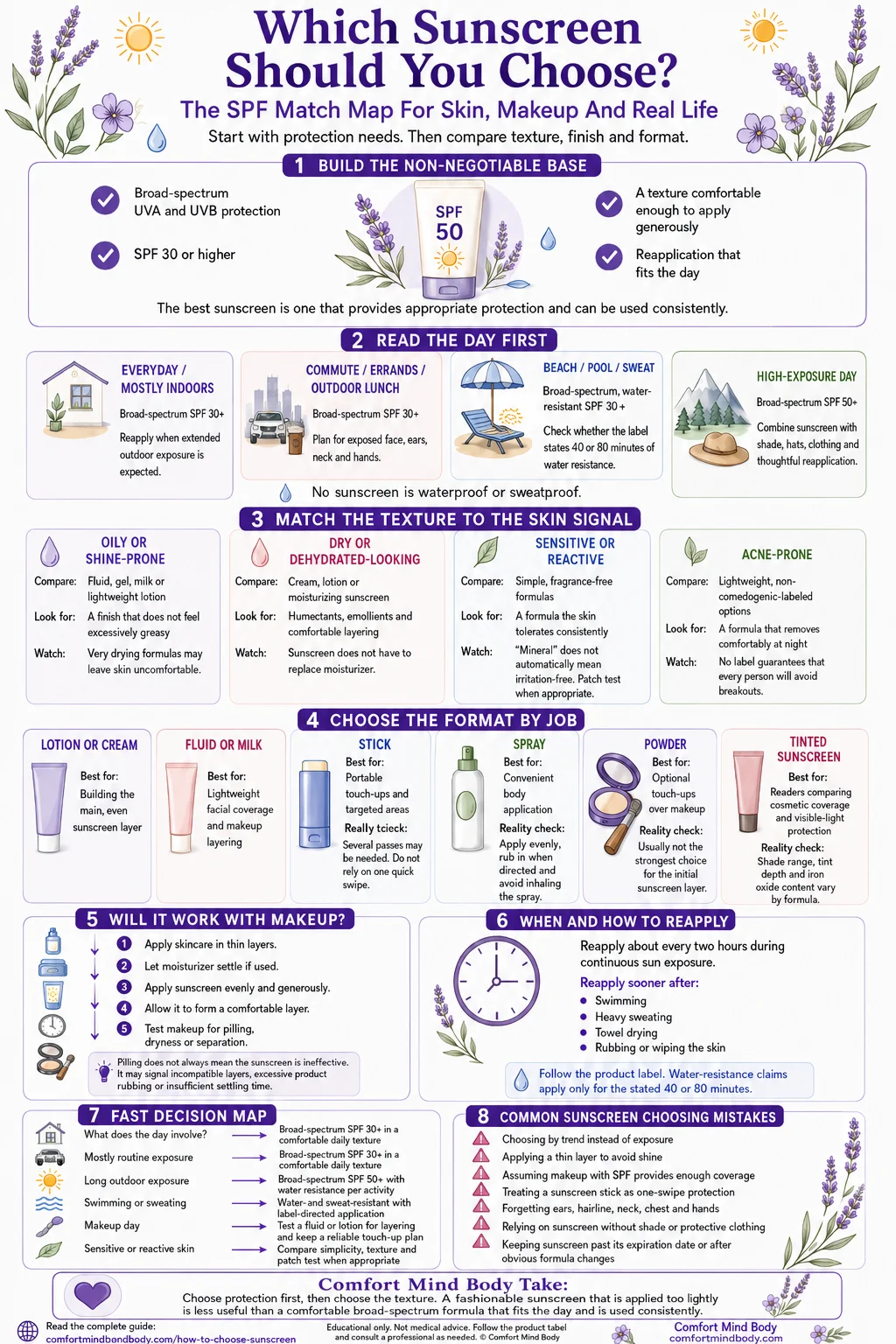
This guide uses the Comfort Mind Body SPF Match Framework: Label → Skin → Situation → Format → Reapply. It explains how to choose sunscreen without fear-based claims, unnecessary product collecting or the idea that one formula must do every job.
Quick Answer: How To Choose Sunscreen
Start with a broad-spectrum, water-resistant sunscreen labeled SPF 30 or higher—the three basic features recommended by the American Academy of Dermatology. Then match the texture to the skin and the performance to the day. For swimming or sweating, check whether the water-resistance label states 40 or 80 minutes and reapply according to the directions.
A lotion, cream, fluid or milk is usually the simplest base layer because it can be spread evenly. Sticks, mists, powders and cushions may make reapplication easier, but convenience does not guarantee complete coverage. The most practical sunscreen is one that can be applied generously, worn comfortably and reapplied when exposure continues.
- Read the SPF, broad-spectrum and water-resistance information.
- Match the texture to oiliness, dryness, sensitivity, tone and eye comfort.
- Match the performance to the activity and environment.
- Choose a format that permits complete, even coverage.
- Plan reapplication before leaving home.
For help building the cleanser, moisturizer and treatment steps around sunscreen, visit the main Comfort Mind Body Skin Care hub.
The Comfort Mind Body SPF Match Framework
Sunscreen shopping becomes easier when the decision is made in the right order. Marketing language and attractive packaging should come after the protection label and the routine’s real needs.
1. Label
Confirm broad-spectrum protection, SPF 30 or higher and water resistance when the day requires it. Check the expiration or usable-period information and follow the directions on the specific package.
2. Skin
Consider whether the skin feels oily, dry, dehydrated, acne-prone or reactive. Also consider white cast, pigmentation concerns, eye sting and how the product behaves over the normal morning routine.
3. Situation
An ordinary office day, a long drive, an outdoor workout and a beach day do not create the same application problem. Water resistance, portability and reapplication matter more as exposure and activity increase.
4. Format
Lotion, cream, fluid, gel, milk, stick, mist, powder and tinted sunscreen each solve different comfort or convenience problems. Format does not replace adequate quantity.
5. Reapply
Choose the reapplication method at the same time as the base sunscreen. A portable format has little value if it cannot be applied evenly, while the perfect lotion is less useful when it is always left at home.
Anna’s Note: The sunscreen that feels easiest to wear consistently is often more useful than a theoretically perfect product that remains in the drawer. Comfort matters, but the label and amount still come first.
Step One: Read The Sunscreen Label Correctly
Broad-Spectrum Protection
Broad-spectrum sunscreen protects against UVA and UVB radiation. UVB is strongly associated with sunburn, while UVA contributes to premature skin aging and can pass through window glass. Both contribute to cumulative skin damage, which is why the SPF number should not be read by itself.
SPF primarily describes UVB protection. The words broad spectrum confirm that the product also meets the applicable UVA protection standard in its market.
SPF 30 Versus SPF 50
Both SPF 30 and SPF 50 can fit a daily routine when they are broad spectrum and applied correctly. SPF 50 offers more UVB protection, but it does not last longer, make missed areas harmless or remove the need for reapplication.
A higher SPF may be a practical choice for readers who burn easily, have pigmentation concerns, use photosensitizing medication, spend long periods outside or tend to apply less than intended. Individual medical guidance should take priority when a health condition or prescription increases photosensitivity.
What Water-Resistant Means
Sunscreen cannot be labeled waterproof or sweatproof in the United States. A water-resistant label should state whether the tested resistance lasts 40 or 80 minutes. Reapply after swimming, heavy sweating or towel drying, even when that interval has not fully passed.
This distinction matters when comparing elegant everyday formulas with beach or exercise sunscreens. A light Korean sunscreen may feel excellent under makeup but should not be assumed to provide water resistance unless its label supports that use.
PA++++ And U.S. Broad-Spectrum Labels
PA ratings describe UVA protection using a system seen on many Asian sunscreens. U.S. products use broad-spectrum labeling under a different regulatory system. PA++++ is useful information, but it should not be treated as proof that every imported formula is automatically better than every U.S. formula.
Check the exact product and package sold in the relevant market. Formula names, filters and directions can differ by country.
Expiration, Heat And Storage
Check the expiration date or labeled period after opening. Replace sunscreen when it has expired or when the smell, color, separation or texture changes unexpectedly. Excessive heat can affect product stability, so a bottle should not live in a hot vehicle for months.
Swipe left or right to view the full table on mobile.
| Label Term | What It Means | What It Does Not Mean | Best Use |
|---|---|---|---|
| SPF 30 | Meets the AAD’s minimum SPF recommendation when paired with broad-spectrum protection and water resistance. | It does not permit skipped areas or unlimited exposure. | Everyday protection when applied correctly. |
| SPF 50+ | Offers more UVB protection than SPF 30. | It does not last longer or remove the need to reapply. | High exposure, easy burning or added protection margin. |
| Broad Spectrum | Meets the applicable UVA and UVB protection standard. | It is not a promise of perfect protection. | Required foundation for a daily sunscreen choice. |
| Water Resistant 40/80 Minutes | Protection was tested during water exposure for the stated interval. | It is not waterproof or towel-proof. | Sweating, swimming and outdoor activity. |
| Tinted | Adds pigment that may reduce cast; iron oxides may add visible-light support. | Tint does not guarantee a good shade match or full application. | White-cast and pigmentation concerns. |
| PA++++ | Indicates high UVA protection under the PA system. | It does not describe water resistance or replace label directions. | Comparing products that use PA labeling. |
Step Two: Choose Sunscreen By Skin Type And Skin Signal
Skin type narrows the options, but it does not create a universal winner. Two readers with oily skin may prefer different finishes, and a formula described as gentle can still irritate an individual routine. Use skin type as a starting point, then judge complete application, comfort and consistency.
Oily Or Acne-Prone Skin
Lightweight fluids, gels and milks may feel easier to apply when the face becomes shiny. Non-comedogenic labeling can be helpful, but no label guarantees that every acne-prone reader will tolerate a formula. Sunscreen removal, makeup, sweat and the rest of the routine also influence congestion.
Do not remove moisturizer automatically. Some oily routines need a lighter moisturizer, while others can use a moisturizing sunscreen without a separate cream. The complete acne skincare routine explains how sunscreen fits around acne treatments.
Dry Or Dehydrated-Looking Skin
A creamier, serum-like or moisturizing sunscreen can reduce the temptation to underapply. When sunscreen alone is not comfortable, use a suitable moisturizer underneath and allow it to settle. Flaking around the nose or mouth may make even a dewy sunscreen look uneven until the barrier routine improves.
Sensitive Or Reactive Skin
Mineral sunscreen may feel more comfortable for some sensitive or rosacea-prone skin, but mineral does not mean irritation-proof. Fragrance, botanical extracts, preservatives, texture and the complete formula still matter. Patch test unfamiliar products and stop when persistent burning, swelling, hives or blistering appears.
If almost every formula causes discomfort, simplify the routine and use the skin barrier guide while arranging professional advice when needed.
Children And Family Sunscreen
For children, look for broad-spectrum, water-resistant SPF 30 or higher and follow the age directions on the label. A comfortable lotion or stick may make complete application easier, but protective clothing, hats and shade remain important.
Ask a pediatric professional about sun protection for babies younger than six months or children with eczema, allergies, photosensitivity or repeated sunscreen reactions.
Darker Skin Tones And Visible White Cast
Modern mineral formulas vary greatly in cast. Tinted sunscreen can improve wearability, but the tint needs to be checked in natural light. A shade that looks gray, pink, orange or too pale may discourage complete application even when the protection label is appropriate.
Darker skin tones still need sun protection. The goal is not to accept an uncomfortable cast; it is to compare transparent, tinted or better-matched formulas until enough product can be worn consistently.
Dark Spots, Melasma And Post-Acne Marks
Consistent sunscreen supports routines focused on discoloration because repeated UV exposure can work against progress. Tinted formulas containing iron oxides may be worth comparing when visible light is relevant, especially for melasma or persistent pigmentation. Sunscreen supports the plan; it does not erase dark spots by itself.
Sunscreen That Stings The Eyes
Eye comfort is underrepresented in many sunscreen guides. Sweat, migration, rubbing and individual formula tolerance can all contribute to stinging. A more resistant stick or mineral formula around the orbital area may be easier for some readers, but no product should be called eye-safe unless the manufacturer supports that claim.
Avoid placing an unfamiliar sunscreen directly against the lash line. Let the base layer settle before exercising, avoid rubbing the eyes and stop using a formula near the eyes if it repeatedly causes burning.
Swipe left or right to view the full table on mobile.
| Skin Signal | Texture To Compare | Helpful Detail | First Adjustment |
|---|---|---|---|
| Shiny or oily | Fluid, gel or milk | Non-comedogenic label when available | Reduce one heavy layer without reducing sunscreen quantity. |
| Dry or flaky | Cream or moisturizing fluid | Comfortable flexible finish | Add moisturizer underneath when needed. |
| Reactive | Simple mineral or familiar gentle formula | Fragrance and full ingredient list | Patch test and change one product at a time. |
| Visible cast | Tinted or transparent fluid | Natural-light shade check | Test the full application amount before deciding. |
| Eye sting | More resistant stick or mineral option | Individual tolerance | Use a separate eye-area formula and avoid the lash line. |
| Makeup pilling | Compatible fluid or lotion | Layer compatibility | Simplify morning layers and allow settling time. |
Step Three: Match Sunscreen To The Day
Office, Errand Or Commuting Day
A comfortable broad-spectrum SPF 30 or higher that layers well is a practical base. Consider time outside, driving and proximity to bright windows rather than treating “indoors” as one identical exposure level. Hands, ears, neck and upper chest are often missed during commuting.
Makeup Day
Apply sunscreen as the final skincare step before complexion makeup. Let moisturizer settle when pilling occurs, and test the full routine before an important event. Do not mix sunscreen into foundation or moisturizer unless the sunscreen manufacturer specifically permits it.
The skincare layering guide explains how to reduce unnecessary layers beneath sunscreen.
Exercise Or Sweaty Outdoor Day
Choose a water-resistant product and cover the hairline, ears and neck. Reapply after heavy sweating and cleanse gently afterward. A formula that feels elegant at a desk may migrate into the eyes during exercise, so test performance before relying on it for a long outdoor event.
Beach, Pool Or Water Day
Prioritize broad-spectrum SPF 30 or higher, water resistance and enough product for repeated full-body application. Reapply after swimming or towel drying. Shade, clothing, hats and sunglasses remain part of the protection plan.
The summer skincare routine includes additional guidance for heat, sweat, swimming and recovery after outdoor days.
Cold, Cloudy Or High-Altitude Day
Cold temperature and cloud cover do not eliminate UV exposure. Snow can reflect radiation, while altitude can increase exposure. A moisturizing sunscreen may feel better in dry conditions, but the same broad-spectrum and reapplication principles remain.
For a seasonal decision guide focused on pollen, warmer weather and longer outdoor days, see how to choose SPF for spring.
Swipe left or right to view the full table on mobile.
| Situation | Base Format | Reapplication Plan | Common Mistake |
|---|---|---|---|
| Office | Comfortable lotion, fluid or cream | Same sunscreen or a portable format when outdoor exposure resumes | Being unprepared for an unexpected outdoor afternoon |
| Makeup | Makeup-compatible lotion or fluid | Carefully pressed fluid, cushion, stick or mist | Using too little to avoid disturbing makeup |
| Running | Water-resistant lotion or fluid | Portable lotion or thoroughly applied stick | Ignoring sweat and eye migration |
| Beach or pool | Water-resistant lotion or cream | Repeat full application after water and towel drying | Treating a mist as effortless complete coverage |
| Driving | Broad-spectrum face sunscreen | Portable face and hand option | Forgetting hands, ears and neck |
Step Four: Choose The Right Sunscreen Format
Lotion Or Cream
Lotion and cream make it easier to see where product has been spread, which is helpful for a dependable face or body base layer. Richer formulas may suit dry skin, while lighter lotions can work across many skin types.
Fluid, Milk, Serum Or Gel
Thin textures can feel more comfortable in humid weather, on oily skin or under makeup. A fluid formula is not inherently weak, but the thin texture should not encourage a tiny serum-sized application. Follow the sunscreen label rather than treating it like an ordinary skincare serum.
Mineral, Chemical Or Hybrid
In the United States, mineral sunscreen uses zinc oxide, titanium dioxide or both. Chemical, also called organic, filters use other approved UV filters. Hybrid formulas combine filter approaches. No category wins every comparison: cast, sensitivity, finish, water resistance and complete application matter more than online fear language.
Tinted Sunscreen
Tint can reduce the visible cast of mineral filters and make a formula easier to wear. Iron oxides may add protection against visible light, which can be relevant for pigmentation. Test the full amount because a tint that looks perfect in a small swatch may become too dark, pale or orange across the whole face.
Sunscreen Stick
Sunscreen sticks are portable, tidy and useful around the hairline, ears, cheeks and hands. They can also be underapplied easily. Use multiple slow, overlapping passes and blend when the label directs. One quick swipe over each area is not dependable coverage.
A stick may serve as a base when applied thoroughly, but many readers will find lotion or fluid easier for the initial layer. The stick can then solve the portability problem.
Spray Or Mist
Sprays can cover large body areas quickly, but wind, distance and a light application can create gaps. Avoid inhaling sunscreen, follow the package directions and do not spray toward the face unless the label specifically instructs that use. Rub in when directed.
Powder Or Cushion
Powder and cushion formats may help over makeup, but they are easy to apply too lightly. Treat them as supplemental options unless the product directions and actual amount support full coverage.
Lips, Scalp And Body
Use a labeled SPF 30 or higher lip product outdoors and reapply it regularly. Protect exposed scalp parts and thinning areas with a suitable sunscreen or hat. For the body, cover shoulders, arms, hands, legs, feet and clothing edges. A tiny face bottle may be impractical for repeated full-body use.
Sushi’s Note: Ears, hands and the back of the neck are small areas with an impressive talent for being forgotten.
Base Sunscreen Versus Reapplication Products
A base product and a reapplication product may have different jobs. Lotion, cream, fluid, milk and gel are usually easiest for the first complete layer. Stick, mist, powder and cushion formats can make later application more convenient, but they still need enough product and even coverage.
No dependable face sunscreen: Buy the base formula first.
Base sunscreen works but reapplication is difficult: Add one portable format.
Outdoor activity is increasing: Compare a water-resistant formula.
White cast prevents full use: Compare tinted or more transparent options.
The current sunscreen works: A replacement is not necessary.
Step Five: Apply Enough And Reapply
Follow the directions on the package. Many sunscreens direct application approximately 15 minutes before sun exposure. The American Academy of Dermatology uses about one ounce—roughly enough to fill a shot glass—as a general reference for exposed adult body skin.
For the face, use an even, generous layer. The popular two-finger method can be a helpful visual estimate for some products, but finger length, nozzle width and texture vary. It should not be treated as a precise universal measurement that replaces label directions.
Do Not Miss These Areas
- Ears and hairline
- Neck and upper chest
- Hands and fingers
- Lips
- Scalp part and thinning areas
- Tops of feet and edges of clothing
Should Sunscreen Go Before Or After Moisturizer?
Sunscreen is normally the last skincare step before makeup. Let moisturizer settle if products pill. Do not mix sunscreen into moisturizer, facial oil or foundation unless the sunscreen manufacturer specifically permits it, because mixing can disrupt even coverage.
Why Sunscreen Pills
Pilling can come from too many layers, incompatible film-forming products, excessive rubbing, insufficient settling time or dry patches. Simplify the morning routine, allow moisturizer to settle and change one product at a time before deciding that the sunscreen itself is unusable.
How Often Should Sunscreen Be Reapplied?
Reapply at least every two hours while outdoors and after swimming, heavy sweating or towel drying. Follow the product label. A higher SPF does not automatically extend the outdoor reapplication interval.
A quiet desk day is different from a beach day, but an unexpected walk or long drive still deserves a plan. Reapply across the full exposed area rather than only the nose and cheeks.
How To Reapply Sunscreen Over Makeup
- Blot sweat or excess oil gently.
- Avoid rubbing the existing makeup across the face.
- Apply a compatible sunscreen in overlapping sections.
- Allow the sunscreen to settle.
- Restore makeup only where needed.
Lotion or fluid offers strong coverage potential but may disturb makeup. Portable formats can help, provided the amount and application directions still support even coverage.
Comfort Mind Body Take: Makeup-friendly reapplication is a compromise. The goal is to improve protection without pretending that one light spray or dusting equals a complete lotion application.
How Products Were Evaluated: Anna-tested products are based on repeated personal use, original photographs and notes about texture, finish, comfort and routine fit. Other products are comparison examples evaluated from current product labels, official manufacturer information, SPF, format, water resistance and intended use. Products not personally tested are never presented as firsthand reviews.
Affiliate Note: This section contains affiliate links. As an Amazon Associate, I earn from qualifying purchases. Anna-tested products are clearly identified.
Anna-Tested Sunscreens: What Worked In Real Life
The following notes come from products I purchased and used myself. They describe my oily, acne-prone skin and personal routines rather than predicting how every reader will respond.

Anna-Tested • Would Repurchase
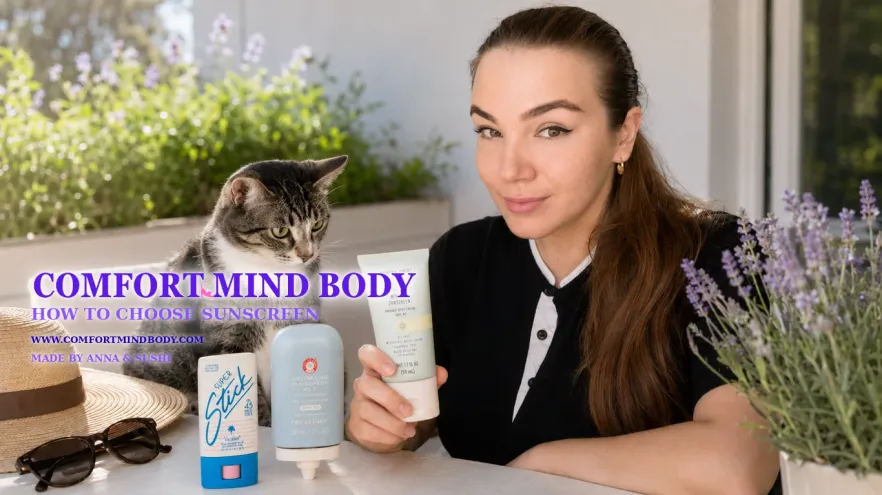
Vacation Super Stick SPF 45
I have bought this clear stick about five times. It feels thick but soft enough to spread, leaves a slightly oily finish on my skin and has not peeled in my routine. I use slow overlapping passes across my face, cheeks and neck. It is my favorite portable sunscreen, but I still cleanse thoroughly in the evening.
Compare Product
Anna-Tested • Neck And Chest Use
First Aid Beauty Hydrating Sunscreen Milk SPF 45
This fluid sunscreen initially looked slightly white on me, then faded shortly. I use it mainly on my neck and chest because sweat caused it to run into my eyes and sting during face wear. That personal experience is why eye comfort and activity need to be considered separately from texture.
Compare Product Anna-Tested • Hand Sunscreen Role
Trader Joe’s Daily Facial Mineral Sunscreen SPF 40
The creamy texture spread and settled quickly in my experience. I used this formula mainly on my hands rather than forcing it into my face routine. Different sunscreens can have different roles, and a face product that is not a favorite on the face may still be practical elsewhere.
Compare ProductSunscreen Examples To Compare By Need
These are comparison examples, not universal winners. Verify the current label, filters, directions and water resistance before buying because formulas and regional versions can change.
Swipe left or right to view the full table on mobile.
| Product | Role To Compare | Why It May Fit | Watch For |
|---|---|---|---|
| Beauty of Joseon Relief Sun | Light everyday sunscreen | A moisturizing K-beauty texture for ordinary daily wear. | Verify the exact regional formula and water-resistance needs. |
| SKIN1004 Hyalu-Cica Water-Fit Sun Serum | Dewy serum-like sunscreen | A light texture for readers who dislike heavy creams. | Do not apply it in an ordinary serum-sized amount. |
| Blue Lizard Sensitive Mineral SPF 50+ | Sensitive-skin mineral comparison | A mineral option when readers prefer zinc-based protection. | Check cast, finish and individual tolerance. |
| Evereden Tri-Orchid Glow Mineral Sunscreen SPF 50 | Mineral glow option | A richer, glow-focused mineral texture to compare for dry skin. | Glow may feel too rich for some oily routines. |
| Activist Tinted Zinc Mineral Sunscreen Stick SPF 30 | Tinted portable option | Tint and stick convenience in one format. | Check shade match and use repeated overlapping passes. |
| Bioré UV Aqua Rich Watery Essence | Japanese lightweight option | A fluid texture for warm weather and makeup layering. | Confirm the current regional version and ingredient preferences. |
| Anessa Perfect UV Sunscreen Milk | Outdoor-performance comparison | A Japanese sunscreen milk to compare for active days. | Check the exact label, removal directions and finish. |
| Bubble Solar Mate Mineral SPF 40 | Affordable mineral comparison | A widely available mineral face option to compare. | Check cast and comfort at the full amount. |
Readers looking for additional seasonal products can use the spring skincare product guide.
2026 Sunscreen Trends: Useful Innovation Or More Marketing?
Sunscreen is moving toward skincare-like textures, more portable formats and products designed for specific areas. These changes can improve consistency, but they can also make underapplication easier when readers treat sunscreen like a serum, mist or makeup accessory.
Trend information last checked July 2026.
| Trend | Why It Is Popular | Comfort Mind Body Take | Watch For |
|---|---|---|---|
| SPF sticks | Portable and tidy | Useful for targeted reapplication with repeated overlapping passes. | One quick swipe |
| Serums and milks | Lighter skincare-like feel | Helpful when texture improves complete daily use. | Serum-sized underapplication |
| Tinted mineral SPF | Reduced cast and pigmentation interest | Worth comparing for visible cast and dark-spot routines. | Poor shade match |
| SPF makeup | Combines beauty and sun care | Useful as support after a complete base layer. | Treating makeup as the only sunscreen |
| Sunscreen wardrobes | Different formulas for face, body, sport and touch-ups | Practical when every product has a clear role. | Unnecessary overbuying |
| Bemotrizinol | First new U.S. sunscreen active approved in decades | A meaningful future formula update, not a reason to distrust current sunscreen. | Assuming every new launch already contains it |
| “Reef-safe” claims | Environmental concern | Read specific filters and local regulations. | The term is not uniformly standardized |
Bemotrizinol And Future U.S. Sunscreens
According to the FDA’s June 2026 announcement, bemotrizinol was approved as a new U.S. sunscreen active ingredient, expanding future filter options. That does not make currently approved sunscreens ineffective or unsafe. Manufacturers need time to develop and release formulas, so ingredient lists should be checked rather than assuming that every new sunscreen contains it.
Reality Check On Viral Sunscreen Claims
Homemade sunscreen cannot be assigned a dependable SPF without validated testing. Diet, oils and supplements do not replace topical sun protection. A tan is a sign of UV response, not proof that skin is protected. Mineral sunscreen is not automatically irritation-free, and approved chemical sunscreens should not be dismissed with vague “toxic” language.
Common Sunscreen Mistakes
- Applying too little to avoid shine or cast
- Believing SPF 50 lasts longer than SPF 30
- Using one quick pass of a stick
- Relying only on makeup SPF
- Missing the ears, hands, lips, neck and scalp
- Ignoring water-resistance limits
- Mixing sunscreen directly into moisturizer or foundation
- Leaving sunscreen in excessive heat
- Continuing a formula that repeatedly burns or stings
- Assuming cloudy or cold weather means no protection is needed
- Using sunscreen without shade, clothing or other protection during long exposure
The One-Minute Sunscreen Audit
Answer each question with yes or no:
- Does the product have broad-spectrum SPF 30 or higher?
- Can enough be applied without significant discomfort?
- Does the finish avoid a cast that causes underapplication?
- Does it stay comfortable around the eyes?
- Does it layer with the normal morning routine?
- Is water resistance appropriate for the activity?
- Is there a realistic reapplication option?
- Are ears, neck, hands, lips and scalp considered?
- Is the sunscreen still within its usable period?
- Has it been stored away from excessive heat?
Eight to ten yes answers: The sunscreen plan is probably practical. Five to seven: Adjust one weak point. Below five: Return to the SPF Match Framework and rebuild the plan from the label and situation. This is a routine tool, not a medical assessment.
Free Sunscreen Workbook
Find A Sunscreen That Fits Real Life
Download the 11-page Sunscreen Match Workbook to compare labels, textures, makeup wear, water resistance and reapplication needs before buying another formula.
Educational only. Not medical advice. Follow the directions on the product label.
Frequently Asked Questions
Final Thoughts
The right sunscreen is not determined by the highest SPF, newest filter or most luxurious texture alone. It is the product that provides appropriate protection, works with the skin and activity, and can be applied in a complete, even layer.
Start with the label. Match the formula to the skin and the day. Then solve reapplication. Sticks, mists, powders and makeup SPF can make protection more convenient, but convenience should support—not replace—a dependable base layer.
If the current broad-spectrum SPF 30+ sunscreen is comfortable, compatible and used correctly, there may be nothing to replace. A practical routine is more valuable than an overflowing sunscreen collection.
Safety Notes
Sunscreen is one part of sun protection. Use shade, protective clothing, hats and sunglasses during meaningful exposure. Follow the product label and ask a qualified professional when a health condition or medication increases photosensitivity.
Stop using a product that causes persistent burning, swelling, hives, blistering or a spreading rash. Seek urgent help for trouble breathing or swelling of the face, lips, tongue or throat.
Ask a dermatologist about repeated sunscreen reactions, severe photosensitivity, suspicious or changing skin lesions, persistent melasma or an inability to tolerate multiple properly used products. Ask a pediatric professional about sun protection for babies younger than six months.
Affiliate Disclosure
This article contains affiliate links. As an Amazon Associate, I earn from qualifying purchases. Comfort Mind Body may also earn a commission from other qualifying purchases at no additional cost to readers. Product inclusion does not guarantee that a formula will suit every skin type. Anna-tested products are clearly identified; other examples are included for comparison based on their current labels, formats and intended uses.
Helpful Resources
- American Academy of Dermatology: How To Select A Sunscreen
- American Academy of Dermatology: Sunscreen FAQs
- FDA: Tips To Stay Safe In The Sun
- FDA: Sunscreen Labeling And Effectiveness Testing
- FDA: Bemotrizinol Approval And Expanded Sunscreen Options
- American Cancer Society: What To Look For When Choosing Sunscreen
- U.S. Environmental Protection Agency: UV Index Tool
- JMIR Dermatology: Sunscreen Misinformation On Social Media

