
How this guide was made. This guide draws on Harvard’s Nutrition Source and Johns Hopkins Medicine for the practice and a randomized trial for the weight-loss question. The meal scenes are examples. Sources checked November 8, 2026.
You open your lunch, answer one email, and look down to find half your sandwich gone. You remember what the email said. The sandwich is a little less clear. You still have another bite, and that’s enough to try mindful eating.
Welcome to Comfort Mind Body. Let’s try mindful eating with the meals you already have, whether lunch happens at your desk, between errands, or around a noisy table.
Quick Navigation
ToggleQuick Answer: How Do You Eat Mindfully?
Notice one thing about your next bite: how warm it is, how it feels as you chew, or what flavor stands out. Keep eating at a comfortable pace. If your attention wanders, pick up with any bite you remember, even halfway through the meal.
What Is Mindful Eating?
Mindful eating means paying attention to what you experience while you eat, with curiosity and without judging what you notice. You might notice the warmth of soup, the crunch of toast, or how much you’re enjoying a familiar meal today.
You might notice hunger, satisfaction, and what’s happening around you. Harvard’s Nutrition Source describes it as an approach you can bring to any way of eating. You can try it with foods you already enjoy. If you’d like to practice the same kind of attention away from the table, start with these mindfulness exercises for beginners.
What Mindful Eating Can and Can’t Do
In some studies, Harvard summarizes, people who practiced mindfulness or mindful eating ate more slowly or noticed fullness more easily.
For a first try, keep the aim simple: notice what this bite is like. Research hasn’t shown consistent weight loss; the FAQ below explains what one trial found.
Try a First-Bite Mindful Eating Exercise
- Start with what’s in front of you. Take a bite or a sip of whatever you’re having.
- Stay with one detail for a moment. You might feel the warmth of the soup or hear the crunch of toast.
- Carry on with your meal. If something pulls your attention away, let the next bite you remember be another chance to notice.
For more beginner ideas, see Johns Hopkins Medicine’s guide to getting started.
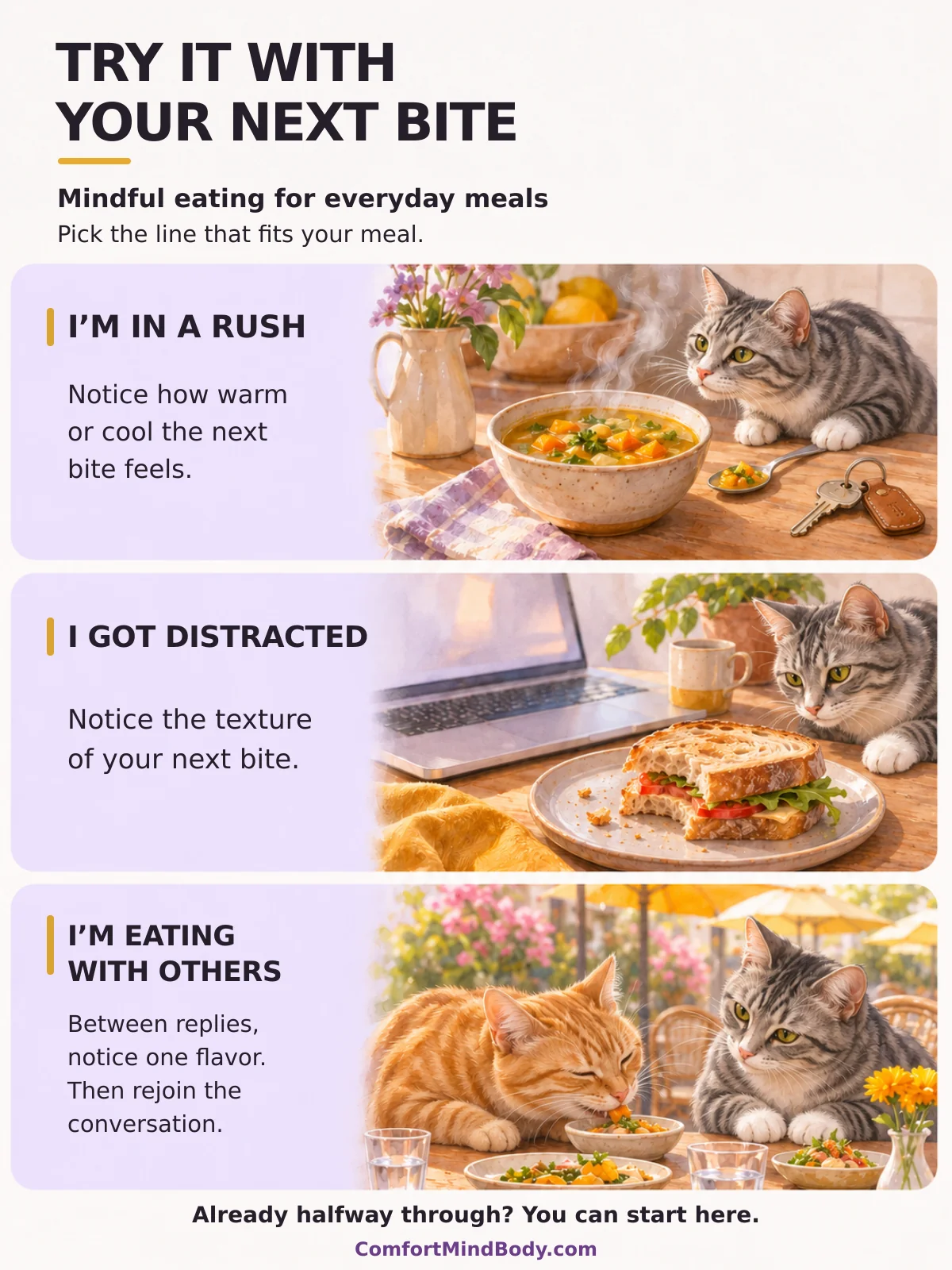
Read the infographic text
Try It With Your Next Bite
Mindful eating for everyday meals
Pick the line that fits your meal.
I’m in a rush
Notice how warm or cool the next bite feels.
I got distracted
Notice the texture of your next bite.
I’m eating with others
Between replies, notice one flavor. Then rejoin the conversation.
Already halfway through? You can start here.
ComfortMindBody.com
One-page printable
Your Next Bite Cards
Print three cut-out cards with a small mindful eating exercise, a note from Sushi, and a wish for your day.
Download the Next Bite Cards (PDF)An Everyday Example: Lunch Between Meetings
Imagine you’re eating a toasted cheese sandwich at your desk. On the first bite, the crust cracks and the cheese is still warm. Then an email arrives about the meeting you’re about to join. You reply, check your calendar, and look down several bites later.
You set the phone beside the plate and take another bite. This piece is softer where the bread has been resting against the plate. You keep eating, and when the calendar reminder goes off, you can turn your attention to it.
“The bread got softer” is plenty. You noticed it, and lunch carried on.
How to Practice Mindful Eating in Different Situations
At Your Desk
Pick one thing you can set aside while you take a bite. It might be a chat window you can minimize or a phone you can turn face down. If you need to keep an eye on a message, try noticing the next bite during a brief lull.
On a Busy Day
When lunch has to fit between two errands, use a detail that’s easy to catch. With leftover soup, you might notice its warmth. With a sandwich you’ve packed, you might notice the coolness of the filling. Let that moment fit into the time you have.
Eating Out With Other People
When the conversation pauses, see if you can pick out one flavor: the lemon in the dressing or the salt on a fry. Then go back to listening. Johns Hopkins Medicine suggests shifting your attention between the food and the people you’re with.
Not sure what to notice?
Pick one of these to try with your next bite or sip.
- How warm or cool is this bite?
- What’s the texture: crisp, soft, chewy, or smooth?
- Does the flavor change as you chew?
- What do you smell just before you take a bite?
- Is there a sound, like a crunch, a crackle, or a slurp?
- Which flavor shows up first: salty, sweet, sour, savory, or bitter?
- Which flavor stays after you swallow?
- What colors are on your plate or in your bowl right now?
- How does the first sip of your drink feel?
- Is this bite different from the last one?
- Can you pick out one ingredient?
- How does the fork, spoon, or cup feel in your hand?
What If I Can’t Tell Whether I’m Hungry or Full?
Start with a cue you can name, such as the flavor of your soup or the texture of your toast. If you also notice hunger or satisfaction, you can include it in what you’re paying attention to. “I’m not sure yet” is a valid observation.
You can be hungry and stressed at the same time, or look forward to a meal because it’s familiar and comforting. There’s room to notice both the food and what the day has been like.
If the exercise adds stress, you can skip it. See Helpful Resources if meals often feel difficult.
Quick Quiz: What Would You Try?
Three everyday meal situations and one small thing you could try in each.
-
1. You look up from a message and your sandwich is already half gone. What would you try?
One thing to try: Try the bite you have. Notice where the bread is still crisp or where it’s gone soft. You can start right in the middle of lunch.
-
2. A friend is telling a story over dinner. How could you give the food a moment of attention?
One thing to try: Use a natural pause. You might catch the lemon in the dressing and then go back to listening. A shared meal can include both.
-
3. You’re partway through lunch and can’t tell whether you’re still hungry. What could you do?
One thing to try: Start with something clear, like the warmth of your soup. You can keep eating and leave the hunger question open.
Frequently Asked Questions
Do I have to eat the whole meal mindfully?
A bite or two is enough to try the practice. When you remember halfway through, start with the next bite.
Can I use a snack for the first-bite exercise?
Yes. Notice the coolness of an apple slice, the crunch of a cracker, or a detail in whatever snack you’re having.
Is mindful eating the same as eating slowly?
You might slow down when you notice more about a bite. There’s no set pace. Even during a quick lunch, you can take a moment to taste what you’re eating.
How is mindful eating different from intuitive eating?
Mindful eating focuses on the experience of eating as it happens. Intuitive Eating is a broader framework with ten principles that also address your relationship with food and your body, including hunger, satisfaction, and food rules. Read the ten principles of Intuitive Eating.
Does mindful eating lead to weight loss?
Research hasn’t found consistent weight loss. In a randomized trial of 194 adults with obesity, adding mindfulness training to a 5.5-month diet and exercise program did not produce a statistically significant difference in weight loss at 18 months. That trial tested a structured program. The exercise in this guide is a way to pay attention to a meal.
Final Thoughts
The next time you look down and realize lunch is already halfway gone, pick up where you are. There might be a little warmth left in the soup or a crisp corner of bread on the plate. Give yourself a moment to taste it, then get back to your day.
I hope your next meal has a bite you get to enjoy.
Take care of yourself,
Anna
Safety Notes
If focusing on a bite makes you more anxious or brings up urges to restrict what you eat, set the exercise aside. It’s okay to just have your meal.
If you’re following a meal plan from an eating disorder care team, keep following their guidance, even when hunger or fullness is hard to read. If meals often feel distressing, see eating disorder support and referral resources.
Helpful Resources
- National Alliance for Eating Disorders helpline and referrals (U.S.): free support from licensed therapists at 866-662-1235, Monday through Friday, 9 a.m. to 7 p.m. Eastern time.
- NIMH eating disorder information and support
- Harvard T.H. Chan School of Public Health’s overview of mindful eating
- Johns Hopkins Medicine’s mindful eating guide for beginners