
Last updated: November 2026. Rewritten with new research, a deeper 4-week reset and winter-friendly ideas.
Affiliate disclosure: This post may contain affiliate links. If you buy through them, we may earn a small commission at no extra cost to you.
How this guide was made: Based on CDC and NIDDK guidance and published research on holiday weight gain. The 4-week reset is an editorial planning tool, not a clinically tested program.
Please note: This guide is for general information, not medical advice. Talk to your doctor before a big diet or exercise change, especially if you have a health condition or take medication.
Welcome to Comfort Mind Body, where we do the research so January can feel like a fresh start, not a punishment. My own January starts the way most of my weeks do: four training days, protein at every meal, and water or tea instead of soda.
If your eating, sleep or exercise routine changed over the holidays, you don’t need a dramatic January diet. Start with your next meal or your next chance to move, and pick one habit you can repeat this week, like keeping a simple dinner on hand or taking a short walk after work. If the scale has gone up, fluid and food in digestion can be part of it, but you don’t need to know the cause before you start taking care of yourself.
The 4 weeks below are a structure for rebuilding your routine, not a deadline.
Quick Navigation
ToggleQuick Answer: How to Lose Weight After the Holidays
Go back to your usual meal pattern, build meals around protein, fiber, and vegetables, cut back on extra drinks and sweets, move in a way that suits your body, and sleep enough.
Some of the change on the scale can be fluid from salty, carb-heavy food, which can settle as your routine returns to normal, but the scale can’t tell you the cause.
How long it takes varies from person to person, and some people may not need to lose weight at all. If you’d rather focus on routine and feeling well than on a weight goal, this plan works for that too.
What Changed Over the Holidays?
Everyone’s holidays look different, so start with the row that sounds like yours. Each one pairs a real situation with one thing to try first.
| If your holidays looked like this | What changed | Try this first |
|---|---|---|
| Drinks at most parties, wine with dinner | More drinks, and snacking after | Pick a few drink-free weeknights; hold sparkling water or tea at events |
| Cookies and chocolate around all day | Grazing between meals | Put treats out of sight, and eat them on a plate, not from the box |
| Workouts stopped, lots of sitting | Less movement | Put one 10-minute session on the calendar |
| Late workdays, no time to cook | Takeout and quick snacks | Keep one easy dinner in the freezer, like soup or chili |
| Travel and late nights | Sleep and meal times | Set a regular bedtime and regular meal times first |
| A few big meals, normal days in between | Not much | Just go back to your usual meals; no special plan needed |
The 4-Week Holiday Reset
Each week builds on the last. You don’t need to be perfect; you need to be a little more consistent than you were in December.
| Week | Focus | Try these | What to notice |
|---|---|---|---|
| 1: Reset | Get your routine back | Freeze, share or put away leftovers; go back to your usual meal times; keep one easy dinner on hand | Which meal time was easiest to stick to? |
| 2: Rebuild | Fill up well | Protein, fiber and vegetables at most meals; plan 3 simple dinners; move a little most days | Which dinner would you happily make again? |
| 3: Routine | Make it repeatable | A regular bedtime most nights; 2 or 3 short workouts or walks; shop with a list | Which movement worked on a cold or busy day? |
| 4: Keep going | Decide what stays | Keep the habits that felt easy; plan for a busy week; set one small next step (see How to Keep Weight Off and staying motivated) | What will you do on a week that goes off track? |
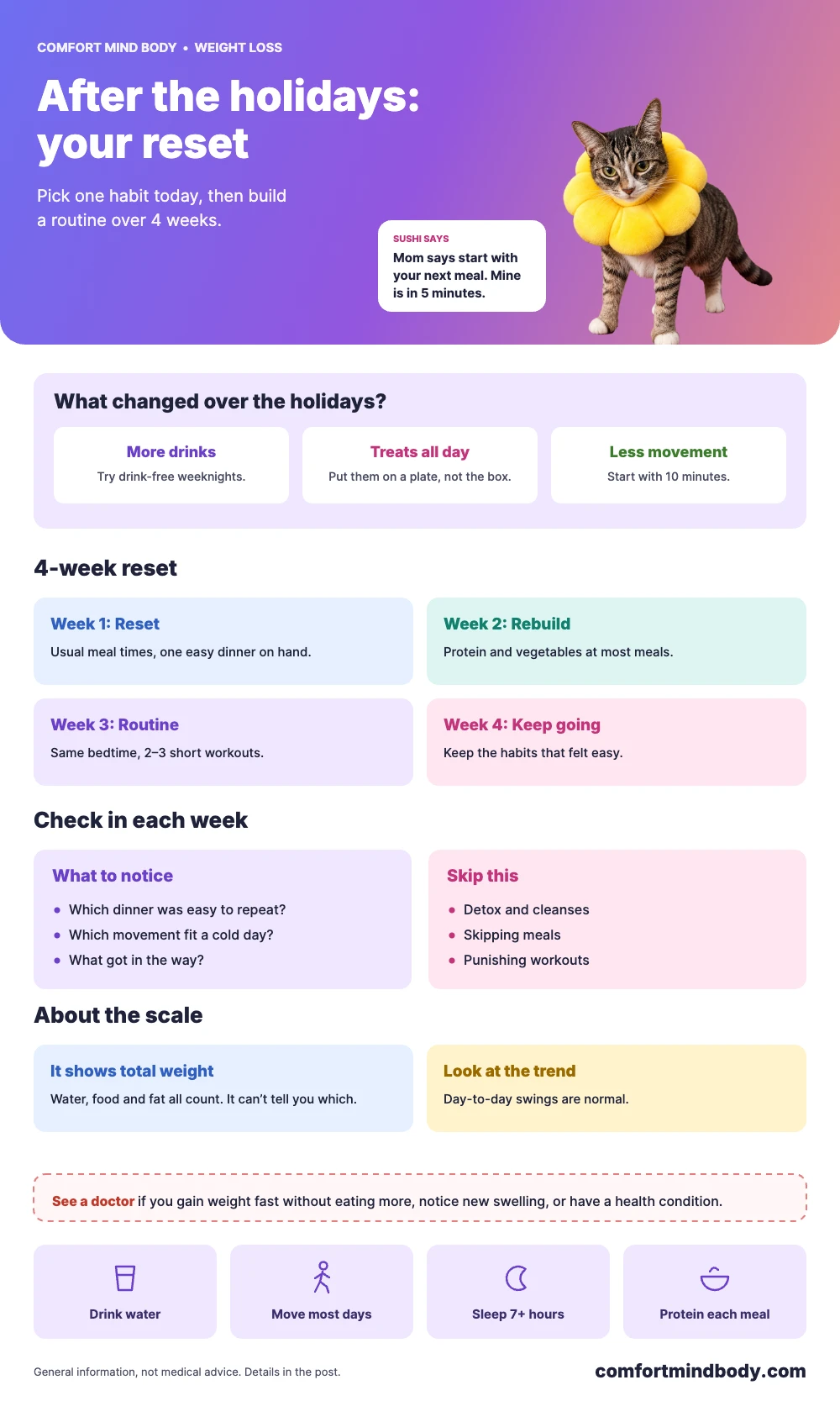
Read the infographic text
After the holidays: your reset. Pick one habit today, then build a routine over 4 weeks.
What changed over the holidays? more drinks: try drink-free weeknights; treats all day: put them on a plate, not the box; less movement: start with 10 minutes.
4-week reset: week 1, usual meal times and one easy dinner on hand; week 2, protein and vegetables at most meals; week 3, a regular bedtime and 2 to 3 short workouts; week 4, keep the habits that felt easy.
Check in each week: which dinner was easy to repeat, which movement fit a cold day, and what got in the way. Skip detox and cleanses, skipping meals and punishing workouts.
About the scale: it shows total weight, and water, food and fat all count, so it can’t tell you which changed. Look at the trend, since day-to-day swings are normal.
See a doctor if you gain weight fast without eating more, notice new swelling, or have a health condition.
What to Eat After the Holidays: Warm Winter Meals
You don’t need to cut out carbs after the holidays. One flexible template works for most meals: about half the plate vegetables, a quarter protein, and a quarter carbs like potatoes, rice or bread. Portions depend on your body, activity and goals. Here are a few ways it can look:
| Meal | A balanced example | Why it helps |
|---|---|---|
| Breakfast (if you eat it) | Greek yogurt with oats, berries and nuts | Protein and fiber keep you full until lunch |
| Lunch | Chicken or chickpea bowl with vegetables and brown rice | Protein, fiber and carbs for steady energy |
| Dinner | Salmon or tofu with roasted vegetables and potatoes | A warm, filling plate without heavy sauces |
| Snack | Fruit with yogurt or a spoon of nut butter | Takes the edge off hunger between meals |
January is cold, and salad doesn’t always sound good. Warm, filling meals with protein, vegetables, and fiber work better than willpower.
- Leftover turkey and vegetable soup: turkey, carrots, celery, onion, beans or barley, and broth. Freeze it in portions.
- Bean and turkey chili: lean ground turkey, two kinds of beans, tomatoes, and spices. Even better the next day.
- Sheet-pan salmon or chicken: with broccoli, carrots, and sweet potato, one pan, about 25 minutes.
- Warm breakfast bowl: oatmeal or Greek yogurt with berries and nuts, if breakfast is part of your routine.
- Leftover makeovers: extra roasted vegetables become a frittata, ham becomes bean soup, and cranberry sauce goes on plain yogurt.
Leftover safety: eat refrigerated leftovers like turkey and ham within 3 to 4 days, or freeze them for later (USDA).
eOptional first-week grocery list: a template, not a diet.
- Protein: eggs, Greek yogurt, chicken or tofu, beans or lentils
- Vegetables and fruit: carrots, broccoli, frozen vegetables, berries or apples
- Grains and pantry: oats, brown rice, potatoes, canned tomatoes and broth
Moving More When It’s Cold and Dark
If you can exercise safely, the general goal for adults is at least 150 minutes of moderate activity a week, like brisk walking, plus muscle-strengthening on 2 days. You can work up to it. In January, these make it easier:
- Short sessions count: three 10-minute walks add up just like one 30-minute walk.
- Indoor options: stairs at home or work, a mall walk, a dance video, bodyweight squats and push-ups.
- Strength helps: it helps you keep muscle while you lose fat.
- Schedule it like a meeting: same days, same time.
Anna’s Note: On days I don’t feel like training, I look in the mirror, put on music and commit to just 10 minutes. I train 4 days a week and don’t weigh myself; I go by how my clothes fit.
Comfort Eating and the January Blues
The weeks after the holidays can feel flat: shorter days, colder weather, bills, back to work. It’s normal to reach for comfort food when you feel low. Instead of fighting it with willpower, plan for it:
- Name the feeling first. Ask “Am I hungry, or tired, bored, or stressed?” before you open the pantry.
- Have a non-food comfort ready. A warm shower, a cozy blanket and a show, a call with a friend, a short walk in daylight.
- Plan your treats. Pick 2 or 3 favorites a week and enjoy them on purpose, so nothing feels forbidden.
- Track one normal week. Writing down what you eat for a few days can show what changed. Tracking is optional, and if it makes food feel stressful, skip it.
If low mood lasts more than two weeks or makes everyday life hard, talk to your doctor.
Is Holiday Weight Gain Fat or Water Weight?
A scale shows your total weight. After weeks of rich, salty food, more drinks and less movement, several things can add to that number at once, and the scale can’t tell you which one changed.
| What can affect the number | Why | How to interpret it |
|---|---|---|
| Fluid from salt | Salty food like ham, stuffing and cheese can make your body hold more water (American Heart Association) | Normal and temporary for many people; look at the trend over a couple of weeks |
| Fluid stored with carbs | Your body stores carbs as glycogen together with water (research) | Can shift as your eating returns to normal |
| Food in digestion | Bigger meals mean more food still in your gut | Part of normal day-to-day swings |
| Body fat | Eating more than you use over several weeks | The scale can’t show whether fat changed; look at weeks, not days |
If reducing body fat is a good goal for you, it generally takes a steady energy deficit over time. That doesn’t mean counting every calorie, cutting out carbs or following a strict diet; steady changes to your meals, movement and daily habits can get you there. You also don’t need to work out exactly what changed before you start. Just go back to your usual routine at your next meal. If you gain weight quickly without eating more, or notice new swelling in your legs or feet, see your doctor (see MedlinePlus on unexplained weight gain).
How Much Weight Do People Actually Gain Over the Holidays?
- The average gain was small. In a 2000 study of 195 adults (a convenience sample near the NIH), the average gain over the holiday period was about 0.8 pounds (0.37 kg). People who were already overweight were more likely to gain 5 pounds or more.
- It shows up after Christmas. A 2016 study of 2,924 smart-scale users (people who chose to own a connected scale, so not a typical group) found weight was 0.4% higher in the US, 0.6% in Germany, and 0.5% in Japan in the 10 days after Christmas than in the 10 days before.
- It doesn’t always go away on its own. In the first study, the average gain hadn’t come off a year later, and Harvard Health notes people tend to keep about half of their holiday gain.
These are group averages. Neither study measured how much of anyone’s change was water, and neither tested a plan like this one. Your own change depends on your starting point, your season, and your body.
January Myths to Skip
| Myth | The truth |
|---|---|
| “I need a detox or cleanse.” | There’s no convincing evidence that detox diets help with long-term weight management (NIH), and they can leave you hungry and tired. |
| “I’ll sweat it out.” | Sweating loses water, not fat. It comes back when you drink. |
| “Skipping meals will speed it up.” | It can make you hungrier later, and for some people it leads to bigger meals. |
| “I ruined everything.” | A few weeks of extras is a blip, not a reset to zero. |
| “I have to cut carbs forever.” | An early drop on the scale after cutting carbs can reflect a change in stored water. Choose your carbs; don’t fear them. |
| “I’ll burn it off with hard workouts.” | Return to your usual activity and build back at a pace you can repeat. Exercise is for your health, not to make up for food. |
Why Am I Not Losing Weight After the Holidays?
- Look at the trend, not one day. Weight can swing a few pounds day to day from water and salt.
- Check the little extras. Bites, sips, and “just one” treat add up.
- Check portions of healthy fats. Nuts, oil, and cheese are good for you but easy to overdo.
- Check sleep and stress. Both affect hunger and water retention.
- Look beyond the scale. Clothes fitting better or feeling stronger can be signs of progress.
Our guide to 8 reasons you aren’t losing weight goes deeper. For more on pace, see Is losing 2 pounds a week healthy?. If calorie tracking suits you, our calorie calculator gives an estimated starting point.
Example (illustrative, not a real case): A woman comes back from a two-week holiday break feeling tired, bloated and out of routine. Instead of skipping meals or doubling her workouts, she spends week one making simple dinners, walking after work and getting back to her usual bedtime. Over the next weeks she eases back into her workouts and keeps a few treats she enjoys. By the end of the month she sleeps better, feels less bloated and has more energy. Her weight changes a little, but those other wins are what keep her going.
When Weight Loss Isn’t the Right Goal
Not everyone needs to lose weight after the holidays. A few pounds of change is normal, and sometimes the better goal is simply feeling like yourself again. Skip the weight-loss focus and talk to your doctor first if you:
- Are pregnant, trying to get pregnant or breastfeeding
- Have a history of an eating disorder, or food and weight feel stressful
- Have a medical condition or take medication that affects your weight or appetite
- Are already at a healthy weight for you
- Are an older adult or recovering from illness, when keeping muscle matters more than losing weight
For many people, better sleep, more energy and a steady routine are worth more than any number on the scale.
Frequently Asked Questions
How long does it take to lose holiday weight?
It depends on how much changed and why. Fluid can shift as your routine returns, while body fat changes more slowly. For adults who would benefit from weight loss, the CDC describes about 1 to 2 pounds a week as a steady, sustainable pace. That’s general guidance, not a weekly target, and slower is fine.
What can I do today?
Eat your next meal the way you usually would, drink some water, and take a short walk or do 10 minutes of movement. That’s enough to start.
Should I skip meals after overeating?
No. Skipping meals tends to make you hungrier later. Just go back to your usual meals the next day.
Can I lose holiday weight without going to the gym?
Yes. Eating patterns matter most, and walking, stairs, home workouts and active chores all count as movement.
Do I need to count calories to lose holiday weight?
Not necessarily. Some people find tracking useful; others do better with regular meals, hunger and fullness cues, and steady movement. If you have a history of disordered eating, calorie tracking may not be right for you.
Why did I gain weight after Christmas?
Usually a mix of richer, saltier food, more drinks, more snacking, less movement and late nights. The scale shows all of it together.
Is it normal to feel bloated after the holidays?
Yes, it can be. Bigger meals, more salt and a change in routine can cause temporary bloating. Going back to your usual meals, drinking enough fluids and moving comfortably may help. Bloating that lasts, is severe or hurts should be checked by a doctor.
When should I see a doctor about weight gain?
See your doctor if you gain weight quickly without eating more, or notice new swelling or bloating that lasts or hurts. Get emergency care for sudden or severe shortness of breath, chest pain or fainting.
How do I avoid it next year?
See our 12 tips to avoid holiday weight gain.
Final Thoughts: You Don’t Have to Undo the Holidays
The holidays aren’t something you have to pay back. The long dinners, the cookies someone baked just for you, the late nights with people you don’t see often enough: that’s what the season is for.
January isn’t a punishment. It’s a return to ordinary days, and ordinary days are where habits actually live. So skip the dramatic plan. Pick one habit that changed and give it a week. Then add the next one.
By the time the decorations come out again, you won’t be starting over. You’ll be starting from somewhere better.
Anna

Safety Notes
Safety Notes
- This guide is general information, not medical advice.
- Avoid very low-calorie diets, cleanses and fasting plans unless your doctor recommends them.
- If you have diabetes, heart or kidney disease, or take medication, talk to your doctor before changing your diet or exercise.
- If you take a weight-loss or diabetes medication, keep taking it as prescribed and ask your doctor before changing your diet a lot.
- Ease back into exercise slowly. Get emergency care for sudden or severe shortness of breath, chest pain or fainting.
- If you’ve gained weight quickly without eating more, or have swelling in your legs, see your doctor.
- If food, weight or exercise feel out of control, talk to a doctor or contact the National Alliance for Eating Disorders helpline.
Helpful Resources
- CDC: Steps for Losing Weight
- CDC: Physical Activity Guidelines for Adults
- NIDDK: Eating, Diet & Physical Activity for Weight Management
- New England Journal of Medicine: A Prospective Study of Holiday Weight Gain (2000)
- New England Journal of Medicine: Weight Gain over the Holidays in Three Countries (2016)
- Harvard Health: Holiday Weight Gain Is a Worldwide Phenomenon
- American Heart Association: Effects of Excess Sodium
- NIH NCCIH: Detoxes and Cleanses
- USDA: How to Handle Leftovers Safely
- MedlinePlus: Weight Gain, Unintentional
- CDC: About Sleep