
Gut health supplements are everywhere in 2026. One product promises better digestion. Another talks about probiotics, prebiotics, postbiotics, enzymes, bloating support, microbiome balance, or weight management. Then there are fiber powders, gut health drinks, cleanse-style capsules, and new formulas built around trending words like Akkermansia, GLP-1 support, and gut-brain wellness.
The problem is that “gut health supplement” can mean many different things. A fiber supplement is not the same as a probiotic. A digestive enzyme is not the same as a postbiotic. A multi-ingredient formula like SynoGut is not the same as a microbiome-focused product like LeanBiome. Each category has a different purpose, different evidence, and different safety cautions.
That is why the better question is not, “What is the best gut health supplement overall?” A safer question is, “What problem am I trying to solve, and which supplement category actually matches that problem?”
This Comfort Mind Body guide breaks down the best gut health supplements by real need: bloating, constipation, regularity, low fiber intake, meal discomfort, microbiome support, weight-management curiosity, and digestive support during changing routines. The goal is not to chase every trend. It is to understand what may help, what may be hype, and when symptoms need medical guidance instead of another capsule.
If the goal is weight management, the Best Weight Loss Supplements guide may also be useful.
Quick Navigation
ToggleQuick Answer: What Are The Best Gut Health Supplements?
The best gut health supplement depends on the problem a person is trying to solve. For many people, fiber is the most practical starting point because it supports regularity, stool bulk, fullness, and a more food-first digestive routine. Probiotics may help some people too, but strain, dose, health status, and the reason for taking them matter.
Digestive enzymes may be useful when discomfort appears after specific meals, such as dairy, beans, or heavier mixed meals. Prebiotics, postbiotics, and synbiotics are also growing in 2026, but they should be understood clearly before buying. A trend word on a label does not automatically mean the product is right for the body.
Multi-ingredient gut formulas, including products like SynoGut and LeanBiome, should be reviewed more carefully. They may combine several digestive or microbiome-support ingredients, but that also means side effects, medication timing, allergies, and claim quality matter more.
Swipe left or right to view the full table on mobile.
| Goal | Supplement Type | Why It May Help | Watch Out For |
|---|---|---|---|
| Support regularity | Fiber, psyllium, PHGG, food-first fiber | May support stool bulk, fullness, and smoother bowel habits. | Too much too fast may cause gas, bloating, or constipation if water is low. |
| Support microbiome balance | Probiotics or synbiotics | May support certain gut bacteria patterns depending on strain and use case. | Effects vary by strain, person, dose, and health status. |
| Support meal digestion | Digestive enzymes | May help break down certain food components when discomfort is meal-specific. | Not a cure for ongoing bloating, pain, IBS, or digestive disease. |
| Compare newer gut trends | Prebiotics, postbiotics, Akkermansia-focused products | May support interest in next-generation gut health categories. | Marketing may move faster than human evidence. |
| Compare gut and weight-management claims | LeanBiome-style microbiome products | May appeal to readers researching microbiome and weight support. | Should not be treated as a guaranteed fat-loss supplement. |
| Compare multi-ingredient digestive support | SynoGut-style formulas | May combine fiber, probiotic, and plant-based digestive support ingredients. | Ingredient stacking may increase side effects or medication timing concerns. |
Anna’s Note: A gut supplement should match a real digestive need. If the product cannot explain whether it supports fiber intake, regularity, enzymes, probiotics, or another clear purpose, it may be more marketing than support.
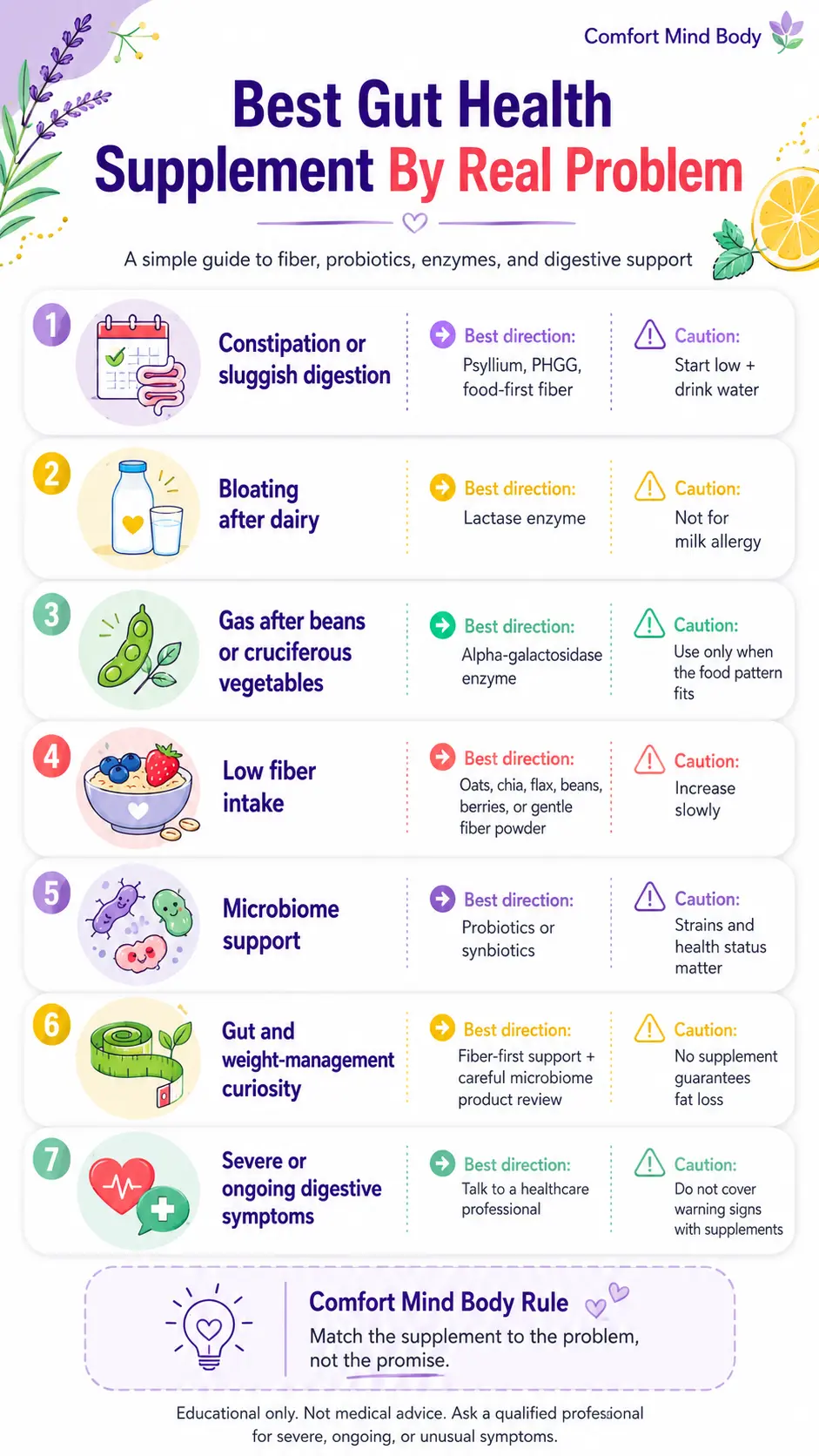
Best Gut Health Supplements By Real Problem
The easiest way to choose a gut health supplement is to start with the actual problem. A person dealing with constipation may need a different option than someone who feels bloated after dairy, wants microbiome support, or is curious about weight-management formulas.
This matters because gut symptoms can have many causes. Bloating may come from constipation, food intolerance, stress, eating too quickly, low movement, too much fiber too fast, or an underlying digestive condition. A random supplement may miss the real issue completely.
Swipe left or right to view the full table on mobile.
| Real Problem | Better First Question | Supplement Type To Consider | When To Ask A Doctor First |
|---|---|---|---|
| Constipation or sluggish digestion | Is daily fiber, water, and movement low? | Psyllium, PHGG, food-first fiber, or gentle fiber support. | Severe constipation, pain, vomiting, blood in stool, or bowel obstruction risk. |
| Bloating after meals | Does it happen after specific foods or every meal? | Digestive enzymes, lactase, alpha-galactosidase, or food tracking. | Persistent bloating, severe pain, weight loss, fever, or ongoing diarrhea. |
| Gas from high-fiber foods | Was fiber increased too quickly? | Slower fiber ramp-up, smaller servings, PHGG, or enzyme support for beans. | Gas with severe pain, vomiting, fever, or major bowel changes. |
| Low fiber intake | Can meals add more plants before adding powders? | Food-first fiber, psyllium, inulin, PHGG, oats, beans, berries, chia, or flax. | Medication use, swallowing difficulty, digestive narrowing, or severe constipation. |
| Microbiome support | Is the goal general wellness, antibiotic support, bloating, or regularity? | Probiotics, synbiotics, prebiotic foods, or fermented foods. | Weakened immune system, serious illness, central line, or medically fragile status. |
| GLP-1 digestive changes | Is the concern constipation, nausea, low appetite, or low protein and fiber? | Gentle fiber, hydration support, protein, and medical guidance. | Severe nausea, vomiting, dehydration, abdominal pain, or medication side effects. |
| Weight-management and gut curiosity | Is the product promising gut support or guaranteed fat loss? | Fiber, protein, LeanBiome-style microbiome products, or a full routine review. | Rapid weight change, diabetes medication, eating disorder history, or extreme claims. |
A good gut supplement should make the next step clearer, not more confusing. If the real issue is low fiber, start with fiber. If the issue is meal-specific discomfort, look at enzymes. If symptoms are severe, ongoing, or unusual, medical guidance matters more than another supplement.
Sushi’s Note: The body usually gives clues before it gives answers. Matching the supplement to the real problem is safer than buying the loudest promise.
Fiber Supplements For Gut Health
Fiber is one of the strongest gut health trends for 2026, and it is also one of the most practical places to start. Many people are not getting enough fiber from meals, which can affect fullness, stool bulk, bowel regularity, and overall digestive comfort.
Fiber supplements are not exciting in the same way as new microbiome products, but they often solve a real problem. They may help when meals are low in plants, bowel movements feel sluggish, or hunger returns quickly after eating. Still, fiber needs to be used carefully because too much too fast can cause bloating, gas, cramping, or constipation changes.
The safest approach is usually simple: start low, increase slowly, and drink enough water. People taking medications should also ask a pharmacist or healthcare professional how to space fiber supplements, because some fibers may affect medication absorption timing.
Swipe left or right to view the full table on mobile.
| Fiber Type | Best For | What To Watch |
|---|---|---|
| Psyllium husk | Regularity, stool bulk, fullness, and simple fiber support. | Needs enough water and may need spacing from medications. |
| PHGG / Sunfiber | Gentler fiber support for some people with sensitive digestion. | Still needs gradual use; tolerance varies by person. |
| Inulin / chicory root fiber | Prebiotic support and feeding beneficial gut bacteria. | May cause gas or bloating, especially if started too quickly. |
| Glucomannan | Fullness and fiber-based appetite support. | Requires enough fluid and caution with swallowing issues or digestive narrowing. |
| Chia, flax, oats, beans, berries, vegetables | Food-first fiber with nutrients, texture, and meal satisfaction. | Needs consistency and gradual increases if current fiber intake is low. |
Fiber supplements may be useful, but food-first fiber still matters. Oats, beans, lentils, berries, chia seeds, flaxseed, vegetables, potatoes, and whole grains can support digestion while also adding vitamins, minerals, and meal satisfaction.
For readers using gut health as part of a weight-management routine, fiber may also support fullness and consistency. The Best Weight Loss Supplements guide explains how fiber fits into a broader safety-first supplement plan.
Anna’s Tip: Fiber is not a race. A small daily increase that the body tolerates is usually more useful than a big dose that causes bloating and makes a person quit.
Probiotics For Gut Health
Probiotics are one of the most familiar gut health supplement categories, but they are also one of the easiest to misunderstand. A probiotic is not automatically helpful just because the label says “billions” or “gut support.” The strain, dose, reason for use, health status, and product quality all matter.
Some probiotics may support certain digestive concerns, especially when matched to a specific use case. Others may do very little, or they may cause temporary gas, bloating, or bowel changes. This is why a probiotic should be chosen more carefully than a generic multivitamin.
A strong probiotic label should name the strain clearly, not only the broad species. For example, a label that lists only “Lactobacillus” is less specific than one that identifies the full strain. Clear storage instructions, expiration information, and realistic claims also matter.
Swipe left or right to view the full table on mobile.
| Probiotic Use Case | What To Look For | Main Caution |
|---|---|---|
| General gut support | Clear strain names, realistic claims, and a product that fits the routine. | General wellness claims may not mean strong evidence for a specific symptom. |
| After antibiotic use | Strain-specific research and guidance from a healthcare professional when needed. | Timing around antibiotics can matter, and not every probiotic is appropriate. |
| Bloating or gas | A product with clear strains and a gradual trial period. | Some probiotics may temporarily worsen gas or bloating. |
| Women’s gut health | Clear use case, strain transparency, and realistic symptom expectations. | Hormones, menopause, medications, and health history can change what is useful. |
| Gut-brain or stress interest | Strain-specific research and careful wording around mood or anxiety claims. | Psychobiotic research is promising, but not every probiotic affects mood or stress. |
Probiotics may not be the safest first step for everyone. People with a weakened immune system, serious illness, central venous catheter, major medical condition, or medically fragile status should speak with a healthcare professional before using probiotic supplements.
Sushi’s Note: A probiotic should not be judged by the biggest number on the bottle. A clearer label and a better match to the problem matter more than a louder promise.
Prebiotics, Postbiotics, And Synbiotics Explained
Gut health labels can get confusing quickly. Many products now mention prebiotics, probiotics, postbiotics, synbiotics, microbiome support, or next-generation biotics. These terms sound similar, but they do not mean the same thing.
A simple way to think about it is this: probiotics are live microorganisms, prebiotics feed beneficial microbes, postbiotics are beneficial non-living microbial preparations or byproducts, and synbiotics combine probiotics with prebiotics. Each category may have a place, but the right choice depends on the person’s goal and tolerance.
This area is growing fast in 2026, especially around postbiotics and newer microbiome ingredients. Still, marketing can move faster than evidence. A product should explain what it contains, why it is included, and what realistic support it may offer.
Swipe left or right to view the full table on mobile.
| Type | What It Means | Examples | What To Watch |
|---|---|---|---|
| Probiotics | Live microorganisms used to support a health-related goal. | Lactobacillus, Bifidobacterium, Saccharomyces boulardii. | Strain, dose, storage, health status, and side effects matter. |
| Prebiotics | Fibers or compounds that feed beneficial microbes. | Inulin, chicory root fiber, PHGG, resistant starch, certain food fibers. | May cause gas or bloating if increased too quickly. |
| Postbiotics | Non-living microbial preparations or beneficial compounds linked to microbial activity. | Heat-treated microbes, fermented food byproducts, short-chain fatty acid related support. | The term is newer for shoppers, so definitions and product quality matter. |
| Synbiotics | A combination of probiotics and prebiotics. | Capsules, powders, or formulas that include both microbes and fibers. | More ingredients can mean more chances for gas, bloating, or tolerance issues. |
Food can support these categories too. Yogurt, kefir, sauerkraut, kimchi, oats, onions, garlic, beans, lentils, asparagus, green bananas, cooked-and-cooled potatoes, and whole grains may all play a role in a gut-supportive routine depending on tolerance.
Anna’s Tip: Do not buy a product just because it uses a newer gut health word. Ask what the ingredient does, how much is included, and whether the claim makes sense for the problem you are trying to solve.
Digestive Enzymes: When They May Help
Digestive enzymes are different from probiotics and fiber. They do not add live microbes, and they do not feed gut bacteria in the same way prebiotic fibers do. Instead, enzymes help break down certain parts of food during digestion.
This category may be useful when discomfort is tied to specific meals. For example, lactase may help people who have trouble digesting lactose. Alpha-galactosidase may help some people who feel gassy after beans or certain vegetables. Other enzyme blends may include amylase, protease, or lipase to help break down carbohydrates, proteins, or fats.
Digestive enzymes are not a cure for ongoing bloating, chronic pain, IBS, IBD, celiac disease, gallbladder issues, pancreatic concerns, or unexplained digestive symptoms. If symptoms are frequent, severe, or getting worse, the safer step is medical guidance.
Swipe left or right to view the full table on mobile.
| Enzyme Type | What It Helps Break Down | When It May Be Useful | Main Caution |
|---|---|---|---|
| Lactase | Lactose in milk and dairy products. | Dairy-related gas, bloating, or discomfort in lactose-sensitive people. | Not useful for every dairy issue or milk allergy. |
| Alpha-galactosidase | Certain carbohydrates in beans, legumes, and some vegetables. | Gas after beans, lentils, broccoli, cabbage, or similar foods. | May not solve bloating caused by constipation, IBS, or other conditions. |
| Amylase | Starches and carbohydrates. | Some enzyme blends include it for general meal support. | General enzyme blends may not match the real cause of symptoms. |
| Protease | Proteins. | Some people use it in broad digestive enzyme formulas. | Persistent discomfort after protein-rich meals should be evaluated if severe. |
| Lipase | Fats. | Some blends include it for heavier meals. | Oily stools, severe pain, or unexplained symptoms need medical guidance. |
A digestive enzyme should match the food that seems to trigger symptoms. If bloating happens after every meal, or if symptoms come with pain, diarrhea, constipation, fever, blood in stool, or weight loss, enzymes are not the right first answer.
Sushi’s Note: Enzymes are most useful when the pattern is clear. If the body is reacting to everything, it may be asking for a closer look, not a bigger blend.
Best Supplements For Bloating And Regularity
Bloating and irregularity are two of the biggest reasons people look for gut health supplements. They are also two of the easiest symptoms to oversimplify. Bloating does not always mean the same thing for every person, and regularity support depends on hydration, fiber intake, movement, stress, medications, and health history.
A supplement may help when the cause is simple, such as low fiber intake, low water intake, or discomfort after a specific food. However, supplements can also make symptoms worse if they are mismatched. Too much fiber too quickly may increase gas. A probiotic may temporarily worsen bloating. A cleanse-style product may cause urgency or diarrhea.
The safest approach is to match the supplement to the pattern instead of buying the strongest-sounding product.
Swipe left or right to view the full table on mobile.
| Pattern | Possible Starting Point | Why It May Help | When To Stop Guessing |
|---|---|---|---|
| Bloating with constipation | Gentle fiber ramp-up, water, walking, and food-first fiber. | Regularity support may reduce pressure from backed-up stool. | Severe constipation, vomiting, sharp pain, or blood in stool. |
| Bloating after dairy | Lactase enzyme or dairy pattern tracking. | May help digest lactose when lactose sensitivity is the issue. | Symptoms with allergy signs, severe pain, or unexplained reactions. |
| Gas after beans or cruciferous vegetables | Smaller portions, slower fiber increase, or alpha-galactosidase. | May reduce gas from certain fermentable carbohydrates. | Gas with ongoing diarrhea, severe pain, fever, or major bowel changes. |
| Bloating after starting probiotics | Pause, reduce dose if appropriate, or reassess the strain and product. | Some people experience temporary digestive shifts from probiotics. | Symptoms are severe, persistent, or worsening. |
| Irregular bowel habits with low plant intake | Food-first fiber, psyllium, PHGG, oats, berries, chia, beans, or lentils. | Fiber may support stool bulk and a steadier routine. | Symptoms continue despite changes or become painful. |
| Bloating with stress or rushed eating | Slower meals, breathing, walking, and mindful eating support. | The gut and nervous system are closely connected. | Severe or persistent symptoms need medical evaluation. |
For readers who notice bloating around stress, rushed eating, or emotional eating patterns, the Mindful Eating For Weight Loss guide may help build a calmer meal routine.
Anna’s Tip: Bloating is a clue, not a diagnosis. If a supplement makes bloating worse instead of better, that is useful information.
Gut Health Supplements For Weight Management
Gut health and weight management are often discussed together, especially as more people learn about the microbiome, fiber, appetite, blood sugar, and GLP-1-related digestive changes. This connection is interesting, but it is also easy for supplement companies to exaggerate.
A gut health supplement should not promise guaranteed fat loss. It should not claim to melt belly fat, replace meals, or work like prescription medication. A more realistic role is support: fiber may help with fullness, probiotics may support certain digestive patterns for some people, and a better gut routine may make healthy habits easier to repeat.
For weight management, the basics still matter most: filling meals, enough protein, enough fiber, realistic calorie awareness, walking, strength training, sleep, and stress care. Supplements can support one part of the routine, but they cannot replace the routine itself.
Swipe left or right to view the full table on mobile.
| Weight-Related Goal | Gut Health Angle | Useful Direction | Red Flag |
|---|---|---|---|
| Stay full longer | Fiber slows digestion and supports meal satisfaction. | Food-first fiber, psyllium, PHGG, chia, beans, oats, vegetables. | Products that promise fat loss without food changes. |
| Improve meal consistency | A calmer gut routine may make meals easier to repeat. | Fiber, hydration, regular meals, walking after meals. | Cleanse products that cause urgency or diarrhea. |
| Support microbiome curiosity | Some products focus on gut bacteria and metabolic wellness. | Carefully reviewed probiotics or LeanBiome-style microbiome products. | Claims that gut bacteria alone guarantees weight loss. |
| Manage bloating during weight loss | Diet changes can affect fiber, sodium, hydration, and bowel habits. | Gradual fiber increases, water, walking, and symptom tracking. | Mistaking laxative scale drops for fat loss. |
| Compare GLP-1 digestive support | Reduced appetite can change fiber, protein, and bowel habits. | Gentle fiber, protein, hydration, and medical guidance. | Supplements claiming to work like GLP-1 medications. |
Readers comparing microbiome-focused weight support can read the LeanBiome Review. For a wider supplement safety framework, visit the Best Weight Loss Supplements guide. For the bigger routine behind safe weight management, start with the Healthy Weight Loss Guide.
Sushi’s Note: A gut supplement may support consistency, but it should not become a shortcut around nourishment. The body still needs food, water, rest, and time.
Multi-Ingredient Gut Formulas vs Basic Fiber
Not every gut health supplement needs a long ingredient list. In many cases, the simplest option may be the easiest to understand, tolerate, and adjust. This is especially true when the main problem is low fiber intake, sluggish regularity, or meals that do not include enough plants.
Multi-ingredient gut formulas may combine fiber, probiotics, plant extracts, enzymes, minerals, or cleanse-style ingredients. That can sound more complete, but it also makes the product harder to judge. More ingredients can mean more possible benefits, but also more chances for gas, bloating, cramping, allergies, medication timing concerns, or unclear claims.
A basic fiber supplement is not automatically better, and a multi-ingredient formula is not automatically worse. The safer question is whether the product clearly matches the reader’s real digestive need.
Swipe left or right to view the full table on mobile.
| Option | Best Fit | Strength | Main Caution |
|---|---|---|---|
| Basic fiber supplement | People with low fiber intake, sluggish regularity, or fullness goals. | Simple, easier to track, and easier to adjust. | Too much too fast may cause gas, bloating, or constipation if water is low. |
| Probiotic-only supplement | People who want strain-focused microbiome support. | More targeted than broad gut blends when strains are clearly listed. | Effects vary by strain, dose, person, and health status. |
| Digestive enzyme supplement | People with meal-specific discomfort after dairy, beans, or heavier meals. | Can match a specific food pattern when the trigger is clear. | Not the same as fiber, probiotics, or treatment for digestive disease. |
| Multi-ingredient digestive formula | People comparing broader digestive support products. | May combine several support categories in one product. | Harder to identify what helps or causes side effects. |
| Microbiome and weight-management formula | People researching gut bacteria, cravings, fullness, and weight-management support. | May connect gut health with broader wellness goals. | Should not promise guaranteed fat loss or replace healthy habits. |
Anna’s Tip: Simple is not weak. If the real issue is low fiber, a clear fiber plan may be more useful than a long ingredient list.
Readers comparing a specific multi-ingredient digestive formula can read the SynoGut Review. For safety details, the SynoGut Side Effects guide explains possible digestive reactions and medication timing concerns.
Functional Gut Drinks: Helpful Or Hype?
Functional gut drinks are one of the fastest-growing wellness trends. Prebiotic sodas, probiotic drinks, kombucha, fiber waters, greens powders, and gut-support drink mixes are now marketed as easy ways to support digestion.
Some drinks can be useful. A low-sugar drink with meaningful fiber may help a person replace soda while adding prebiotic support. A fermented drink may fit some routines. A protein-and-fiber smoothie may support fullness and meal structure. However, a drink should still be judged by its label, not by the word “gut” on the front.
Watch for added sugar, sugar alcohols, vague probiotic claims, tiny fiber amounts, high caffeine, or “detox” language. A gut health drink should not promise to flatten the stomach, heal digestion, or replace real meals.
Swipe left or right to view the full table on mobile.
| Drink Type | When It May Help | What To Check | Red Flag |
|---|---|---|---|
| Prebiotic soda | May replace regular soda while adding some prebiotic fiber. | Fiber amount, added sugar, sugar alcohols, and serving size. | Claims that a soda can fix gut health by itself. |
| Kombucha | May fit some fermented-food routines. | Sugar, caffeine, alcohol traces, carbonation, and tolerance. | Drinking large amounts because it sounds healthy. |
| Fiber water or fiber drink mix | May support people who struggle to add fiber through meals. | Fiber type, dose, water intake, and medication timing. | Adding too much fiber too quickly. |
| Probiotic drink | May support a probiotic routine if strains and storage are clear. | Strain names, live cultures, expiration, sugar, and serving size. | Vague “live culture” claims with no useful details. |
| Greens powder | May add convenience for people who like powdered wellness routines. | Fiber amount, sweeteners, proprietary blends, and claim quality. | Marketing that makes powders sound equal to vegetables. |
Drinks can make a gut-health routine easier, but they should not become the whole plan. Food-first fiber, enough water, balanced meals, movement, and sleep still matter more than a trendy bottle.
For more drink-focused options, read the Best Drinkable Supplements guide.
Sushi’s Note: A drink can support a routine, but it should not hide behind a wellness label. The back of the bottle tells the real story.
2026 Gut Health Trends To Watch
Gut health is changing quickly in 2026. The category is no longer only about probiotics. Readers are seeing fiber-first nutrition, prebiotic sodas, postbiotics, Akkermansia, microbiome tests, GLP-1 digestive support, menopause gut health, and gut-brain products in the same wellness space.
These trends are worth watching, but they should not all be treated the same. Some are practical and food-first. Some are promising but early. Others are mostly marketing unless the product explains the ingredient, dose, evidence, and safety cautions clearly.
Swipe left or right to view the full table on mobile.
| Trend | Why It Matters | Best Reader Takeaway |
|---|---|---|
| Fiber-first gut health | Fiber supports regularity, fullness, and a more food-first digestive routine. | Start with meals, then consider simple fiber support if needed. |
| Prebiotic and functional drinks | Gut-health drinks are becoming mainstream and easier to find. | Check sugar, fiber amount, caffeine, and digestive tolerance. |
| Postbiotics | Postbiotics are gaining attention as a newer gut health category. | Learn the difference before buying supplements with trendy wording. |
| Akkermansia | This microbiome topic is moving from research into consumer supplement interest. | Promising does not mean proven for every shopper or goal. |
| Gut microbiome testing | At-home tests are popular, but interpretation can be limited and inconsistent. | Use caution before making major health decisions from one test report. |
| GLP-1 digestive support | More people are looking for help with constipation, nausea, low appetite, protein, and fiber. | Medical guidance matters; supplements should not claim to work like GLP-1 drugs. |
| Menopause and gut health | Hormonal changes may overlap with bloating, constipation, sleep, stress, and weight changes. | A food, fiber, stress, sleep, and medical-guidance approach is safer than one supplement promise. |
| Gut-brain and psychobiotics | The gut-brain conversation is growing around stress, mood, and sleep. | Look for strain-specific evidence and avoid products that overpromise mental health results. |
These trends can become useful future guides, but the foundation stays the same. The best gut health plan usually starts with food, fiber, hydration, movement, sleep, stress support, and medical care when symptoms are serious or ongoing.
Anna’s Note: Trends can help readers discover new ideas, but they should not rush a health decision. A good gut health product should still be clear, realistic, and safe enough to understand before buying.
What Gut Health Supplements Cannot Do
Gut health supplements can sometimes support digestion, regularity, fullness, or microbiome routines. However, they cannot do everything a sales page may suggest. This is especially important in a category where words like detox, cleanse, microbiome repair, gut reset, and natural weight loss are used often.
A supplement cannot diagnose a digestive condition. It cannot cure IBS, IBD, Crohn’s disease, ulcerative colitis, celiac disease, food allergies, infections, gallbladder disease, pancreatic problems, or chronic unexplained symptoms. It also cannot safely replace medical care when symptoms are severe, ongoing, or unusual.
Gut supplements also cannot guarantee weight loss. Fiber may support fullness, probiotics may support some digestive goals, and enzymes may help with certain meal patterns, but no gut supplement should promise to melt fat, flatten the stomach, or work like prescription medication.
Swipe left or right to view the full table on mobile.
| A Gut Supplement Cannot... | Why It Matters | Better Next Step |
|---|---|---|
| Diagnose digestive disease | Bloating, diarrhea, constipation, and pain can have many causes. | Track symptoms and speak with a healthcare professional if they persist. |
| Cure IBS, IBD, or chronic gut symptoms | Medical conditions need proper evaluation and management. | Use supplements only with appropriate guidance when symptoms are complex. |
| Guarantee weight loss | Gut health may support habits, but fat loss still depends on a full routine. | Focus on protein, fiber, movement, sleep, and realistic calorie awareness. |
| Replace food-first fiber | Food provides fiber plus nutrients, texture, volume, and satisfaction. | Add plants gradually before depending on powders or capsules. |
| Erase the impact of stress, sleep, and low movement | Digestion is affected by the nervous system and daily routine. | Support meals, walking, hydration, stress care, and consistent sleep. |
| Make warning symptoms safe to ignore | Blood in stool, severe pain, fever, vomiting, or unexplained weight loss need attention. | Seek medical guidance instead of trying to cover symptoms with supplements. |
For readers who prefer a food-first wellness approach, the Natural Weight Loss Remedies guide may help build a steadier routine without relying only on supplements.
Sushi’s Note: A supplement can be a tool, but it should never become a reason to ignore what the body is trying to say.
Ingredients And Claims To Avoid
Gut health supplements can sound gentle because they often use words like natural, cleanse, microbiome, detox, balance, or reset. Still, a soft wellness label does not automatically make a product safe, useful, or honest.
A trustworthy supplement should explain what is inside, how much is inside, what the product is meant to support, who should be careful, and what kind of results are realistic. If the label hides basic information or the sales page promises dramatic results, that is a reason to pause.
Swipe left or right to view the full table on mobile.
| Red Flag | Why It Matters | Safer Move |
|---|---|---|
| “Cures IBS” or “heals digestive disease” | Supplements should not claim to cure medical conditions. | Choose realistic support language and ask a healthcare professional about ongoing symptoms. |
| “Detoxes your colon” | Detox language may hide laxative-style effects or fear-based marketing. | Look for regularity support, fiber support, or medical guidance when symptoms persist. |
| “Gut reset in days” | Digestive health usually changes through routine, not overnight promises. | Expect gradual changes and track tolerance honestly. |
| Guaranteed weight loss | Gut supplements should not promise fat loss without habit changes. | Use a full weight-management routine and treat supplements as support only. |
| Hidden proprietary blend | It may be hard to know the dose of each active ingredient. | Prefer clear labels with listed ingredient amounts. |
| No Supplement Facts label | A buyer cannot judge safety or dosage without the label. | Pause until the full label is visible and readable. |
| No caution section | Pregnancy, medications, immune status, allergies, and digestive disease can matter. | Look for clear warnings and ask a professional when health factors apply. |
| Fake doctor, celebrity, or news-style claims | Borrowed trust symbols can make weak claims look stronger. | Verify claims from official sources, not ad graphics or copied logos. |
The safest products are usually the easiest to understand. A clear label, realistic purpose, honest cautions, and simple refund terms are better signs than dramatic promises.
Anna’s Tip: If a gut supplement makes normal digestion sound scary so the product feels necessary, pause. Good wellness support should create clarity, not fear.
Who Should Ask A Doctor First?
Gut health supplements are not risk-free for every person. Fiber, probiotics, herbs, digestive enzymes, cleanse-style formulas, and multi-ingredient blends can affect digestion, hydration, medication timing, immune safety, and symptom patterns.
Medical guidance is especially important when symptoms are severe, ongoing, painful, or unusual. A supplement should not be used to delay care for signs that need proper evaluation.
Swipe left or right to view the full table on mobile.
| Ask A Healthcare Professional First If... | Why It Matters |
|---|---|
| There is pregnancy, breastfeeding, or trying to become pregnant. | Some herbs, probiotics, enzymes, and cleanse-style ingredients may not be appropriate during these times. |
| The reader is a child or teen. | Adult gut supplements may not be appropriate without pediatric guidance. |
| There is IBS, IBD, Crohn’s disease, ulcerative colitis, celiac disease, or chronic digestive disease. | Fiber, probiotics, herbs, and enzymes may affect symptoms unpredictably. |
| There is severe constipation, chronic diarrhea, frequent abdominal pain, or bowel obstruction risk. | Expanding fibers or bowel-support ingredients may not be safe for every digestive situation. |
| There is a weakened immune system, serious illness, or medically fragile status. | Probiotic safety may vary in higher-risk medical situations. |
| Prescription medications or several supplements are already being used. | Fiber, clay-style ingredients, herbs, and supplements may affect timing, absorption, or interactions. |
| There is kidney disease, liver disease, heart disease, diabetes, or major health concerns. | Hydration, glucose, medication timing, and supplement tolerance may need personalized guidance. |
| There is blood in stool, fever, persistent vomiting, severe pain, or unexplained weight loss. | These symptoms should be medically evaluated instead of managed with supplements alone. |
Anna’s Safety Note: Asking for medical guidance is not overreacting. It is the safest way to match a supplement to the body instead of forcing the body to tolerate the supplement.
Best Gut Health Supplement Checklist
Before buying a gut health supplement, it helps to slow down and review the product like a health-related decision. A good supplement should make the next step clearer. It should not rely on pressure, fear, vague promises, or a label that is hard to understand.
Use this checklist before choosing fiber, probiotics, enzymes, prebiotics, postbiotics, multi-ingredient digestive formulas, or microbiome-focused products.
Swipe left or right to view the full table on mobile.
| Question | Why It Matters |
|---|---|
| What problem am I trying to solve? | Bloating, constipation, low fiber, meal discomfort, and microbiome curiosity may need different approaches. |
| Is my food-first fiber intake low? | Many gut routines improve by adding plants, water, and gradual fiber before buying complex products. |
| Is this single-ingredient or multi-ingredient? | Simple products are easier to understand, while blends may be harder to evaluate. |
| Are strains, ingredient amounts, and serving size clear? | Transparent labels make it easier to judge quality, dose, and possible side effects. |
| Are the claims realistic? | A gut supplement should not promise cures, instant resets, or guaranteed weight loss. |
| Do I need to space it from medications? | Fiber, clay-style ingredients, herbs, and some supplements may affect medication timing. |
| Is there a clear refund policy and seller information? | Clear terms help avoid confusion if the product is not tolerated or not useful. |
| Do I have symptoms that need a doctor? | Severe pain, blood in stool, fever, vomiting, chronic diarrhea, or unexplained weight loss should not be handled with supplements alone. |
A gut health supplement should pass a basic clarity test before it earns a place in the routine. If the product does not explain what it is, what it contains, how it may help, and who should be careful, it may not be worth buying.
Sushi’s Note: A calm checklist can protect the body better than a rushed purchase. If the product still makes sense tomorrow, it is easier to trust the decision.
Free Gut Health Checklist
Add Fiber Gently In 7 Days
Want to support digestion without overwhelming your gut? Download the 7-Day Gentle Fiber Ramp-Up Checklist for simple daily steps, fiber-friendly food ideas, hydration reminders, and safety notes.
- One small fiber action per day
- Gentle ideas for bloating-sensitive routines
- Quick reminders for when to pause and ask first
Educational only. Not medical advice. Ask a qualified professional for severe, ongoing, or unusual symptoms.
Final Thoughts: What Is The Best Gut Health Supplement?
The best gut health supplement is not the newest trend or the longest ingredient list. It is the one that matches the real problem, has a clear label, fits the body safely, and supports a routine that can be repeated.
For many people, the first step is not complicated. More food-first fiber, enough water, steady meals, walking, sleep, and stress support can do more than another product with vague claims. When a supplement is needed, fiber, probiotics, digestive enzymes, prebiotics, postbiotics, or multi-ingredient formulas should each be judged by their actual purpose.
Fiber may help with regularity and fullness. Probiotics may support certain microbiome goals when the strain and use case make sense. Digestive enzymes may help with specific meal patterns. Multi-ingredient digestive formulas may be useful for some readers, but they deserve more careful label review because more ingredients can mean more possible reactions.
Gut health is personal. Bloating, constipation, gas, diarrhea, food reactions, and digestive discomfort can have many causes. If symptoms are severe, persistent, painful, or unusual, a healthcare professional should be part of the plan.
The safest choice is the one that creates clarity. A good gut supplement should help the reader understand the next step, not pressure them into believing one bottle can fix everything.
Anna’s Reminder: The goal is not to collect more supplements. The goal is to build a calmer digestive routine that supports the body in real life.
Frequently Asked Questions About Gut Health Supplements
What is the best gut health supplement?
The best gut health supplement depends on the problem. Fiber may be the best starting point for low fiber intake, sluggish regularity, or fullness support. Probiotics may help some people, but strain and health status matter. Digestive enzymes may be useful when discomfort is tied to specific meals.
Are probiotics or fiber better for gut health?
Neither is automatically better. Fiber helps feed gut bacteria and supports stool bulk, fullness, and regularity. Probiotics add specific live microorganisms, but effects vary by strain, dose, person, and goal. Many people may benefit from improving fiber intake before buying a complex probiotic.
What supplement is best for bloating?
The best supplement for bloating depends on the cause. Fiber may help if bloating is linked to constipation, but too much fiber too quickly can make gas worse. Lactase may help with dairy-related bloating. Alpha-galactosidase may help with gas from beans or some vegetables. Persistent or painful bloating should be discussed with a healthcare professional.
Do digestive enzymes help with bloating?
Digestive enzymes may help when bloating is tied to specific foods. For example, lactase may help some people digest lactose, and alpha-galactosidase may help with gas from beans or certain vegetables. Enzymes are not a cure for chronic bloating, IBS, IBD, severe pain, or unexplained digestive symptoms.
What is the difference between prebiotics, probiotics, and postbiotics?
Probiotics are live microorganisms used to support a health-related goal. Prebiotics are fibers or compounds that feed beneficial gut microbes. Postbiotics are non-living microbial preparations or beneficial compounds linked to microbial activity. Synbiotics combine probiotics and prebiotics.
Are gut health supplements safe?
Gut health supplements are not risk-free for everyone. Fiber can cause gas, bloating, or constipation changes if used too quickly or without enough water. Probiotics may not be appropriate for medically fragile or immunocompromised people. Herbs, enzymes, and multi-ingredient formulas may also interact with medications or cause side effects.
Can gut health supplements help with weight loss?
Gut health supplements should not be treated as weight loss pills. Fiber may support fullness and consistency, and some microbiome products are marketed for weight-management support, but no gut supplement should promise guaranteed fat loss. Healthy weight management still depends on food, movement, sleep, stress care, and realistic calorie awareness.
Is SynoGut better than a basic fiber supplement?
SynoGut and basic fiber supplements are different. A basic fiber supplement is usually easier to understand and adjust. SynoGut is a multi-ingredient digestive formula, so it needs more careful label review because several ingredients may affect digestion, side effects, allergies, or medication timing.
Is LeanBiome good for gut health and weight management?
LeanBiome is positioned around microbiome and weight-management support. It may interest readers researching gut bacteria and weight claims, but it should not be treated as a guaranteed fat-loss product. Review the label, claims, side effects, refund terms, and whether it fits a realistic routine before buying.
When should I see a doctor instead of taking a gut supplement?
A person should seek medical guidance for severe abdominal pain, blood in stool, black stools, fever, persistent vomiting, chronic diarrhea, severe constipation, unexplained weight loss, trouble swallowing, or symptoms that are worsening or unusual. Supplements should not be used to cover up warning signs.
Sources And Safety Notes
This guide is educational and is not a substitute for medical advice, diagnosis, or treatment. Gut health supplements can affect people differently based on age, health history, medications, pregnancy status, breastfeeding, immune health, digestion, hydration, kidney health, liver health, diet, and current symptoms.
Dietary supplements are not approved by the FDA for safety and effectiveness before they are sold in the same way drugs are approved. Fiber, probiotics, digestive enzymes, herbs, prebiotics, postbiotics, and multi-ingredient gut formulas should be reviewed carefully before use.
Anyone with severe abdominal pain, blood in stool, persistent vomiting, chronic diarrhea, severe constipation, unexplained weight loss, fever, trouble swallowing, immune compromise, major health conditions, pregnancy, breastfeeding, or medication use should speak with a qualified healthcare professional before using gut health supplements.
Affiliate And Medical Disclosure
This article is for educational and informational purposes only. It is not medical advice and should not replace guidance from a doctor, registered dietitian, pharmacist, or qualified healthcare professional.
Some links on Comfort Mind Body may be affiliate links. This means the site may earn a small commission if a purchase is made through certain links, at no extra cost to the reader.
Affiliate partnerships do not determine safety guidance. Gut health supplements, probiotics, fiber products, digestive enzymes, prebiotics, postbiotics, drinkable supplements, and microbiome-focused products should be compared by label transparency, realistic claims, possible side effects, medication cautions, refund terms, and whether the product fits a healthy routine.