How this guide was made. Anna’s reflection draws on her original essay and her own experience. The guide draws on research by Kate Mulgrew and Angela Hinz and public guidance from the Centre for Clinical Interventions and the NHS. The reader scenarios are examples. Sources checked November 9, 2026.
I usually look the other way when I pass a mirror. I often get dressed without looking in one at all. Sometimes I look because I hope it’ll motivate me. The thought I get is usually something like, “You should be working harder.” Some days I walk away feeling disappointed in myself.
The girls held up as beautiful when I was growing up were usually thin and had long hair. I didn’t see myself in that picture. I know who I am, and I still feel the pull of that old standard when I see my reflection.
Some days I wonder why I should bother taking care of myself if I don’t think anything will change. I’m still working through that. What does taking care of yourself look like on a day when it’s hard to feel worth the effort?
Quick Navigation
ToggleWhat Can You Do on a Bad Body Image Day?
Body neutrality means giving your appearance less say in how you treat yourself. At the mirror, start with the question you came to answer.
If you’re getting dressed, that might be “Is this comfortable for what I’m doing today?” Once you have an answer, move to the next part of getting ready. You can do that while you’re still unsure how you feel about your reflection.
When taking care of yourself feels pointless, ask, “What would make the next hour a little easier?” It might be making lunch, sitting somewhere comfortable, or texting a friend that you’d like some company.
Pick something you’d still want for yourself even if you felt the same about your reflection afterward.
What Does Body Neutrality Mean?
In a 2024 study by Kate Mulgrew and Angela Hinz, participants described it in terms of accepting the body and putting less emphasis on how it looks. The study explored what people meant by the term.
In everyday life, this can mean asking what you need today. That might be a more comfortable place to sit or a break when you’re tired. Your body deserves care on days it hurts, feels tired, or can do less than you expected.
An Everyday Example of Body Neutrality
Imagine you’re meeting a friend for lunch. You put on a jacket you haven’t worn in a while and notice that the sleeves pull when you reach for your bag. That’s useful information. You can try a different layer or decide the jacket is comfortable enough for a short walk.
Then you turn sideways again, this time trying to decide if you look good enough to be seen. You already know what you needed to know about the jacket. Pick the layer that works for you and send your friend the “On my way” text. You might still feel self-conscious on the way out. You can leave space for that feeling and still make it to lunch.
When You Keep Checking or Catch Yourself Looking Away
You already got the answer you needed
Checking whether your buttons line up answers a practical question. Turning back to ask whether you look good enough to leave is a different question. If the buttons are fine and you’re ready to go, pick up your keys. You can leave while you still feel unsure about how you look.
You look away as you pass a mirror
Maybe you were on your way to make coffee, and the reflection caught you off guard. Ask yourself, “What was I on my way to do?” Making coffee can still be the next thing.
Looking away is something I do. I still want to understand why the feeling comes up so often. If the same thing keeps happening to you, you could bring it up with someone you trust: “I usually look away when I pass a mirror.
It’s been bothering me, and I’d like to talk about it.” If it regularly interrupts things you need or want to do, bring that example up with a healthcare professional.
You want to ask someone how you look again
If what you want is company, you can ask for that directly. Try, “I’m having a rough morning. Want to go for a walk with me?” If you need a practical second opinion, ask the question you actually need answered, such as “Does this jacket work for the weather?”
The Centre for Clinical Interventions explains body checking and avoidance in the context of eating disorders.
If the same harsh thought follows you out of the room, our guide to responding to recurring negative thoughts gives you a few ways to decide whether there’s something to act on or whether your attention can go back to what you’re doing.
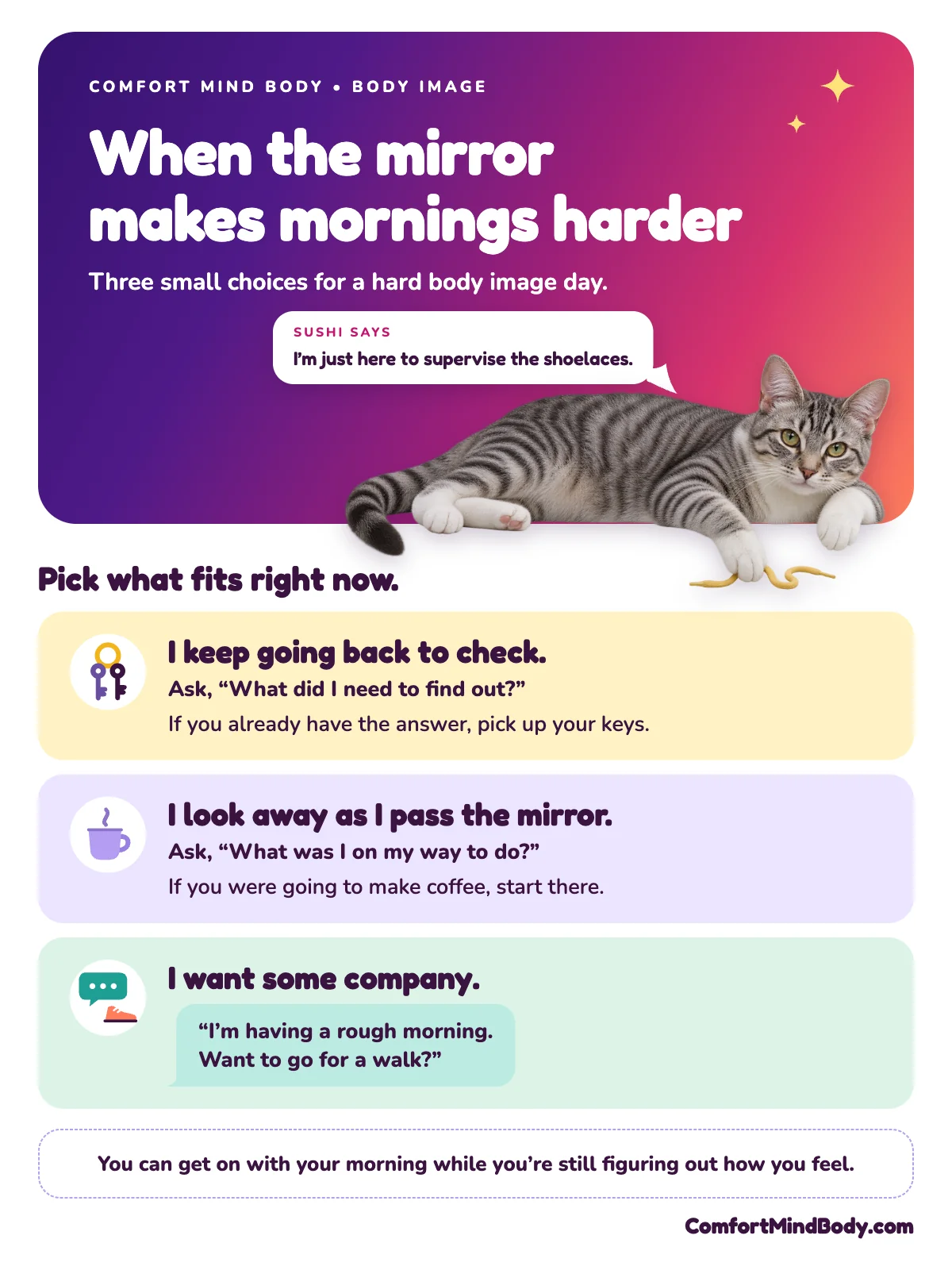
Read the infographic text
Comfort Mind Body • Body Image
When the mirror makes mornings harder
Three small choices for a hard body image day.
Sushi says
I’m just here to supervise the shoelaces.
Pick what fits right now.
I keep going back to check.
Ask, “What did I need to find out?”
If you already have the answer, pick up your keys.
I look away as I pass the mirror.
Ask, “What was I on my way to do?”
If you were going to make coffee, start there.
I want some company.
“I’m having a rough morning. Want to go for a walk?”
You can get on with your morning while you’re still figuring out how you feel.
ComfortMindBody.com
When Someone Pulls Out a Camera
I don’t like taking photos or being in them, especially when I’m with other people. Group photos are still hard for me.
Say a friend suggests a group photo at lunch. If you want to be in it and keep it private for now, you could say, “I’d like to be in it. Please ask me before you post it.” If you’d rather sit this one out, you can say so. Either way, the afternoon is still yours to enjoy.
Frequently Asked Questions
How do body neutrality and body positivity differ?
Can I practice body neutrality away from the mirror?
What can I say when someone comments on my body?
Final Thoughts
I like getting outside, working out, and making time to eat well. Keeping up with those things can be hard when life gets in the way. And on the hard days, spending time with Sushi, my cat, helps.
If you’re having one of those days, think about what you’d want a friend to offer you. For me, “Want to go for a walk?” or “Let’s go somewhere fun” would mean more than a pep talk about confidence. Maybe there’s someone you’d like to send that text to today.
Push yourself to take a look,
Anna
Safety Notes
If trying an example makes you more distressed or leaves you wanting to check again and again, set the example aside. If appearance worries take up a lot of time or affect eating, work, relationships, or plans you want to keep, talk with a healthcare professional who has experience in body image or eating disorders.
If it’s hard to know how to start, try, “I keep going back to check how I look,” or “I often look away from mirrors, and it’s starting to get in the way of ____.” A specific example gives you both something to talk about.
If you already have a care team, bring up the checking or avoidance with them and keep following their guidance.
Helpful Resources
- NHS guidance on body dysmorphic disorder explains persistent appearance worries and when to ask for help.
- National Institute of Mental Health information on eating disorders includes links to support and treatment resources.
- National Alliance for Eating Disorders helpline and referrals offers U.S. support and help finding care.