Last updated: November 2026. New guide based on dermatology guidance and my own tretinoin routine.
Affiliate disclosure: This post has no affiliate links.
How this guide was made: I compared American Academy of Dermatology and Cleveland Clinic guidance with the top-ranking peeling guides, and added what has worked in my own routine. My routine is an example, not a rule.
Please note: Tretinoin is a prescription medicine. Follow your prescriber’s instructions first; this guide is general education, not medical advice.
Flakes around your nose, a tight chin, a cheek that stings when you put on moisturizer: if you’ve started tretinoin or retinol, you probably know the feeling.
Welcome to Comfort Mind Body, where we turn dermatology advice into routines you can actually keep.
Peeling is one of the most common side effects of tretinoin and retinol. It usually means your skin is adjusting, not that something is wrong. But it doesn’t have to be miserable. In this guide, I’ll explain why retinoids peel, what’s normal and what isn’t, and the simple changes that calm it down, including what I do in my own routine and how I adjust in winter.
Quick Navigation
ToggleQuick Answer: How Do You Stop Tretinoin and Retinol Peeling?
Simplify your routine and protect your skin barrier. With over-the-counter retinol, use a pea-sized amount for the whole face, follow the product directions and go back to every second or third night while you peel. With prescription tretinoin, ask your prescriber before changing the amount or how often you use it. Apply moisturizer before or after your retinoid (the “sandwich” method), put a thin barrier balm or petroleum jelly around your nose, mouth and eyes before your retinoid, and pause other strong actives like acids and scrubs.
Mild flaking that slowly improves is normal. Burning, swelling, blisters, or raw skin that cracks are not; stop and contact your prescriber.
Why Do Tretinoin and Retinol Make Your Skin Peel?
Retinoids speed up how quickly your skin renews itself. New cells reach the surface faster, and the older top layer sheds sooner than usual. While your skin adjusts, it can also lose moisture more easily. The result is dryness, flaking, tightness and sometimes redness. This adjustment period is often called “retinization.”
Tretinoin is a prescription retinoid, and it usually causes more peeling than over-the-counter retinol. Higher strengths and starting every night both make peeling more likely.
How Long Does Peeling Last?
It varies from person to person. Peeling is often strongest in the first few weeks and usually eases as your skin gets used to the retinoid. It can flare again when you increase the strength, start using it more often, or when the weather turns cold and dry.
Normal Peeling or a Reaction? A Quick Check
| What you notice | Usually means | What to do |
|---|---|---|
| Light flaking, mild tightness, pinkness that fades | Normal adjustment | Keep going; add moisture, go slower |
| Flakes around nose, mouth and chin | Normal; these areas are more delicate | Barrier balm or petroleum jelly on those spots first |
| Stinging when you apply moisturizer | Your skin is irritated | Take 2 to 3 rest nights, then restart less often |
| Red, raw, cracked or weeping skin | Too much irritation | Stop and contact your prescriber |
| Swelling, blisters, hives or burning that doesn’t fade | Possible reaction | Stop and get medical advice promptly |
How To Stop Tretinoin and Retinol Peeling, Step by Step
1. Use a Pea-Sized Amount
More product doesn’t work faster; it just irritates more. A pea-sized amount, dotted on the forehead, cheeks and chin and spread thinly, covers the whole face. Keep it away from the corners of the nose, the mouth and the eyes.
2. Slow Down, Then Build Up
If you’re peeling, drop back to every second or third night. Once your skin feels calm for a week or two, add one more night. Most people do better building up slowly than starting every night. With prescription tretinoin, follow your prescriber’s schedule and ask before changing it.
3. Apply Tretinoin to Dry Skin as Directed
Tretinoin can sting more on damp skin, and its directions usually say to apply it to clean, dry skin. After cleansing, wait until your face feels fully dry, then apply. With an over-the-counter retinol, follow the directions on your product.
4. Try the Sandwich Method
The sandwich method means moisturizer, then your retinoid, then moisturizer again. The first layer acts as a buffer; the second locks moisture in. If you’re very dry, even a single layer of moisturizer before your retinoid helps. The American Academy of Dermatology lists applying moisturizer first as one of the ways dermatologists reduce retinoid irritation.
- Cleanse gently and pat dry.
- Wait until skin is completely dry.
- Thin balm or petroleum jelly on the corners of your nose, mouth and eyes, to protect them.
- Thin layer of a simple, fragrance-free moisturizer.
- Pea-sized amount of tretinoin or retinol, as directed, keeping it away from those protected spots.
- Another layer of moisturizer (a richer one on dry nights).
5. Moisturizer Before or After Retinol?
Both work. Moisturizer after is the standard order and fine for most people. Moisturizer before (or the full sandwich) is gentler, which helps when you’re peeling, new to retinoids, or in cold weather. For picks, see my guides to the best moisturizer for dry skin in winter and the best moisturizer for acne-prone skin.
6. Pause Other Strong Actives
While you’re peeling, skip scrubs, peel pads, AHA and BHA exfoliants, strong vitamin C and benzoyl peroxide on the same night. Don’t scrub or pick the flakes; let them fall off as your skin settles. For more on what not to combine, read Skincare Products You Shouldn’t Mix.
7. Wear Sunscreen Every Morning
Retinoids make skin more sensitive to the sun, and freshly peeled skin burns more easily. Use a broad-spectrum SPF 30 or higher every morning, even in winter.
What I Do When My Skin Peels From Tretinoin
In my routine: I use prescription tretinoin every other night. I never apply my strong actives together: my La Roche-Posay Effaclar BPO and my exfoliating pads go on the nights between, never on tretinoin nights. Sometimes that in-between night is a spicule serum (VT Reedle Shot 100 or Medicube One Day Exosome Shot 2000), and sometimes it is just B5 balm to repair my skin barrier. Around my eyes I use a PDRN eye cream every night, not tretinoin. On tretinoin nights I add extra moisture, and when a spot starts to flake, I put a thin layer of La Roche-Posay Cicaplast Baume B5+ only there, not over my whole face. If my skin feels irritated, I skip the strong products for a few days and come back slowly.
This is what works for my oily, acne-prone skin, not a rule for everyone. Your prescriber’s plan comes first.
My Real Week on Tretinoin
Important: This is my established routine when my skin is comfortable, not a routine to copy while you’re peeling. If my skin starts stinging, flaking or feeling raw, I skip the exfoliating pads, benzoyl peroxide and spicule serums and stick to a gentle cleanser and moisturizer until it settles.
| Night | What I use | Steps |
|---|---|---|
| Night 1 | Tretinoin | Cleansing oil, gentle cleanser, PDRN eye cream, moisturizer, tretinoin, extra moisturizer |
| Night 2 | Benzoyl peroxide, an exfoliating pad or, sometimes, a spicule serum: VT Reedle Shot 100 or Medicube One Day Exosome Shot 2000 (only one treatment per night) | Cleansing oil, gentle cleanser, treatment, PDRN eye cream, moisturizer |
| Night 3 | Tretinoin | Same as night 1, with B5 balm on any flaky spot |
| Night 4 | Barrier night when my skin feels dry or irritated: just B5 balm | Cleanse, PDRN eye cream, then B5 balm to repair my skin barrier (no treatment) |
Then the rhythm repeats: tretinoin every other night, with one other treatment or a B5 barrier night in between.
A Gentler Week for Beginners
My schedule took time to build. If you’re new to tretinoin or retinol, start slower than I do, and keep the other nights plain:
| Week | Retinoid nights | Other nights |
|---|---|---|
| Weeks 1 to 2 | 2 nights a week (for example, Monday and Thursday) | Cleanse and moisturize only |
| Weeks 3 to 4 | 3 nights a week, if skin is calm | Cleanse and moisturize only |
| Weeks 5 and on | Every other night, if skin is calm | Rest nights; add other actives back one at a time |
If peeling or stinging starts, drop back one step. With prescription tretinoin, follow the schedule your prescriber gave you. For the full evening order, see my Night Skincare Routine.
Peeling Around the Mouth, Nose and Eyes
The corners of the nose, the skin around the mouth and the chin often peel first, and creams tend to collect in the creases there. Dermatologists often suggest a small amount of petroleum jelly or a hydrating moisturizer under the eyes and on the corners of the nose and mouth before you apply your retinoid.
Around the eyes, keep regular tretinoin and retinol away from the lids and the inner corners unless your prescriber says otherwise.
Dry, Cracked Lips From Retinoids
Retinoid that drifts onto the lips can leave them chapped and cracked. Put a thick lip balm or petroleum jelly on first, keep the retinoid away from the lip line, and use a lip balm with SPF in the day.
Using Tretinoin and Retinol in Winter
Cold air outside and dry heat inside pull water from the skin, so many people who tolerated a retinoid in summer start peeling again in winter. You usually don’t need to stop; you need to adjust:
- Go back to fewer nights a week when the heating comes on.
- Switch to a richer moisturizer, and use the full sandwich method.
- Add a thin balm on the spots that flake first.
- Keep cleansing gentle and short, in warm, not hot, water.
- Run a humidifier in the bedroom.
- Keep sunscreen every morning; winter sun and snow still reflect UV.
For more on winter dryness, see Dry Skin In Winter.
In my routine: In winter, I keep my tretinoin on its every-other-night rhythm but give it more support: extra moisturizer on tretinoin nights and Cicaplast Baume B5+ on any spot that starts to flake.
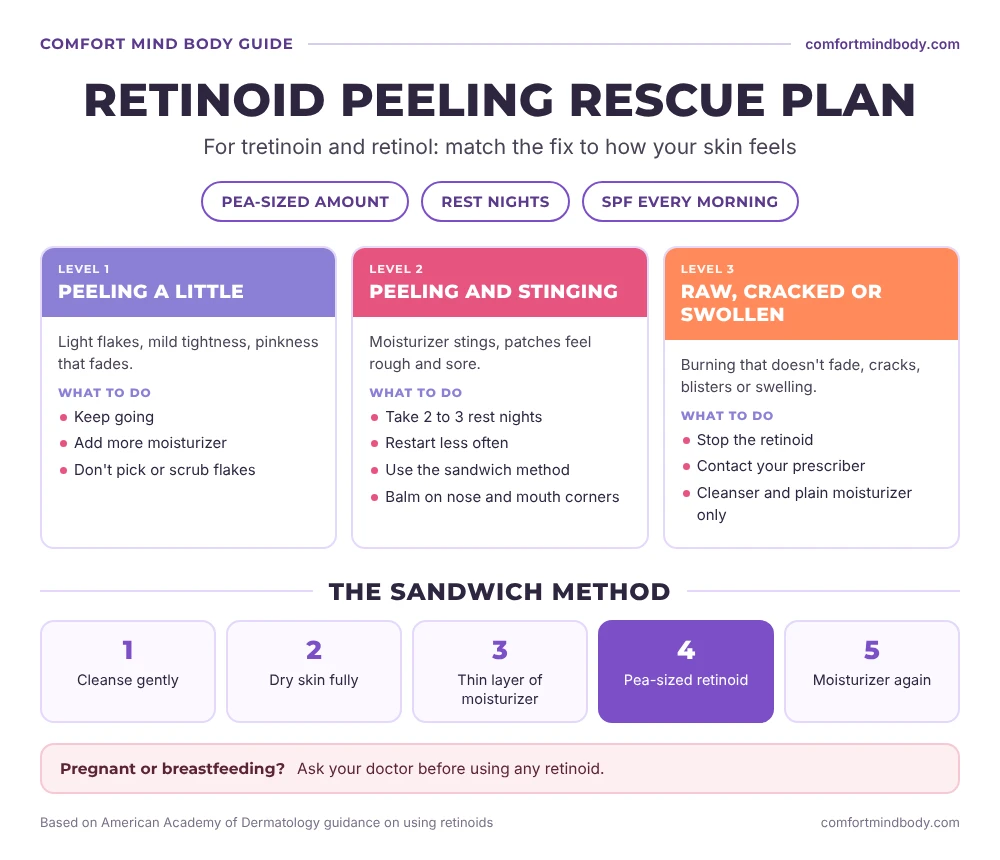
Read the infographic text
Retinoid Peeling Rescue Plan: for tretinoin and retinol, match the fix to how your skin feels. Use a pea-sized amount, take rest nights, and wear SPF every morning.
Level 1, peeling a little: light flakes, mild tightness, pinkness that fades. Keep going, add more moisturizer, and don’t pick or scrub flakes. Level 2, peeling and stinging: moisturizer stings and patches feel rough and sore. Take 2 to 3 rest nights, restart less often, use the sandwich method, and put balm on the corners of your nose and mouth. Level 3, raw, cracked or swollen: burning that doesn’t fade, cracks, blisters or swelling. Stop the retinoid, contact your prescriber, and use only cleanser and plain moisturizer.
The sandwich method: 1. Cleanse gently. 2. Dry skin fully. 3. Thin layer of moisturizer. 4. Pea-sized retinoid. 5. Moisturizer again.
Pregnant or breastfeeding? Ask your doctor before using any retinoid.
Retinol Peeling Mistakes That Make It Worse
- Using more product to get faster results
Better move: A pea-sized amount for the whole face. - Starting every night
Better move: Start 2 to 3 nights a week and build up. - Scrubbing or picking the flakes
Better move: Moisturize and let them fall off. - Adding acids, peel pads or a second strong active on the same night
Better move: One strong active per night. - Skipping sunscreen in winter
Better move: SPF 30 or higher every morning, all year. - Stopping and starting every few days
Better move: Steady, slower use usually works better than on-and-off use.
Frequently Asked Questions
Is peeling from tretinoin normal?
Yes. Mild flaking, dryness and some redness are common while skin adjusts, especially in the first weeks. Painful, raw, swollen or blistered skin is not normal; stop and contact your prescriber.
How long does tretinoin peeling last?
It varies from person to person. It is often strongest in the first few weeks and usually eases as your skin gets used to the retinoid. It can return when you raise the strength, or when the weather turns cold and dry.
Should I stop tretinoin if my skin is peeling?
Not usually. For mild peeling, use it less often and add moisturizer. Take a few rest nights if skin stings. Stop and call your prescriber for raw, cracked, swollen or blistered skin.
Does peeling mean retinol is working?
Not exactly. Peeling shows your skin is adjusting, not how well the product works. Many people get results with little or no peeling.
Can I moisturize before tretinoin?
Yes. Moisturizer first, or the sandwich method, is a common way to reduce irritation. Follow your prescriber’s advice if it differs.
Should I exfoliate the flakes off?
No. Scrubs and acids make irritation worse. Moisturize and let the flakes shed on their own.
Why is my skin peeling around my mouth and nose?
The skin there is thinner, and product collects in the creases. Put a little petroleum jelly or balm on those spots before your retinoid.
Is purging the same as peeling?
No. Purging means a temporary rise in breakouts as clogged pores clear. Peeling is dryness and flaking. You can have both at once.
Can I use retinol in winter?
Yes. Many people need fewer nights a week and a richer moisturizer in winter, but most don’t need to stop.
Can I use tretinoin or retinol while pregnant or breastfeeding?
Retinoids are generally avoided in pregnancy. Ask your doctor before using any retinoid if you are pregnant, trying to conceive or breastfeeding.
Final Thoughts: Go Slower, Not Stronger
Peeling from tretinoin or retinol is common, temporary and manageable. Use a pea-sized amount, give your skin rest nights, sandwich it with moisturizer, protect the corners of your nose and mouth, and wear sunscreen every morning. If your skin is raw, cracked or swollen, stop and talk to your prescriber.
A retinoid is a long game. The routine you can keep calmly for a year will do more for your skin than the one that leaves you peeling for a month.
Wishing you smooth, calm skin on the other side of the flakes,
Anna

Safety Notes
Safety Notes
- This guide is educational and not a substitute for medical advice. Tretinoin is a prescription medicine; follow your prescriber’s instructions.
- Stop and get medical advice for severe burning, swelling, blistering, hives, or raw, cracked or weeping skin.
- Retinoids are generally avoided during pregnancy. Ask your doctor if you are pregnant, trying to conceive or breastfeeding.
- Retinoids increase sun sensitivity. Use broad-spectrum SPF 30 or higher every morning.
- Don’t use retinoids on sunburned, broken or eczema-flared skin, and pause them before waxing or in-office procedures as your provider advises.
Helpful Resources
- American Academy of Dermatology: Acne Diagnosis and Treatment (Tips for Using a Retinoid)
- American Academy of Dermatology: Skin Care for Your 20s (When To Apply a Retinoid)
- American Academy of Dermatology: Tips on Introducing Retinoids
- American Academy of Dermatology: Dermatologists’ Top Tips for Relieving Dry Skin
- Cleveland Clinic: Retinol
- MedlinePlus: Tretinoin Topical