
Personal reflection · Supporting sources checked November 12, 2026
Welcome to Comfort Mind Body. If you’re reading this between shifts, over dinner, or in the last quiet minutes before bed, I’m glad we have a moment together.
Say you set aside 15 minutes to write after dinner. Then you get home late, someone you love needs a call, and by the time you’re free, you need sleep. What would make it easier to come back to your notebook tomorrow?
I work in hospitality. Between shifts, I write and build Comfort Mind Body. When I plan my week, I make room for what I care about and keep the promises I make to myself. Meet Anna and Sushi.
We’ll use that writing routine as an example throughout the guide. Think of something you want more time for and what usually takes its place.
Quick Navigation
ToggleWhat’s the Simplest Way to Start a Self-Care Routine?
Start with one need that keeps getting squeezed out, like a meal you can count on or time to yourself. Choose one action you can repeat and decide when you’ll do it. Give yourself a shorter version for days when time is tight. On Day 21, look back at how it’s going and decide whether to adjust it.
Free printable PDFs
Download the 30-day check-off poster
Put it on your fridge or wall. Check a box each day you do either version of your routine.
Download the 30-day self-care worksheet
Use it to choose your routine, plan for interruptions, and decide what to keep at your Day 21 check-in.
What Does a Realistic Daily Self-Care Routine Look Like?
Here are three places a routine could fit into a workday. Pick the one that would help you most and use its shorter version when you need it.
- Before work. Sit down for breakfast. On a rushed morning, take something you can eat when you get a break.
- During a break. Call a friend if you both have time. If you only have a minute, send a voice note and suggest a time to talk.
- After dinner. Write for 15 minutes. If you get home late, save an idea in a single sentence and leave the longer session for your day off.
Week 1 (Days 1–7). Choose What Keeps Getting Squeezed Out
Think back over the last few days. What did you keep putting off, and what took its place? If you got home hungry and couldn’t face another decision, choose dinner before you leave for work. If you’ve barely had a chance to talk to anyone all week, set aside time for a call. Start with the need you can name most clearly.
- Food, movement, and rest. Choose something that fits the part of the day you’re struggling with. Take a short walk when you have a break, or move a chore out of the time you have before bed. More on everyday food, movement, and sleep habits.
- Emotional care and relationships. Decide whether you need company, time alone, or help with a specific task. If you’d like to talk, ask for a time. “I’ve had a heavy week. Are you free for ten minutes on Thursday?” Relationship ideas in our lifestyle guide.
- Work and everyday money tasks. If something keeps following you into your evenings, give it one action and a time. Write down the question you’ll ask at work tomorrow, or set a time to check one bill. Choose a small first step for work or money.
- Home, getting dressed, and skin care. Make one part of getting ready or coming home easier. Clear space to sit down for dinner, lay out something comfortable, or put the skin care you already use where you’ll reach for it. Start with one area at home or find the order for your skin care steps.
- Creativity, learning, and meaning. Make room for something you want in your week because you enjoy it or it matters to you. Read a little, play music, pray, work on a craft, or write about something you noticed. Ideas for making time for a hobby.
If you want to explore a different part of your life, find more ideas in the Comfort Mind Body self-care hub.
A randomized study of everyday nutrition habits found similar results for people who used a daily routine and those who used a clock time as their cue. Read the study on routine and time cues.
Set a Goal You Can Try This Week
Start with what you want more of, then name one action that would make room for it. If you want more time to write, look at the week you actually have. Which two evenings are usually free enough to open your notebook? Put those evenings on your calendar, or write them on the worksheet.
A first goal might be “On two evenings this week, I’ll write for 15 minutes after I clear my dinner plate. If I’m short on time, I’ll write one sentence.” You can choose different days next week if your shifts change.
When you look back, check two things. Did you make time for writing? Did that time give you what you were looking for? If the writing helped but the timing was hard, try a different slot. If you mostly wanted quiet, you might choose a different way to spend those minutes.
Tie the action to something you already do or to a time you’re usually free. In the writing example, clearing your dinner plate is the signal to open your notebook. If your midday break always starts at noon, a clock time might fit better.
Week 2 (Days 8–14). Notice What Gets in the Way
Make It Easier to Follow Through
At the start of the week, decide when you’ll next try your routine. Set up what you need before the first one. If you’re writing after dinner, leave your notebook and a pen where you’ll see them when you clear your plate.
Try the plan on an ordinary day and a demanding one. If a plan falls through, jot down what happened in a few words, like “remembered at bedtime” or “dinner ran late.” Then change one thing. If you forgot, move the reminder.
If you remembered and 15 minutes felt too long, try one sentence. If dinner keeps running into chores, try a different time and see how it goes. How to get started when a task feels hard.
If a responsibility is taking up the time you set aside, see whether someone can share it. “Could you handle dinner cleanup on Wednesday? I’d like a little time to write.” If the timing is out of your hands, look for the next opening you can count on.
Week 3 (Days 15–21). Make a Plan for the Day That Goes Sideways
Now imagine your shift runs late on the evening you meant to write. When you get home, you still need dinner and sleep. Jot down an idea if you have one you want to save, or give yourself the night off. Decide when you’ll open the notebook again. “After lunch on my next day off, I’ll open my notebook and start with the idea I saved.”
On Day 15, you write for 15 minutes. Check the poster and mark R on the worksheet. On Day 16, one sentence counts too. Check the poster and mark S. On Day 17, you skip writing and go to bed. Leave the poster box blank and mark P for paused on the worksheet.
When You Feel Like You Let Yourself Down
It can sting to realize you didn’t do something you promised yourself. Maybe you wanted those 15 minutes to write because they were the only time that felt like yours. Give yourself a moment to feel that disappointment. Then describe what happened as plainly as you can. Try “I got home late and went to bed” when you catch yourself thinking “I never keep my promises.” One describes an evening. The other makes it harder to see what you could change.
Choose the next step based on what happened. If you forgot, leave the notebook by your dinner plate. If you were too tired, try writing one sentence after lunch on your day off. Let that sentence be the whole plan. If you needed sleep, give yourself credit for taking care of that need, too.
When the same promise keeps falling through, make a new one that fits the week you have. If one sentence is what fits on a workday, you can make that your regular version. If what you really wanted was a few quiet minutes to yourself, you can give yourself those minutes without opening the notebook.
Day 21. What Feels Easier Now?
Look back at your worksheet. When did the routine fit easily? When did you shorten it or pause? In the writing example, if one sentence fit on workdays and you had more time on a day off, keep the short note for workdays and save the longer session for a day off.
Day 21 gives you a chance to decide what to try for the rest of the month. How quickly an action feels automatic varies.
In a 2024 review, only four studies reported how long habit formation took, and the results varied widely across people and behaviors. Read the review on how long habits take to form.
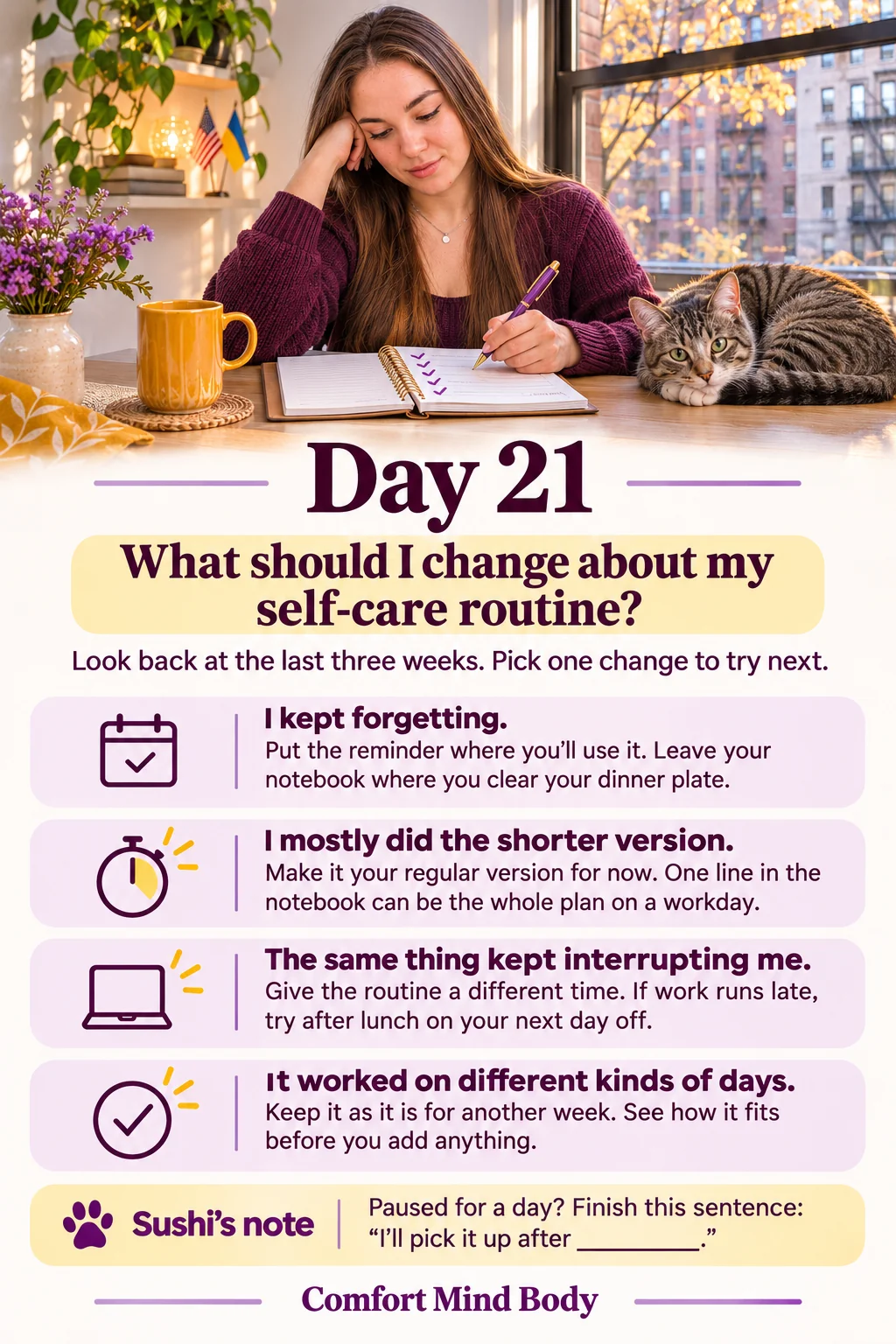
Read the infographic text
Day 21
What should I change about my self-care routine?
Look back at the last three weeks. Pick one change to try next.
I kept forgetting.
Put the reminder where you’ll use it. Leave your notebook where you clear your dinner plate.
I mostly did the shorter version.
Make it your regular version for now. One line in the notebook can be the whole plan on a workday.
The same thing kept interrupting me.
Give the routine a different time. If work runs late, try after lunch on your next day off.
It worked on different kinds of days.
Keep it as it is for another week. See how it fits before you add anything.
Sushi’s note
Paused for a day? Finish this sentence: “I’ll pick it up after ______.”
Comfort Mind Body
Week 4 (Days 22–30). Decide What You Want to Keep
Think of one day the plan fell through and what helped you return to it. Maybe a shorter version was enough, a different time worked better, or someone helped with a chore. Use what you learned to fill out the last section of your worksheet.
- On a typical day, I’ll do this.
- On a demanding day, I’ll use this shorter version.
- If both plans fall through, I’ll come back at this time or after this event.
If your schedule changes week to week, take a minute when you get your shifts to choose the next time you’ll try the routine. Keep the shorter version handy for the days that fill up.
Pick a date next month to see how your plan is holding up.
At the end of the month, ask what the routine made room for. Give that time a place in the week ahead. My reflection on patience, learning, and keeping promises.
My December Birthday Reset
My birthday is in December, and I’m doing a 30-day reset. I want to see how it feels to keep one small promise to myself. After I change out of my work clothes, I’ll sit somewhere comfortable for ten minutes before I open my laptop or start on chores. On a long day, two minutes will count. On a day off, I’ll try it after lunch.
I want to see where that break fits on a busy day and what helps me come back to it after I miss it.
Until next time, I hope you get a little time for the thing you keep saving for a quieter week.
Anna


