
Last updated: November 2026. Rewritten with new research and merged with our older weight loss tips.
Affiliate disclosure: This post has no affiliate links.
How this guide was made: I compared guidance from the CDC, the National Institutes of Health and Mayo Clinic with recent research on sleep and weight. Family examples are examples only.
Please note: This guide is for general education, not medical advice. Talk to your doctor before starting a weight loss plan, especially if you have a health condition or take medication.
The healthy way to lose weight is slow and steady: about 1 to 2 pounds a week, from eating a little less, moving a little more and sleeping enough. The CDC notes that people who lose weight at that pace are more likely to keep it off.
Welcome to Comfort Mind Body, where we do the research so you can skip the hype. This guide shows you how to start on an ordinary week, what to eat, how to move, and what to do when the scale stops moving.
Quick Navigation
ToggleQuick Answer: The Healthy Way to Lose Weight
- Aim for 1–2 pounds a week. Faster loss is harder to keep off.
- Start with a 5% goal. Even that much can improve blood pressure, cholesterol and blood sugar.
- Eat a little less, not a lot less. Build meals around vegetables, protein and fiber.
- Move most days. Work up to 150 minutes a week, plus 2 strength days.
- Sleep enough. Short sleep makes it easier to overeat.
- Change 2 or 3 things at a time. Add more once those feel normal.
Slow, small and steady beats fast and strict.
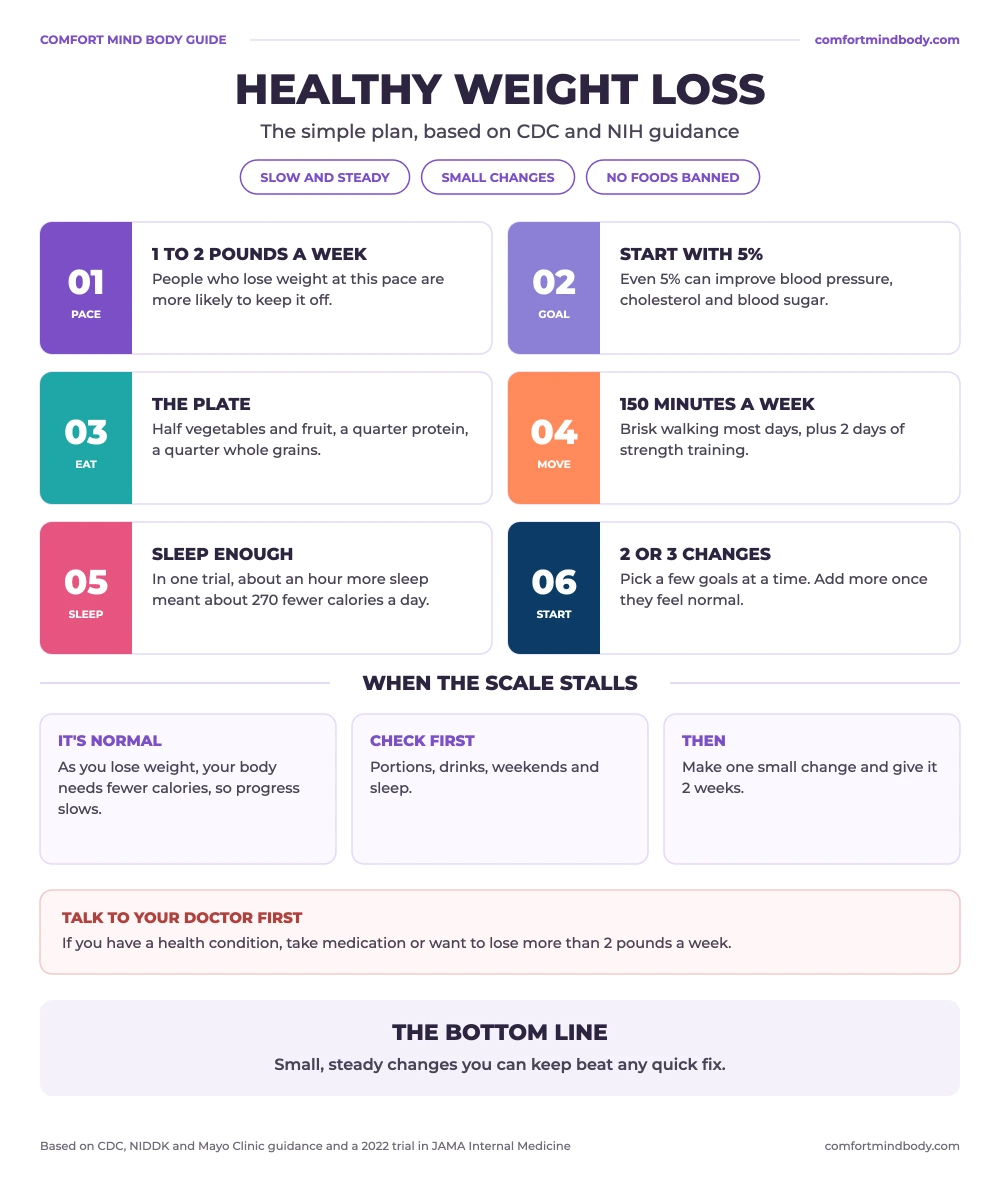
Read the infographic text
Healthy weight loss: the simple plan, based on CDC and NIH guidance. Slow and steady, small changes, no foods banned.
01 Pace: 1 to 2 pounds a week; people who lose at this pace are more likely to keep it off. 02 Goal: start with 5%, which can improve blood pressure, cholesterol and blood sugar. 03 Eat: half the plate vegetables and fruit, a quarter protein, a quarter whole grains.
04 Move: 150 minutes a week of brisk walking, plus 2 days of strength training. 05 Sleep: in one trial, about an hour more sleep meant about 270 fewer calories a day. 06 Start: 2 or 3 changes at a time; add more once they feel normal.
When the scale stalls: it’s normal, because your body needs fewer calories as you lose weight. Check portions, drinks, weekends and sleep, then make one small change and give it 2 weeks.
Talk to your doctor first if you have a health condition, take medication or want to lose more than 2 pounds a week. The bottom line: small, steady changes you can keep beat any quick fix.
How Much Weight Can You Lose in a Week, Safely?
About 1 to 2 pounds a week. That’s the pace the CDC recommends, and Mayo Clinic puts the range at 0.5 to 2 pounds. Faster loss can be safe only under a doctor’s care.
The first week often shows a bigger drop. Much of that is water, so don’t judge your plan by week one. For more, see Is It Healthy to Lose 2 Pounds a Week?
What Is a Good First Weight Loss Goal?
Start with 5% of your weight. The CDC says that much can improve blood pressure, cholesterol and blood sugar. The National Institute of Diabetes and Digestive and Kidney Diseases suggests a first goal of 5% to 10% within 6 months.
Example: If you weigh 180 pounds, 5% is 9 pounds and 10% is 18 pounds. A first goal of 9 to 18 pounds over 6 months works out to well under a pound a week. That’s slow enough to keep, and big enough to matter for your health.
How to Start Losing Weight This Week
The CDC suggests picking 2 or 3 goals at a time, not 10. Here’s a first week built that way:
| Goal | What it looks like |
|---|---|
| Walk | 15 minutes, 3 days this week |
| Swap one drink | Water or sparkling water instead of one sugary drink a day |
| Add one vegetable | One extra serving at dinner |
| Write down why | Your reasons, somewhere you’ll see them every day |
Once these feel normal, add the next thing: a longer walk, a strength day, or a protein-rich breakfast.
Anna’s Note: Every big plan I’ve seen falls apart on an ordinary Tuesday. So I like goals that are almost too small, like one walk or one swap. Small goals get done, and done is what adds up.
What to Eat for Healthy Weight Loss
You need to eat a little less than your body uses, without feeling starved. The easiest way is to fill your plate with foods that keep you full:
- Half the plate: vegetables and fruit.
- A quarter: protein, like chicken, fish, eggs, beans, tofu or Greek yogurt. Cleveland Clinic notes that protein helps you keep muscle while you lose fat.
- A quarter: whole grains or starchy foods, like brown rice, potatoes or whole-grain bread.
- A little: healthy fats, like olive oil, nuts or avocado.
Not sure how much to eat? How Many Calories Should I Eat to Lose Weight? walks you through it.
Keep the Foods You Love
No food has to be off-limits. Plan your favorites in, in a portion that fits, instead of banning them and then overeating them later.
Anna’s Note: Crêpes are my favorite thing to cook, sweet with dulce de leche or savory with ground beef and cream cheese. I’d never give them up. A plan with no room for crêpes is a plan I wouldn’t keep.
How to Move More (Without Punishing Yourself)
The CDC recommends that adults get at least 150 minutes of moderate activity a week, like brisk walking, plus 2 days of strength training. You don’t have to start there. Build up to it.
Walking is the easiest place to start. Strength training helps you keep muscle while you lose weight. Here’s what a full week can look like, based on the CDC’s own example:
| Day | Activity |
|---|---|
| Monday | 30-minute brisk walk |
| Tuesday | 30-minute brisk walk |
| Wednesday | Strength training |
| Thursday | 30-minute brisk walk |
| Friday | 30-minute brisk walk |
| Saturday | Strength training |
| Sunday | 30-minute brisk walk |
That’s 150 minutes of walking and 2 strength days. Bodyweight moves like squats and push-ups against a wall count as strength training. Does the weather matter? See Do You Burn More Calories in the Cold or the Heat?
Sleep and Stress Matter Too
Short sleep makes it easier to overeat. In a 2022 trial in JAMA Internal Medicine, 80 adults who usually slept under 6.5 hours were coached to sleep longer. They slept about an hour more and ate about 270 fewer calories a day, without being told to diet.
Stress works the same way: it pushes you toward comfort food. A short wind-down routine helps with both. More in The Impact of Sleep on Weight Loss.
Anna’s Note: My kind of wind-down is a cozy blanket, a candle and a warm mug of something without sugar. It’s the easiest way I know to stop snacking and start sleeping.
Sushi’s Note: I sleep most of the day and I’ve never once raided the fridge at midnight. Mom says that’s because I can’t open it. I say it’s discipline.
Why Am I Not Losing Weight?
It’s normal for weight loss to slow down. As you lose weight, your body needs fewer calories, so the same habits bring smaller results. Kevin Hall, the NIH researcher who built the Body Weight Planner, explains that the old “3,500 calories = 1 pound” rule overestimates how much weight people really lose over time.
If the scale hasn’t moved for 2 to 3 weeks, check these first:
- Portions have crept up. Measure for a few days.
- Drinks add up. Juice, sweet coffee drinks and alcohol count.
- Weekends undo the week. Plan one treat instead of a free-for-all.
- Sleep is short. See the section above.
- Medication or a health condition. Some can affect weight. Ask your doctor.
Then make one small change, like 10 more minutes of walking or a smaller dinner portion, and give it 2 weeks. More causes in 8 Reasons You Aren’t Losing Weight.
Example: You lost 6 pounds in your first month and 2 in your second. That isn’t failure. Your body needs a little less food now than when you started, so the same plan gives smaller results. Add a little more walking or trim one portion, then wait 2 weeks before judging.
How to Stay Motivated
Motivation fades. Habits last. These help:
- Write down your reasons and keep them where you’ll see them, as the CDC suggests.
- Track something besides the scale, like walks taken or nights with good sleep.
- Reward yourself without food: new walking shoes, a book or a slow Sunday.
- Get support. A friend to walk with or a family member who cooks with you makes it easier.
- Restart fast after a slip. One big meal is one meal, not a ruined week.
More ideas in Weight Loss Motivation Techniques. If weight loss has been tied up with shame for you, start with Self-Love Weight Loss.
Anna’s Note: My mom and little brother are visiting for the holidays, so our table will be full for weeks. I’m not going to count anything on those plates. I’d rather plan a walk together after dinner.
Weight Loss Myths That Waste Your Time
| Myth | What’s true |
|---|---|
| Carbs make you gain weight | Total calories matter more. Whole grains, fruit and potatoes fit a healthy plan |
| Skipping meals speeds things up | It often leads to overeating later |
| Eat as little as possible | Very low intake makes it hard to keep muscle and stick with it |
| Sweating means burning fat | Sweat is mostly water, and it comes back when you drink |
| You need a special product | No pill or tea replaces eating, moving and sleeping well |
Thinking about a supplement? Read our guide to weight loss supplements first, and talk to your doctor before taking anything.
Your Free 30-Day Healthy Weight Loss Reset
Free download: the 30-Day Healthy Weight Loss Reset
A printable plan with one small habit a day.
Download the PDFFrequently Asked Questions
What is the healthiest way to lose weight?
Slowly, about 1 to 2 pounds a week, by eating a little less, moving more and sleeping enough. Changes you can keep matter more than any single diet.
How much weight can you lose in a week?
About 1 to 2 pounds is the pace health experts recommend. The first week may show more, mostly from water.
Can I lose weight without exercise?
Yes, by eating less, but it’s harder. Exercise helps you keep muscle and keep the weight off.
Why did my weight loss stop?
Your body needs fewer calories as you get lighter, so progress slows. Check portions, drinks, weekends and sleep, then make one small change.
Should I talk to a doctor before losing weight?
Yes, if you have a health condition, take medication, are pregnant, or want to lose weight faster than 2 pounds a week.
Final Thoughts: Slow, Steady and Kind
Healthy weight loss isn’t a sprint. Pick 2 or 3 small changes, keep them for a few weeks, then add the next one. Eat well, move most days, sleep enough, and be patient when the scale slows down.
Small, steady and kind to yourself: that’s the whole plan. I’m rooting for you.
Anna

Safety Notes
Safety Notes
- Talk to your doctor before starting a weight loss plan if you have a health condition, take medication, or are pregnant or breastfeeding.
- Don’t aim to lose more than 2 pounds a week unless a doctor is supervising you.
- Very low-calorie diets, skipping meals and “detox” products can be unsafe. Avoid them unless your doctor recommends a plan.
- Check with your doctor before taking any weight loss supplement or pill, since some interact with medications.
- If you notice an unhealthy focus on food, weight or exercise, reach out to a doctor or the National Alliance for Eating Disorders.
Helpful Resources
- CDC: Steps for Losing Weight
- CDC: Adult Activity: An Overview
- CDC: Adding Physical Activity as an Adult
- NIDDK: Choosing a Safe & Successful Weight-Loss Program
- NIDDK: The NIH Body Weight Planner, with Kevin Hall
- Tasali et al., JAMA Internal Medicine, 2022: Sleep Extension and Energy Intake
- Cleveland Clinic: How to Lose Weight the Right Way
- Mayo Clinic: Look for a Safe Weight-Loss Program