
How this guide was made: Researched from public guidance from the NHS, the Centre for Clinical Interventions, UCSF and NIMH. The everyday examples and reflection prompts are editorial illustrations; Anna's personal note is identified separately.
Sources checked: November 6, 2026.
You had pictured the afternoon a certain way. There would be time together, a change of scenery, perhaps a conversation you had been looking forward to all week. Then the message arrives: the plans have changed. Now you have an empty afternoon and a disappointment that feels bigger than the canceled arrangement.
Welcome to Comfort Mind Body, where we check the research and make room for the days that don’t go to plan, so you can find a next step that respects what matters to you.
Learning how to let go often begins in a moment like this. You may be releasing an expectation, adjusting to a different role, or accepting that someone cannot give you the answer you hoped for. Something mattered, and the situation turned out differently. There is room to acknowledge that before deciding what comes next.
Quick Navigation
ToggleQuick Answer: How Do You Let Go?
Start by naming what happened and what you had hoped for. Separate what you can still do from what you cannot change, then choose one manageable action.
If an expectation no longer fits the situation, consider a more flexible way to meet the need underneath it. You can take that next step while disappointment is still present; feeling completely ready is not a requirement.
What Letting Go Can Mean
Letting go can mean ending the effort to make an unchangeable part of a situation turn out differently. The conversation happened. A plan fell through. A stage of life ended. Acknowledging those facts gives you a starting point for deciding how to respond now.
Acceptance and action can coexist. You can accept that a deadline was missed and ask for a revised plan. You can recognize that a relationship has changed and decide what contact works for you. You can remember a happy period without expecting your present life to reproduce it.
UCSF’s introduction to practicing acceptance describes recognizing reality even when you dislike it, while leaving room for change.
For this guide, letting go does not require forgetting, forgiving someone, abandoning a responsibility, or pretending a hurt was acceptable. Your standards, memories, and care for other people can remain.
The question is which effort still serves them, and which effort keeps asking for something that is no longer possible.
Why Letting Go Can Feel So Hard
Sometimes the attachment is to what an experience represented. A canceled visit might mean missing connection. A job change might mean losing familiar work, confidence, or a sense of belonging. Even a welcome transition can leave you missing parts of the life you knew.
Uncertainty can add another difficulty: if you stop planning, reviewing or hoping for a particular outcome, what happens next? The Centre for Clinical Interventions’ guide to accepting uncertainty explores how a demand for guarantees can keep worry going. It offers ways to notice that demand and practice living with some uncertainty. That is a skill to try gradually, rather than a reason to criticize yourself for wanting reassurance.
There may also be expectations you have carried for years: being the person who always copes, keeping everyone happy, or reaching a milestone by a certain age. Caring for people and meeting commitments take real effort. Adding the rule that you must do everything without disappointment or help makes the task harder still.
If it is hard to name what is happening, our guide to mindfulness and self-awareness can help you separate the event, your interpretation, and your feelings. That distinction can make the next question clearer: what actually needs your attention?
Start With What You Can Still Change
Choose one situation rather than trying to sort out your whole life at once. Describe what happened in a sentence, then consider the different parts of it. An outcome may be beyond your control, while a request, a boundary, or a decision remains available.
The NHS approach to problem solving separates concerns you can act on from worries that more thinking cannot resolve. The table below adds a middle category for situations where your actions may help but cannot guarantee the result.
What Is Yours to Change?
On a smaller screen, swipe or scroll across the table.
| Part of the situation | What it can include | A possible next step |
|---|---|---|
| Actions you can take | What you say, whether you ask for help, how you use the available time and which commitments you make. | Make one specific request, adjust a plan or decide on a boundary you can follow through on. |
| Outcomes you can influence | Whether a conversation goes well, a shared plan changes or someone responds to a reasonable request. | Explain what you need and listen to the response. Decide what you will do if the answer is different from your preference. |
| Things you cannot change | An event that has already happened, time that has passed or another person's independent decision. | Acknowledge the fact, allow your feelings about it and consider what care or action is possible now. |
A situation can belong in more than one row. You cannot undo a cancellation, but you can discuss what happened and choose whether to reschedule. You cannot guarantee that someone understands you, but you can explain yourself clearly and decide how much further effort makes sense.
If there is an action to take, make it specific enough to use: who you will contact, what you will ask, and when. If you need advice before deciding, getting that advice can be the next step. Letting go of a guaranteed result still leaves room for preparation and persistence.
Loosen the Expectation, Keep What Matters
Some expectations protect important needs. It is reasonable to want respect, dependable arrangements, and a fair share of responsibilities.
Other expectations leave very little room for human limits or changed circumstances: everyone must understand you immediately, the day must follow the plan, or you must handle everything alone.
Try the following questions with one ordinary disappointment. You can think them through briefly or write a few lines. They are prompts to consider, not questions with a perfect answer.
1. What had I hoped would happen?
Be specific. Perhaps you wanted an uninterrupted evening, a warm response or a plan that made you feel included. Naming the hope gives the disappointment some context. “I wanted time together” is easier to work with than a sweeping conclusion that nothing ever goes your way.
2. What need or value was underneath that hope?
Consider whether the plan represented connection, rest, recognition, fairness or something else. The need can still matter when the original arrangement falls through. It may also explain why a seemingly small change feels significant to you.
3. What is a realistic way to care for that need now?
You might suggest another time, ask for clearer communication, take the rest you had planned, or speak with someone who can help. An alternative may be less satisfying than your first choice. You can acknowledge that and still choose it.
If a reasonable agreement has repeatedly been ignored, the issue may need a firmer conversation or boundary. Flexibility should include your needs too. “I can accept a change of plan” does not have to become “I must always make myself available.”
A Worked Example: The Plans Changed, but Your Needs Still Matter
Imagine a friend cancels an afternoon you had set aside together. You arranged your errands around it and were looking forward to a proper catch-up. When the message comes, you feel let down. You are tempted to reply, “Forget it,” even though you would still like to see them.
First, name the part that hurts: “I wanted time with someone I care about, and I had made room for it.” There is no need to talk yourself into being delighted about the change. You can wait until you are ready to send a response you mean.
Next, separate the facts from the decisions still available. The afternoon will not happen as planned. Your friend’s reason may be understandable, and you can ask for context if you need it. You can also be honest about the effect on you: “I’m disappointed because I was looking forward to seeing you. Would another day work?”
Now consider the need underneath the plan. If it was connection, you could suggest a short call or contact another friend. If it was a break from a busy week, you could keep the afternoon free and do something you enjoy. Neither option has to replace the visit perfectly to be worth choosing.
If cancellations have become a pattern, add that information to your decision. A boundary might sound like: “I’d still like to meet. For now, let’s choose something that doesn’t require me to rearrange the whole day.” Your friend can respond as they choose; you can decide which future arrangements you are willing to make.
By the evening, you might still wish the original plan had happened. That feeling can sit alongside a clear response, a different use of your time and a better understanding of what you need. Moving forward does not require a cheerful verdict on the cancellation.
Move Forward Without Erasing the Past
Sometimes what you are releasing is larger than an afternoon: a familiar job, an earlier role in your family or a version of the future you had expected. Give yourself room to name what was valuable. You may miss the people, the routine, the independence, or the feeling of being needed.
Consider what you want to carry with you. A friendship might continue differently. A skill from an old job might have a place in something new.
A photograph or small tradition might hold a good memory without requiring you to recreate that period of your life. You get to keep what mattered, even when the circumstances have changed.
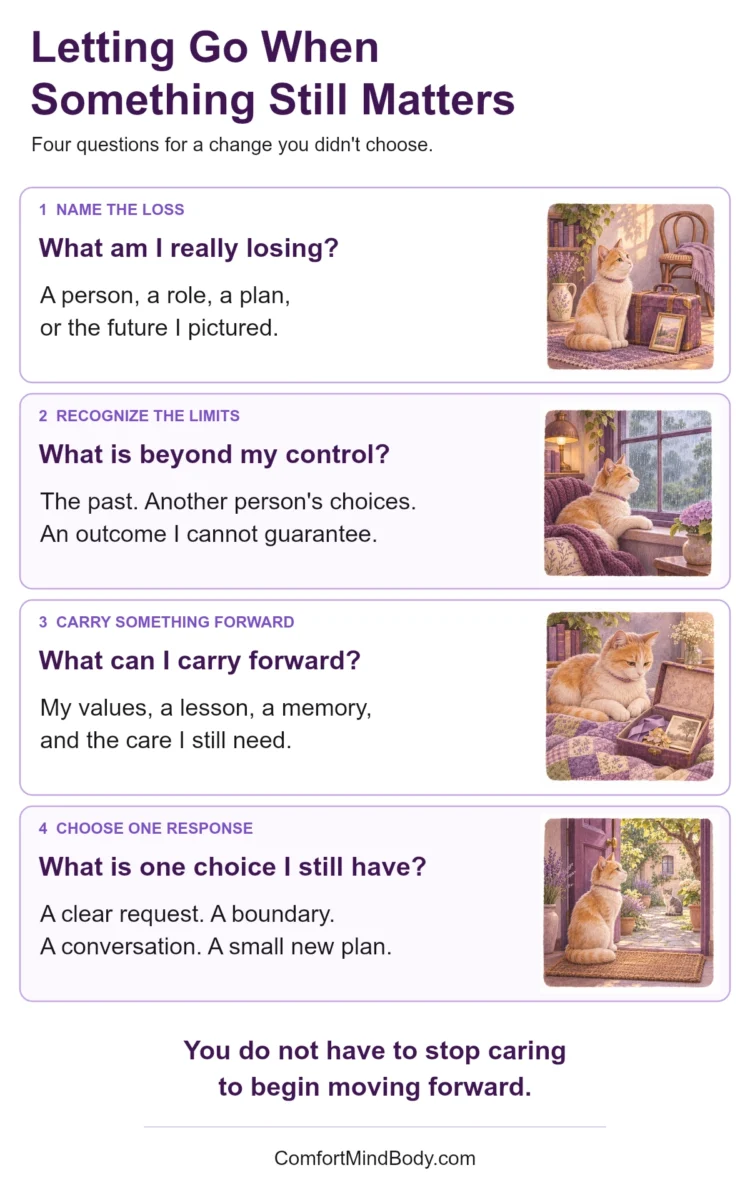
Read the infographic text
Letting Go When Something Still Matters
Four questions for a change you didn't choose.
1. Name the loss
What am I really losing?
A person, a role, a plan, or the future I pictured.
2. Recognize the limits
What is beyond my control?
The past. Another person's choices. An outcome I cannot guarantee.
3. Carry something forward
What can I carry forward?
My values, a lesson, a memory, and the care I still need.
4. Choose one response
What is one choice I still have?
A clear request. A boundary. A conversation. A small new plan.
You do not have to stop caring to begin moving forward.
ComfortMindBody.com
Then choose something modest in the life you have today: arrange a conversation, spend a little time on an interest, or make one part of the day more comfortable.
The NHS guidance on change and uncertainty suggests focusing on manageable near-term tasks, supportive routines, and people you trust.
If you keep replaying the same judgment about yourself, our guide to letting go of negative thoughts offers a more focused way to respond to that loop.
For a brief way to notice the moment you are in, try one of these beginner mindfulness practices. Choose what fits; this does not need to become another daily assignment.
Anna's Note: Music gives me extra motivation on a walk, and Sushi always makes me happy. There is room for a small pleasure while a bigger question is still unsettled.
When You Need More Support
Ask for support when distress is worsening, affecting your sleep or making work, relationships, or everyday tasks difficult. A primary care provider or qualified mental health professional can help you understand what is happening and consider suitable care.
NIMH’s My Mental Health: Do I Need Help? resource emphasizes the effect symptoms have on daily life. You can reach out whenever you are concerned; you do not have to wait for a set number of days.
Major loss, traumatic experiences, and ongoing mistreatment deserve care suited to the situation. If someone is harming or threatening you, prioritize safety and appropriate help. Financial, housing, or workplace problems may also need practical advice alongside emotional support; a reflection exercise cannot settle those issues for you.
You can start the conversation plainly: “Since this change, I’m struggling to sleep and keep up with things. I’d like some help.” A friend or family member may be able to help you make the first appointment or find a relevant service.
If you are having thoughts of suicide or urges to hurt yourself in the US, call or text 988 or visit the 988 Suicide & Crisis Lifeline for immediate support. Call 911 in a life-threatening emergency. Outside the US, contact your local crisis or emergency service.
Frequently Asked Questions
Why am I struggling to let go?
You may be losing something meaningful, facing uncertainty or adjusting an expectation you have carried for a long time. Difficulty does not tell you, by itself, what is causing it. Start with one situation and consider what mattered about it. If the distress is persistent, worsening or disruptive, seek support suited to your circumstances.
Can I let go without forgetting?
Yes. You can keep memories, lessons and affection while changing what you expect from the present. There is no need to remove every reminder or prove that an experience no longer matters. Consider which ways of remembering feel meaningful and which habits keep asking the past to happen again.
Does letting go mean giving up on someone?
It can mean accepting that you cannot make another person's choices for them. You may still care, offer appropriate help or maintain a relationship with boundaries. Whether to stay involved, change the contact or step away depends on the situation, including your safety and responsibilities. This guide cannot make that decision for you.
How do I loosen expectations without lowering my standards?
Identify the standard you want to protect, such as respect, fairness or reliable communication. Then consider where there is room to negotiate the timing or method. You can accept an occasional change while addressing a repeated broken agreement. Flexibility does not require making every adjustment yourself.
How long does letting go take?
There is no deadline you need to meet. An everyday disappointment, an ongoing difficulty and a major loss call for different kinds of attention. You may make a decision before your feelings settle. Notice whether your current approach leaves room for daily life and support, rather than checking whether you are completely over it.
Final Thoughts
The afternoon you pictured may still be the one you would have chosen. Letting go can begin with recognizing that, then deciding how you want to use the time that remains. Perhaps there is a conversation to have, another arrangement to suggest, or a quiet hour you can keep for yourself.
The same question can help with a larger change: what matters to you, and what can you do for it now? You do not need to find a lesson in every disappointment or turn every ending into an opportunity. A clear request, a little support, or a gentler plan for today can be enough to begin.
Our self-care guide has more ideas for making room for your own needs in daily life. I hope you leave this page with permission to care about what happened and still take part in what comes next.
May your next step leave a little room for you, too.
Take care of yourself,
Anna
About This Guide
This guide provides general educational information for adults and has not undergone clinical review. The table, optional quiz, prompts and hypothetical example are editorial aids, not validated assessments or individualized treatment. The quiz suggests a section from the choices you select; it does not measure your mental health. Anna's music and Sushi note describes personal preferences, not treatment recommendations.
Use an exercise only while it feels manageable. If reflection increases distress, pause and seek suitable support. The UK and Australian sources below provide educational information; their local service arrangements may differ from those where you live.
Helpful Resources
- NHS: How to Deal With Change and Uncertainty — everyday adjustments, supportive routines and practical advice.
- NHS: Problem Solving — identifying actionable concerns and making a specific plan.
- Centre for Clinical Interventions: Accepting Uncertainty (PDF) — a module about demands for certainty and responses to worry.
- UCSF: Practicing Acceptance — an introduction to acknowledging reality and considering available responses.
- NIMH: My Mental Health: Do I Need Help? — recognizing when additional support may be needed.