How this guide was made: This guide draws on public guidance from the NHS, McLean Hospital, the Centre for Clinical Interventions and NIMH, with further sources linked where relevant. Anna's Note describes her own break choices, separately from the sourced guidance.
Sources checked: November 4, 2026.
A small work mistake can follow you long after the task is over. You have corrected the error, but your mind is still replaying it. Before long, “I missed something” has become “I always mess things up.” The first statement points to something specific. The second turns a difficult moment into a sweeping judgment about you.
Welcome to Comfort Mind Body, where we check the research and keep everyday life in view, so you can find a kinder, clearer way through the thoughts that keep circling. Learning how to let go of negative thoughts starts with telling apart a problem that needs attention and a thought you have already considered.
Quick Navigation
ToggleQuick Answer: How Do You Let Go of Negative Thoughts?
Notice the thought and give yourself a little distance from its wording. Then choose a useful response: check an assumption briefly, act on a real problem, or return your attention to what you are doing when more thinking adds nothing.
Letting go means making room for that next activity even if the thought is still present. A quiet mind is not a requirement for continuing your day.
Anna's Note: When thoughts loop, music gives me extra motivation on a walk, and my cat Sushi always makes me happy. A drive is another option when it's possible. When nothing else works for me, sometimes I take a nap.
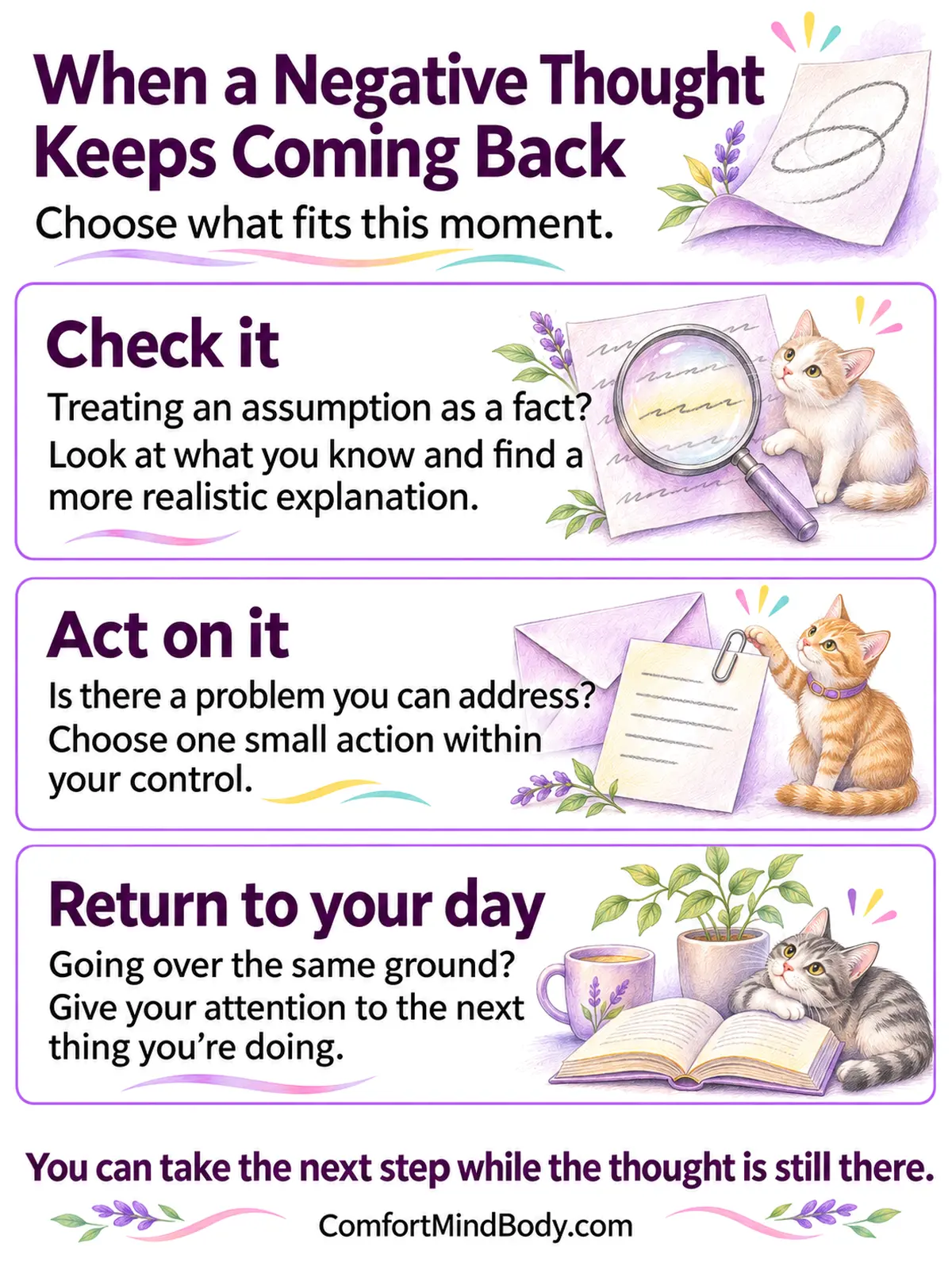
Read the infographic text
When a Negative Thought Keeps Coming Back
Choose what fits this moment.
Check it
Treating an assumption as a fact?
Look at what you know and find a more realistic explanation.
Act on it
Is there a problem you can address?
Choose one small action within your control.
Return to your day
Going over the same ground?
Give your attention to the next thing you’re doing.
You can take the next step while the thought is still there.
ComfortMindBody.com
What Letting Go Actually Means
Letting go is a change in how you respond to a thought. You can acknowledge “That is on my mind” without giving it the rest of your afternoon. You can also feel disappointed about a mistake while taking responsibility for it.
Trying to force a thought away can sometimes make the struggle with it more absorbing. The Centre for Clinical Interventions’ Mindfulness and Letting Go information sheet describes noticing negative thinking and redirecting attention to the present, rather than trying to eliminate thoughts. A thought can show up again while you are getting on with something else. Its presence does not mean you have failed.
A real difficulty still deserves care. An overdue bill needs a plan. Hurtful behavior may call for a boundary or outside support. Letting go of repeated mental rehearsal does not require accepting harm, abandoning a responsibility, or deciding that everything is fine.
Recognize the Kind of Thought You're Having
Listen for the difference between an observation and the conclusion attached to it. “I made an error” describes an event. “I am incapable” is a much broader judgment. “Tomorrow might be difficult” expresses a possibility. “Tomorrow will be a disaster” treats a prediction as settled.
The NHS guide to reframing unhelpful thoughts describes patterns such as expecting the worst, seeing only two extremes, and overlooking parts of a situation. Recognizing a pattern can help you question an interpretation without dismissing the concern underneath it. Our guide to separating an event from an interpretation explores how feelings and assumptions can shape a response.
Also notice where the thinking is taking you. Reflection might lead to a lesson or decision. Rumination involves repeatedly returning to negative material without finding a way forward, as Cleveland Clinic’s explanation of rumination describes. A simple question can help here: “Am I learning anything new, or going over the same ground?”
How to Let Go of Negative Thoughts: 5 Practical Steps
Notice the thought
Start with its actual wording. Perhaps it is “I should have handled that better” or “This will go wrong.” Name it briefly as a judgment, a prediction, or a replay. If writing helps, one sentence is enough to capture what you want to work with.
Create some distance from its wording
Describe what your mind is saying: “I’m predicting a bad outcome” or “I’m judging myself for that mistake.” This makes space to respond before accepting the wording as a complete account. McLean Hospital’s guide to negative thinking explains the value of noticing and labeling thoughts rather than automatically treating them as literal truth.
Choose a suitable response
Match the response to the situation. An assumption might benefit from a brief review of the facts. An unfinished responsibility might need action.
A familiar replay with no new information might be your cue to rejoin the activity in front of you. The three choices below give you somewhere concrete to begin.
Rejoin what you're doing
Choose something specific enough to do now: read the next paragraph, prepare lunch, fold the clean clothes, or listen to the person speaking. Let the task have your attention for the next small part of it. You can begin while some discomfort remains.
Respond gently when it returns
If the thought comes back, recognize it without criticizing yourself for having it again. You might say, “I’m back at that moment,” and then continue with what you chose to do. You don’t need the perfect words. Just notice the thought and carry on with the next part of your day.
Check It, Act on It, or Return to Your Day
Start with the choice that fits what is happening. You can explore the other options as you need them, or use more than one for the same situation.
Check it — when you are treating an assumption as a fact
Identify what you know directly and what you are adding. Ask whether there is relevant information you have left out, then put the situation into more accurate words. A realistic sentence can acknowledge an error without making a claim about your whole character.
Example: “My draft needs changes” does not establish “I have no useful ideas.” A more measured statement is “This draft needs work. I can ask which part needs clarifying.”
For a fuller written exercise, the NHS thought record organizes a situation, feelings, evidence and an alternative perspective. Our guide to CBT thought records and thinking tools adds context for using these resources.
Finish with a workable view, even if uncertainty remains. Reopening the same evidence to feel completely sure is a reason to step back from this route and seek suitable support if the pattern is difficult to stop.
Act on it — when there is a practical problem to address
Name one action within your control and when you can take it. The NHS guidance on tackling worries distinguishes problems you can address from hypothetical worries and recommends a specific plan for actionable concerns.
Example: “I might miss the deadline” could lead to checking the remaining work and asking about an extension today. If the right person is unavailable, note when you will contact them instead of rehearsing the conversation all evening.
A manageable action can include asking for help, setting a boundary or getting advice. If the issue is urgent or unsafe, prioritize appropriate help now.
Return to your day — when more reviewing adds nothing useful
Ask whether you have learned anything new or identified another necessary action. If you are repeating the same review, choose something to do and give its first small part your attention.
Example: You have already dealt with a minor scheduling mix-up, but keep replaying how it sounded. Put the calendar away and begin preparing dinner. Notice the task in front of you without checking whether the thought has finally gone.
For a simple introduction to bringing attention back, see our guide to mindfulness for beginners.
A Worked Example: One Mistake Is Not Your Whole Story
Imagine you send a work email and forget the attachment. A colleague asks for it. You feel embarrassed, and the thought arrives: “I always make careless mistakes. They must think I can’t do my job.”
First, deal with what happened. Attach the file and send a straightforward correction: “Sorry, I missed the attachment. Here it is.” If the mistake caused a delay, acknowledge that and address whatever else is needed.
Then look at the extra judgment. You did forget the file. You do not know everything your colleague thinks about you, and this one event cannot describe all of your work. A realistic response might be: “I missed an attachment and corrected it. I can use a final attachment check before sending similar emails.”
That statement leaves room for responsibility. It also gives the lesson a practical home: a sending habit you can use next time. If forgotten attachments are a repeated problem, improve that process or ask for support with it.
Now open the next task and begin its first part. Embarrassment may still be there. If you replay the email again, notice that you are reviewing the same event and return to the task. The correction, lesson, and feeling can coexist; you don’t need a final verdict on yourself to continue working.
What If the Same Thought Keeps Coming Back?
A returning thought is not automatically a new problem to solve. It might be the same uncertainty or self-criticism asking for another round of attention. Before reopening it, ask whether anything relevant has changed.
For an everyday concern, a short note can hold the part you need to remember: “Ask about the invoice tomorrow morning.” Then put it aside. If worries spread through the day, the NHS describes an optional short, planned worry period for considering concerns and possible actions. It is not a reason to delay an urgent problem or a task you must repeat until you feel certain.
A change of activity gives your attention somewhere else to settle. Cleveland Clinic’s rumination guidance includes movement and engaging activities among its suggestions. You could take a walk, tidy a shelf, or talk with someone about something else. Choose what fits the moment; you can begin before you feel calm.
Talking something through can clarify a problem. Needing the same answer again and again, or repeatedly reviewing your intentions to neutralize a disturbing thought, deserves a different kind of help.
These patterns are discussed by the International OCD Foundation. They do not establish a diagnosis, and this guide is not an OCD treatment plan.
When Negative Thoughts Need More Support
Reach out to a primary care provider or qualified mental health professional when negative thoughts cause significant distress, keep worsening, disrupt sleep, or make work, relationships, or daily responsibilities difficult. You can ask for help before things become severe.
NIMH’s Caring for Your Mental Health resource explains how a primary care provider can help you find suitable support.
Repeated unwanted thoughts, images or urges, strong pressure to check or seek reassurance, and distress linked to traumatic experiences call for care suited to the particular difficulty. A professional can help assess what is happening and whether a different approach is needed.
You can describe the problem in ordinary language: “I keep replaying mistakes, I lose sleep over them, and I find it hard to return to other things.” No perfect explanation or self-diagnosis is needed to start that conversation.
If you are having thoughts of suicide or are in emotional crisis in the US, call 988, text 988, or visit the 988 Suicide & Crisis Lifeline. If you or someone else is in immediate danger, call 911. Outside the US, contact your local crisis or emergency service.
Frequently Asked Questions
Can I stop negative thoughts permanently?
There is no reliable way to guarantee that an unwanted thought will never return. A more workable aim is to choose how you respond and keep taking part in your life. Frequent, distressing thoughts deserve support rather than a more demanding effort to eliminate them.
Should I replace every negative thought with a positive one?
No. A balanced or neutral perspective is often more believable than a cheerful replacement. Sometimes a thought calls for action. Other times, you can let it be present while you focus elsewhere. You do not need to analyze every thought that passes through your mind.
What if the negative thought is true?
Respond to the specific fact. If you missed a commitment, acknowledge it and discuss a repair. If someone is treating you badly, seek support and consider what would protect you. A real problem deserves attention without becoming a sweeping statement about your worth.
What can I do when thoughts keep repeating at night?
If a practical concern can wait safely, note it briefly with a time to address it, then settle back into a quiet bedtime activity. An optional worry period earlier in the evening can give everyday concerns a separate place. Avoid repeatedly reviewing the note to feel certain. If recurring thoughts regularly disturb your sleep, discuss them with a healthcare professional.
When should I get help with negative thoughts?
Ask for support when the thoughts are distressing, worsening or interfering with your life, including repeated checking or reassurance seeking that is hard to stop. A primary care provider or qualified mental health professional can help you work out what to do next. You can reach out whenever you are concerned; the support section above includes crisis contacts for urgent help.
Final Thoughts
A difficult thought can point toward something worth caring for: a mistake to repair, a decision to make, or a need for support. It can also keep repeating long after you have taken care of the problem. Recognizing that difference helps you decide where to put your energy.
I hope you leave this guide with a little more room to be human. You can take responsibility for what happened and still enjoy your lunch, join a conversation, or settle into the rest of the evening. One difficult moment doesn’t need the whole day.
If the bigger issue is a change you’re still adjusting to, my guide on how to let go when life doesn’t go as planned walks through what you can still change and what you want to carry forward.
Make room for something beyond the thought.
Take care of yourself,
Anna
About This Guide
This guide provides general educational information for adults and has not undergone clinical review. Its response choices are an editorial aid, not a validated clinical tool or an individualized treatment plan. They do not replace professional care. Anna's break choices, including naps, are personal preferences rather than treatment recommendations.
Use reflection or writing prompts during a safe pause; if you are driving, wait until safely stopped or parked. Keep your attention on traffic, machinery and responsibilities that require immediate awareness. Stop an exercise that increases distress, and seek appropriate professional guidance if the reaction is strong or recurring. Real danger, abuse and urgent responsibilities need practical help.
Helpful Resources
- McLean Hospital: Negative Thinking — a clinician's explanation of noticing thoughts and choosing how to respond.
- NHS: Reframing Unhelpful Thoughts — evidence checking and flexible, realistic alternatives.
- NHS: Thought Record — a structured written exercise for examining a particular situation.
- NHS: Tackling Your Worries — practical problems, hypothetical worries and optional worry time.
- Centre for Clinical Interventions: Mindfulness and Letting Go (PDF) — an information sheet on disengaging from negative thinking.
- Cleveland Clinic: Rumination — repetitive thinking, everyday activities and professional support.
- International OCD Foundation: How to Let Go of OCD Thoughts — condition-specific context for intrusive thoughts, checking and reassurance; not a general self-help protocol.
- NIMH: Caring for Your Mental Health — everyday care and routes to professional help.