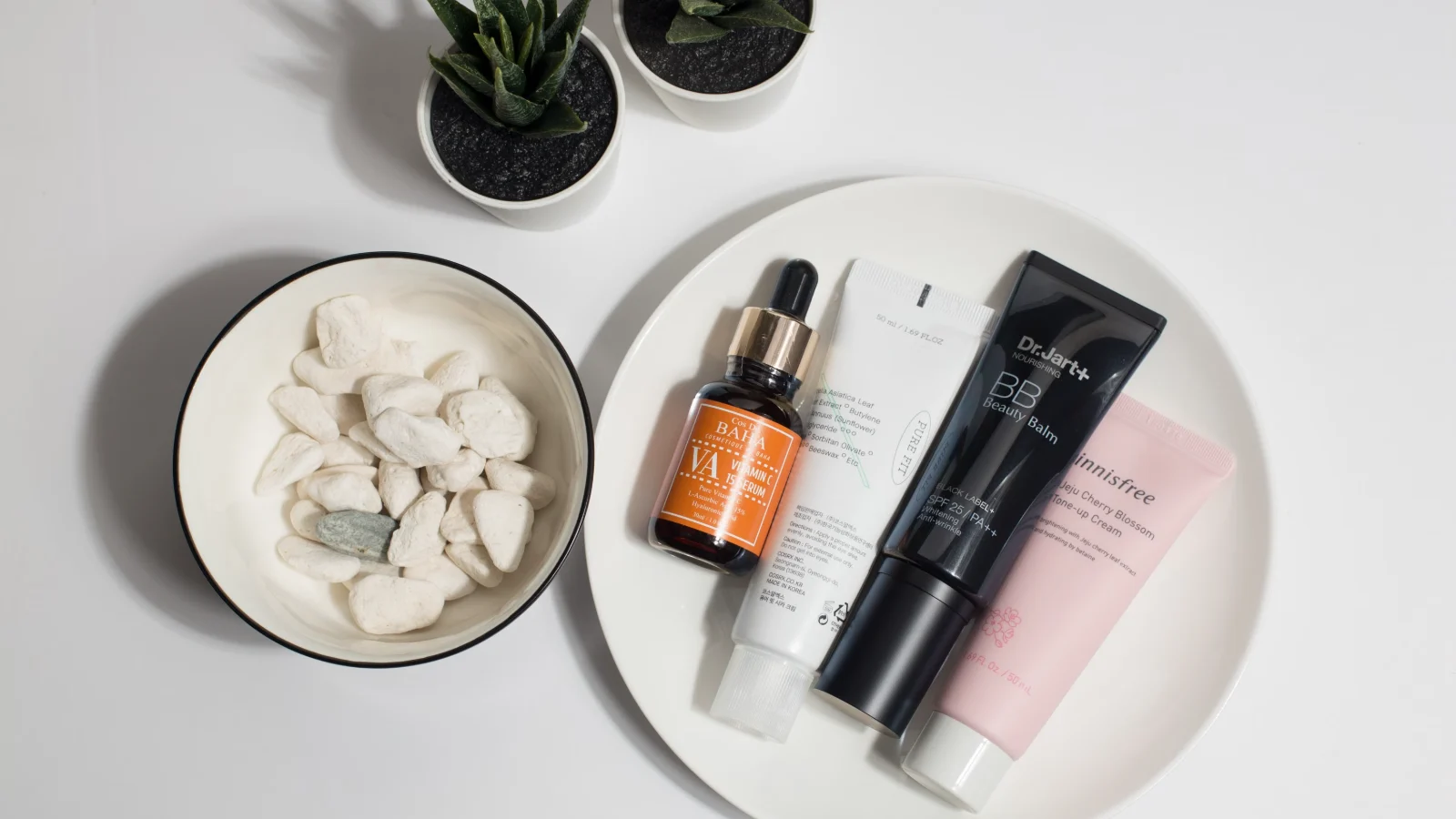
Last updated: November 2026. Rewritten with my own Korean and Japanese picks and 2026 sunscreen news.
Affiliate disclosure: This post has no affiliate links.
How this guide was made: I compared what I've used from both styles with dermatology and FDA sources and the top-ranking comparison guides. Drafted with AI help, then edited by Anna.
Please note: This guide is for education, not medical advice.
Korean and Japanese skincare get lumped together, but they feel different the moment you use them. One loves layers and new textures. The other keeps things short and steady.
Welcome to Comfort Mind Body, where we do the research and try what we can on our own skin. Most of my shelf is Korean, and I’ve also used Japanese staples like Bioré, Curél and an SK-II toner. Here’s how the two styles really compare, and how to pick for your skin.
Quick Navigation
ToggleQuick Answer: Korean Vs Japanese Skincare
K-beauty is known for layering hydration and trying new ingredients. J-beauty is known for fewer steps, gentle cleansing and textures you’ll use every day. Neither is better, and both make products for every skin type. If you enjoy a ritual, Korean-style layering is fun. If you want three or four steps, Japanese-style basics fit. Pick each product by what your skin needs, and mix freely.
K-Beauty Vs J-Beauty At A Glance
| Feature | K-beauty (Korean) | J-beauty (Japanese) |
|---|---|---|
| Mindset | Layer, experiment, glow | Keep it simple, protect, repeat |
| Popular routine length | Often 5 to 10 | Often 3 to 5 |
| Signature step | Essences, toner pads, sheet masks | Cleansing oil and a watery "lotion" |
| Textures | Gels, jellies, bouncy creams | Milks, light lotions, silky creams |
| Exfoliation | Toner pads, acids, spicule serums | Gentle peeling gels and enzyme powders |
| Sunscreen | Light, dewy, lots of new launches | Watery gels and long-wear milks with PA++++ |
| Ingredient buzz | Snail mucin, centella, PDRN, exosomes | Rice, hyaluronic acid, ceramides, vitamin C |
| Often chosen for | Oily or dehydrated skin, trend lovers | Dry or sensitive skin, minimal routines |
These are popular approaches, not rules. A Korean routine can be three steps, and a Japanese one can have several layers. The formula matters more than the country on the label.
What I Noticed Using Both Korean And Japanese Skincare
My shelf leans Korean, and I’ve also used Japanese staples. Here’s what’s actually in my routine, or was at some point:
| Product | Style | How it fits my routine |
|---|---|---|
| Medicube PDRN Mild Cleansing Oil | Korean | My first cleanse at night |
| Medicube Red Succinic Acid Peeling Pad and Zero Pore Pad | Korean | One exfoliating pad on some nights between tretinoin, never with benzoyl peroxide the same night |
| VT Reedle Shot 100 | Korean | A spicule serum I use some nights between tretinoin |
| Abib Airy Sunstick | Korean | My daily sunscreen |
| COSRX cleanser and Snail Mucin essence | Korean | Used both |
| Bioré UV Aqua Rich (US version) | Japanese | Used it in the past and liked it a lot |
| Curél Intensive Moisture Cream | Japanese | Used it in the past |
| SK-II Facial Treatment Clear Lotion | Japanese | Used it in the past, but it's pricey, so I moved on |
My biggest takeaway: I don’t choose skincare by whether the label says Korean or Japanese. I choose it by how my skin is behaving that week. The popular differences help when you’re exploring, but the individual formula matters more than the category.
What Is K-Beauty?
Korean skincare treats your routine like a daily ritual. You layer thin products, from toner to essence to serum to cream, so the skin stays hydrated and calm. New ingredients launch fast, so there’s always something to try. Read more in Why Do Koreans Have Good Skin? and my Korean skincare routine.
What Is J-Beauty?
Japanese skincare is quieter. Fewer steps, gentle cleansing, a watery lotion, a moisturizer and a sunscreen you’ll actually wear. Formulas often stay the same for years because they work. My picks are in Best Japanese Skincare Products.
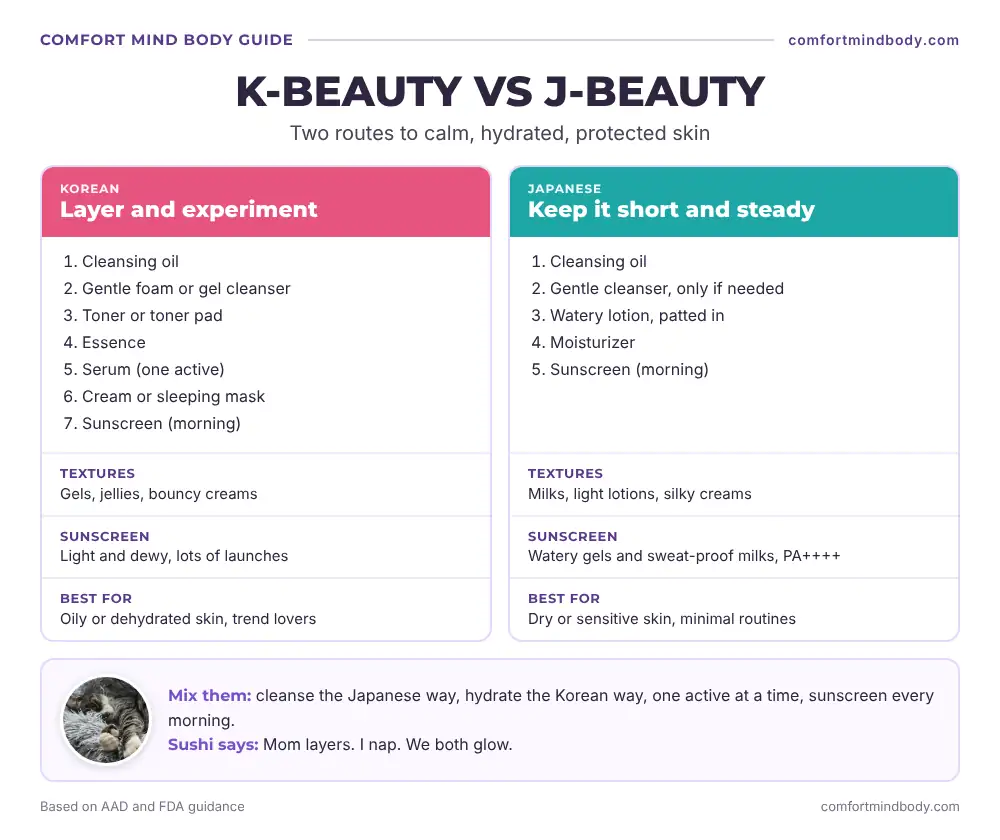
Read the infographic text
Korean (layer and experiment): 1. Cleansing oil. 2. Gentle foam or gel cleanser. 3. Toner or toner pad. 4. Essence. 5. Serum (one active). 6. Cream or sleeping mask. 7. Sunscreen (morning). Textures: gels, jellies, bouncy creams. Sunscreen: light and dewy, lots of launches. Best for: oily or dehydrated skin, trend lovers.
Japanese (keep it short and steady): 1. Cleansing oil. 2. Gentle cleanser, only if needed. 3. Watery lotion, patted in. 4. Moisturizer. 5. Sunscreen (morning). Textures: milks, light lotions, silky creams. Sunscreen: watery gels and sweat-proof milks, PA++++. Best for: dry or sensitive skin, minimal routines.
Mix them: cleanse the Japanese way, hydrate the Korean way, one active at a time, sunscreen every morning.
Sushi says: Mom layers. I nap. We both glow.
Which Fits Your Skin Type?
Country of origin doesn’t decide whether a product suits you. The formula does. Use this as a starting point:
| Your skin | What to look for | Korean or Japanese? |
|---|---|---|
| Oily | Lightweight gels, fluid moisturizers, non-comedogenic formulas | Either. Korean gels are an easy place to start. |
| Dry | Richer creams, humectants, barrier ingredients like ceramides | Either. Japanese milks and creams are an easy place to start. |
| Sensitive | Gentle cleansers, fragrance-free formulas, fewer actives | Either. A short routine matters more than the country. |
| Dehydrated | A hydrating toner, lotion or serum under a moisturizer | Either. Korean toners and Japanese lotions both do this. |
| Acne-prone | Non-comedogenic products plus a proven acne treatment | Either, kept simple |
| Mature | A comfortable moisturizer plus one targeted serum | Either. Many people mix both. |
| Busy | Three steps you'll actually do | Either. The short Japanese-style routine is a good model. |
Anna's Note: My skin is oily, so Korean gels and pads suit me day to day. When tretinoin makes my skin dry, I lean on calmer, Japanese-style basics: fewer layers and a comforting cream.
Korean Vs Japanese Sunscreen
Both countries make some of the most pleasant sunscreens in the world. Korean sunscreens lean dewy and light. Japanese ones include watery gels and sweat-proof milks, labeled with a PA rating for UVA (PA++++ is the highest).
Some US versions use different filters than the originals. That’s changing: in June 2026 the FDA added bemotrizinol, a filter long used in Asia and Europe, to the US list. Which filters a sunscreen can use depends on where it’s sold, not on whether the brand is Korean or Japanese. My daily sunscreen is the Abib Airy Sunstick, a Korean stick. For more, see my Sunscreen Match Guide.
A Korean Night Vs A Japanese Night
| Step | Korean-style night | Japanese-style night |
|---|---|---|
| 1 | Cleansing oil | Cleansing oil |
| 2 | Gentle foam or gel cleanser | Gentle cleanser, only if needed |
| 3 | Toner or toner pad | Watery lotion, patted in |
| 4 | Essence | (skip) |
| 5 | Serum (one active) | Serum, optional |
| 6 | Eye cream | (skip) |
| 7 | Cream, sometimes a sleeping mask | Moisturizer |
Same result, different pace: both clean gently and keep the skin hydrated. For the full order of steps, see my step-by-step skincare routine.
How To Mix K-Beauty And J-Beauty
You don’t have to pick a team. A mix often works best.
- Cleanse the Japanese way: a cleansing oil at night, then a gentle second cleanse if needed.
- Hydrate the Korean way: one thin toner or essence layer.
- Treat with one active at a time, whatever its passport.
- Moisturize to match your skin: a light gel if oily, a richer cream if dry.
- Finish every morning with a sunscreen you like enough to reapply.
What To Avoid When Mixing
- Stacking acid toner pads, peeling gels and spicule serums in the same week.
- Adding several new products at once, so you can’t tell what irritated you.
- Using acids or spicules on the same night as a prescription retinoid unless your doctor says it’s okay.
- Skipping moisturizer because the toner felt hydrating.
If your skin starts flaking, my tretinoin and retinol peeling guide shows how I calm it down.
Sushi's Note: Mom layers. I nap. We both glow.
So, Is Korean Or Japanese Skincare Better?
Neither wins on paper. Korean skincare gives you more choice and fun textures. Japanese skincare gives you fewer, steady steps. The better one is the routine you’ll actually do every day, with a sunscreen you don’t skip.
Comparing Korean skincare with American products too? See Is Korean skincare better than American skincare? in my Korean guide.
Frequently Asked Questions
What's the main difference between K-beauty and J-beauty?
K-beauty layers many hydrating steps and loves new ingredients. J-beauty keeps fewer steps and focuses on gentle cleansing, hydration and sunscreen.
Is Japanese skincare better than Korean skincare?
Neither is better overall. Pick by skin type and how many steps you'll keep up.
Which is better for oily skin?
Either can work. Look for lightweight gels and non-comedogenic formulas. Korean brands have lots of gel textures, which makes them an easy place to start.
Which is better for dry or sensitive skin?
Either can work. Look for gentle, fragrance-free formulas and a comforting moisturizer. Short Japanese-style routines are an easy model to follow.
Can I mix Korean and Japanese products?
Yes. Mix by step, add one new product at a time, and don't stack exfoliants.
Are Korean or Japanese sunscreens better?
Both make light, pleasant sunscreens. Japanese labels show UVA with PA+ to PA++++, and Korean ones often do too. Check that the version you buy is the one you want.
Is K-beauty or J-beauty cheaper?
Both have budget and luxury lines. Drugstore J-beauty and K-beauty basics are often affordable.
Safety Notes
Safety Notes
- This article is for education, not medical advice.
- Patch test new products, especially if your skin is sensitive or acne-prone.
- Don't stack acids, peeling gels and spicule serums.
- Using a prescription retinoid? Ask your dermatologist before adding exfoliants or spicules.
- Use enough sunscreen and reapply outdoors.
- See a dermatologist for burning, swelling, rashes or acne that doesn't improve.
Final Thoughts
K-beauty and J-beauty are two ways to the same goal: calm, hydrated, protected skin. Borrow what suits you, skip what doesn’t, and give any change a few weeks.
A little Seoul, a little Tokyo,
Anna