
Welcome to Comfort Mind Body. If you’ve got half an hour before you have to be somewhere else, pull up the work you’d like to give that time to. So, how to focus on one task?
I write and build this blog around my work in hospitality. “Work on the blog” can mean a dozen things. Revising an opening and checking a source both belong on that list, but they ask for different kinds of attention.
It’s hard to motivate yourself sometimes, but it’s always worth trying.
Let’s use an editing example to see how you can pick one piece, handle an interruption, and find your place again later.
Quick Navigation
ToggleHow To Focus on One Task for 30 Minutes?
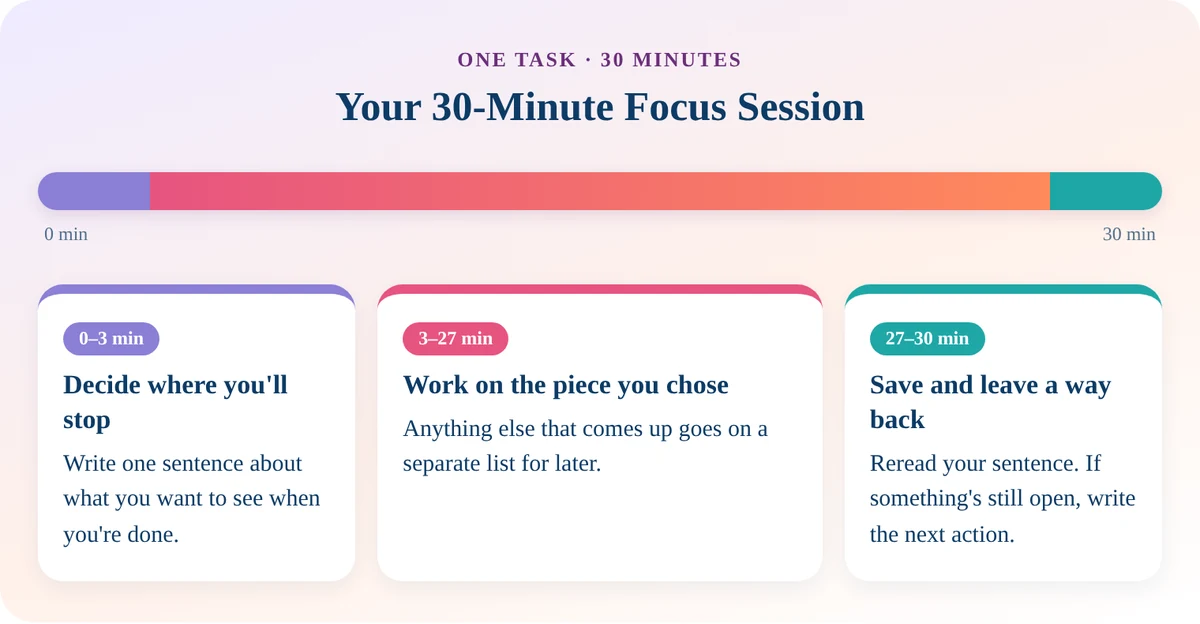
Take three minutes to choose a small, visible result. Spend up to 24 minutes working toward it. Use the last three minutes to save your work and write down the next action if anything is left. Start with this split and adjust it to the time you have.
Read the infographic text
Your 30-Minute Focus Session
- 0–3 min. Decide where you’ll stop. Write one sentence about what you want to see when you’re done.
- 3–27 min. Work on the piece you chose. Anything else that comes up goes on a separate list for later.
- 27–30 min. Save and leave a way back. Reread your sentence. If something’s still open, write the next action.
First 3 Minutes. Decide Where You’ll Stop
Open the draft and write one sentence about what you want to see when you’re done. “Revise the opening and flag any claim it contains that needs a source” gives you a stopping point. You can leave the title and photo for another session.
If you keep staring at the draft without knowing which part to touch, try a smaller decision. Pick the first paragraph or write down the question you need answered before you can edit it. The guide to getting started when a task feels hard walks through a few ways to do that.
Next 24 Minutes. Work on the Piece You Chose
Keep the draft and anything you need for this edit within reach. If you notice the photo needs replacing, write “new photo” on a separate list and go back to the opening. If you reach your stopping point early, you can save the work and use the rest of the time however you need.
If Something Interrupts You
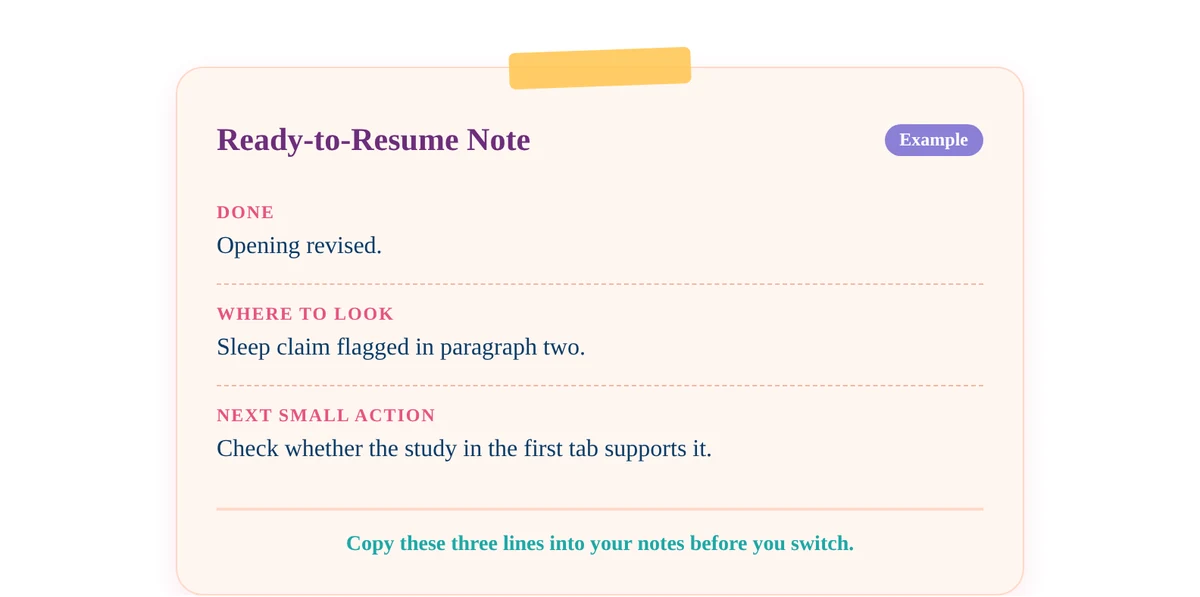
Say a call comes in just after you revise the opening. If it can wait, put it on your list and finish flagging the claims. If you need to take it and have a moment, leave a note before you switch. Record what’s done, where to look, and the next small action.
Before you begin, silence notifications and close tabs you don’t need. Keep a scrap of paper nearby for thoughts or tasks that can wait until later.
Read the infographic text
Ready-to-Resume Note Example
- Done
- Opening revised.
- Where to look
- Sleep claim flagged in paragraph two.
- Next small action
- Check whether the study in the first tab supports it.
Copy these three lines into your notes before you switch.
Save the study title or a link in your note if you’ll need to find it after closing the tab.
If you need to leave immediately, you can write the note when you return. Look at the last thing you changed and name one action you can take from there.
In a paper reporting four studies, Sophie Leroy and Theresa Glomb looked at interruptions when people expected to resume their original work under time pressure.
Briefly planning the return helped participants shift attention to the task that interrupted them. A quick note is one way to make that plan. Read the interruption study.
Last 3 Minutes. Save Your Work and Leave a Way Back
Save the draft and read the sentence you wrote before you started. If the opening is revised and the claims are flagged, you’ve reached the stopping point you chose. If something is still open, update the note so you can tell where to begin without rereading the whole article.
What if You Only Have Five Minutes When You Come Back?
Open the draft in the note. In five minutes, you might read the study abstract and see whether the researchers looked at sleep. If they didn’t, cross that source off your list. If they did and you need more time, leave yourself a specific next step, such as “Read the results and check how they measured sleep.”
If setting aside even one block is the hard part, you can look at where it fits in your week with the broader guide to managing your time.
I hope the next time you open your work, you can see right away where you meant to begin.
Anna
Helpful Resources
- When you have to switch tasks. Sophie Leroy and Theresa Glomb studied how briefly planning your return can help you shift attention to the task that interrupted you. Read the interruption study .
- If you’d like to try a timed session with a break. The University of Arizona walks through 25 minutes of work on one task, followed by a five-minute break. It also suggests jotting down other tasks as they come to mind. Read the University of Arizona’s focus guide .


