
Last updated: November 2026. Rewritten and merged with our older quick weight loss post, based on research and science.
Affiliate disclosure: This post may contain affiliate links. If you buy through them, we may earn a small commission at no extra cost to you.
How this guide was made: We compared the top guides on losing 20 pounds and checked the numbers against the CDC, NIH and Cleveland Clinic.
Please note: This guide is for general information, not medical advice. Talk to your doctor before starting a weight loss plan, especially if you have a health condition, take medication, or are pregnant or breastfeeding.
Twenty pounds is one of the most common weight loss goals, and one of the most rushed. Welcome to Comfort Mind Body, where we do the research so you can set a goal you can actually reach. Below you’ll find how long 20 pounds usually takes, who can go faster, a simple 12-week plan and the signs you’re cutting too hard.
Quick Navigation
ToggleQuick Answer: How Long Does It Take to Lose 20 Pounds?
For most people, losing 20 pounds takes about 10 to 20 weeks or longer, roughly 3 to 5 months. The CDC calls 1 to 2 pounds a week a healthy pace that’s more likely to last, so 20 pounds takes at least 10 weeks at the fastest pace and about 20 weeks at 1 pound a week. Your starting weight, calorie needs and health all change what’s realistic, and 2 pounds a week isn’t right for everyone. Losing 20 pounds in one month isn’t realistic or safe for most people.
How Long Does It Take to Lose 20 Pounds?
It depends on your pace, and your pace depends on how much you have to lose, your body size and how many calories you burn. A rough rule says 1 pound of fat is about 3,500 calories, so 20 pounds is a gap of about 70,000 calories.
Real bodies don’t follow that math exactly (see the NIH Body Weight Planner), because you burn less as you get smaller. Treat these timelines as estimates, not deadlines.
| Timeline | Weekly pace | Estimated daily calorie gap | Is it realistic? |
|---|---|---|---|
| 1 month | About 5 lb a week | About 2,500 | Not realistic or safe for most people |
| 2 to 2.5 months | About 2 lb a week | About 1,000 | Possible for some adults with a higher starting weight and higher calorie needs |
| About 3 months | About 1.5 lb a week | About 750 | A solid goal for many people |
| About 5 months | About 1 lb a week | About 500 | The steadiest pace, easiest to keep off |
The calorie gaps above are simple estimates, not calorie targets. The 3,500-calorie rule tends to overestimate weight loss over time, because your body burns less as you get smaller.
If you’re not sure which row fits you, put your details in our calorie calculator. It shows a starting calorie target for 0.5, 1 or 1.5 pounds a week, and tells you if there isn’t room for a bigger cut. For the 2-pound question in detail, see Is Losing 2 Pounds a Week Healthy?
Read the infographic text
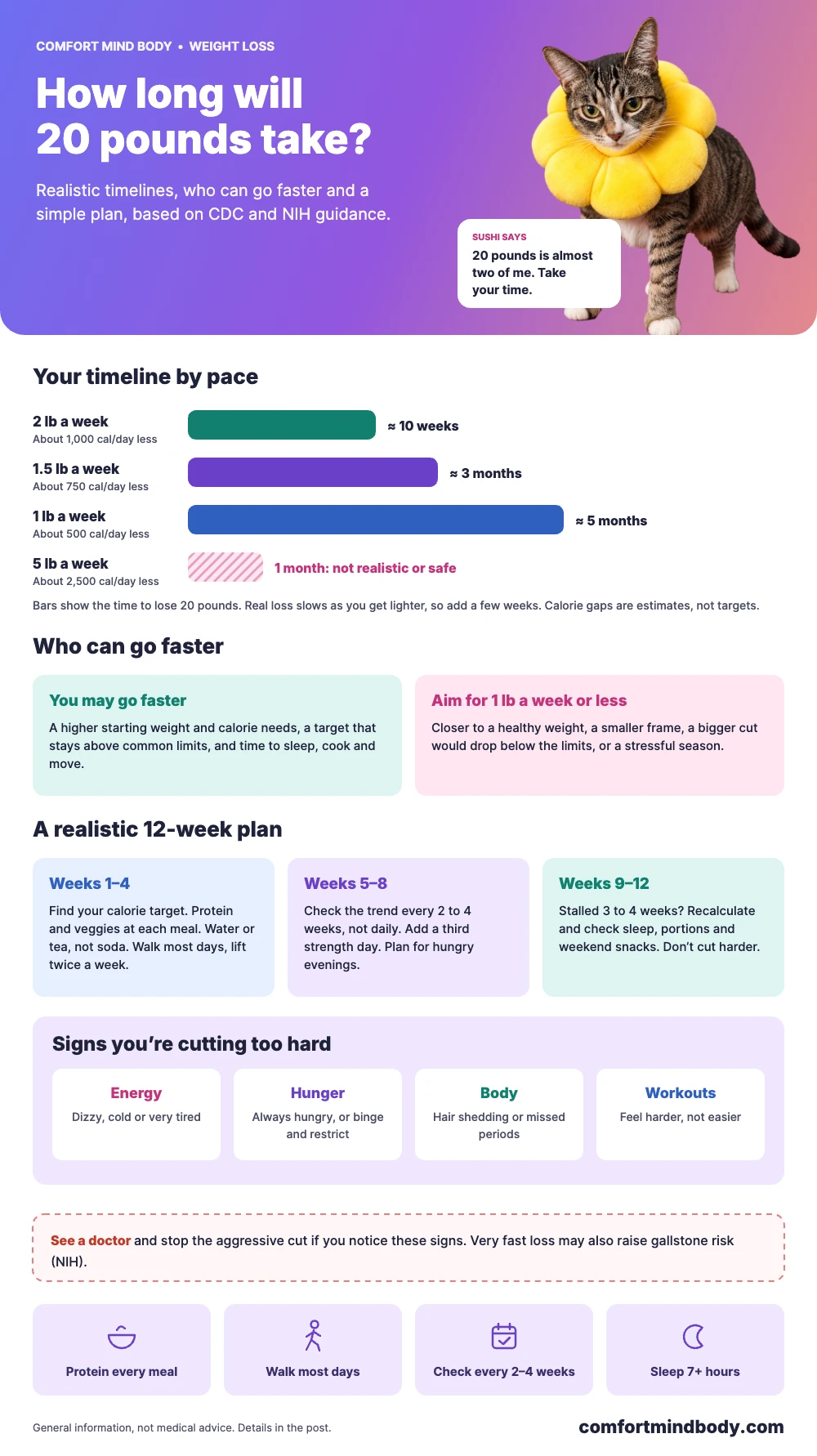
How long will 20 pounds take? Realistic timelines, who can go faster and a simple plan, based on CDC and NIH guidance. A safe pace is 1 to 2 pounds a week; 20 pounds is roughly 70,000 calories.
Your timeline by pace: 2 lb a week (about 1,000 calories a day less), about 10 weeks; 1.5 lb a week (about 750 less), about 3 months; 1 lb a week (about 500 less), about 5 months. 1 month would take about 5 lb a week, which isn’t realistic or safe for most people. Real loss slows as you get lighter, so add a few weeks.
You may go faster if: you have a higher starting weight and higher calorie needs, your target stays above common lower limits, and you’re sleeping well with time to cook and move.
Aim for 1 lb a week or less if: you’re closer to a healthy weight, have a smaller frame, a bigger cut would drop below the lower limits, or it’s a stressful season.
A simple 12-week plan: weeks 1 to 4, set your base (calorie target, protein and vegetables at each meal, water or tea instead of soda, walk most days and lift twice a week); weeks 5 to 8, keep it steady (check the trend every 2 to 4 weeks, add a third strength day, plan for hungry evenings); weeks 9 to 12, adjust without cutting harder (recalculate if stalled for 3 to 4 weeks, check sleep, portions and weekend snacks).
Signs you’re cutting too hard: dizzy, cold or very tired; always hungry or binge-and-restrict; hair shedding or missed periods; workouts feel harder. If you notice these, stop the aggressive cut and talk to your doctor. Very fast loss may also raise gallstone risk (NIH).
The bottom line: 20 pounds is a season, not a sprint. The pace you can keep beats the pace you can’t.

Can You Lose 20 Pounds in a Month?
For most people, no. Losing 20 pounds in 4 weeks means about 5 pounds a week, a daily gap of roughly 2,500 calories. That’s more than many adults eat in a whole day. Very fast loss usually means very low calories, which can raise your chances of gallstones, muscle loss and regaining the weight (NIH). If a plan promises 20 pounds in a month, it’s mostly water, or it isn’t safe.
What you can do in a month: build the habits, see the first 4 to 8 pounds come off (part of it water), and notice your clothes fitting differently.
Can You Lose 20 Pounds in 2 or 3 Months?
Two months is possible for some adults with a higher starting weight and higher calorie needs, because their body can handle a bigger daily cut and still stay above common lower limits. It’s too aggressive for smaller adults or people closer to a healthy weight. The right pace depends on your health and circumstances, not just your goal.
Three months, about 1.5 pounds a week, is a realistic target for many people. Five months is slower, but it’s the pace most people can keep, and keeping it is what matters.
Who can go faster, and who should go slower
| You may go faster | Go slower | |
|---|---|---|
| Starting point | Higher starting weight | Closer to a healthy weight |
| Calorie needs | Higher, so a bigger cut still leaves enough food | Lower, so a big cut drops below common lower limits |
| Life right now | Sleeping well, time to cook and move | Stressful season, little sleep, busy schedule |
| Health | No conditions, and your doctor is on board | Health condition, medication, pregnancy or breastfeeding: ask your doctor first |
A Realistic 12-Week Plan Toward Losing 20 Pounds
This plan aims for 1 to 1.5 pounds a week. Some people reach 20 pounds in 12 weeks; many get 12 to 18 pounds and finish the rest over the next month or two. Both are a win.
Weeks 1–4: set your base. Find your starting calorie target with our calorie calculator. Build each meal around protein and vegetables. Swap soda and juice for water or tea. Walk most days, and add 2 strength sessions a week.
Weeks 5–8: keep it steady. Check your trend every 2 to 4 weeks, not every morning. Add a third strength session or a longer walk. Plan for the hard moments: hungry evenings, weekends, eating out.
Weeks 9–12: adjust. If progress has slowed for 3 to 4 weeks, recalculate your number, since you burn less as you get smaller. Don’t cut harder; check sleep, portions and weekend snacks first. For a full guide to building these habits, see Healthy Weight Loss: How to Start and Keep It Off.
Example: A 35-year-old woman, 5’6”, 190 pounds, lightly active, burns about 2,200 calories a day. At 1.5 pounds a week (about 750 calories less a day) she’d eat around 1,450 to 1,500, still above 1,200. That puts 20 pounds at about 13 to 16 weeks, since progress slows as she gets lighter. A smaller woman, 5’2” and 150 pounds, burns about 1,800. A 750-calorie cut would put her near 1,050, below the common lower limit, so 1 pound a week (about 5 months) fits her better.
Why the First 10 Pounds Come Off Faster Than the Second 10
The first weeks often show a quick drop, partly water as your body uses stored carbs. After that the trend gets steadier, with normal day-to-day ups and downs. Later, progress often slows because a smaller body needs fewer calories. That’s not a stall, it’s math. If you’re stuck for a month, 8 Reasons You Aren’t Losing Weight walks through the usual causes. Trying to trim your middle too? See How to Lose Belly Fat.
What About 10 or 30 Pounds?
10 pounds: about 5 to 10 weeks at 1 to 2 pounds a week. Losing 10 pounds in a month is a big ask for most people; 4 to 8 pounds is more typical, and part of it is water.
30 pounds: about 4 to 7 months. People with more to lose may move faster at first, then slow down. Break it into 10-pound steps, and celebrate each one.
Anna’s Note: I set goals like this too, but mine aren’t numbers. I don’t weigh myself, because the scale makes me sad. My goal is simple: I keep going until I feel strong and like how my clothes fit. I track protein, train 4 days a week and judge my progress by how my clothes fit after a few weeks. Some weeks I get stuck and overeat, and that’s okay. I just pick up at the next meal.
Sushi’s Note: Mom says 20 pounds takes months. I weigh 12 pounds, so in my opinion that’s almost two of me. No wonder it takes a while.
Frequently Asked Questions
How long does it take to lose 20 pounds?
For most people, about 3 to 5 months at 1 to 1.5 pounds a week. At 2 pounds a week, the top of the CDC’s healthy range, it’s about 10 weeks.
Can I lose 20 pounds in a month?
Not safely for most people. It would take a daily gap of about 2,500 calories. Expect 4 to 8 pounds in the first month, part of it water.
Can I lose 20 pounds in 2 months?
Some adults with a higher starting weight and higher calorie needs can. For smaller adults or people closer to a healthy weight, it’s too aggressive.
Why did I lose weight fast at first and then slow down?
Early loss is partly water. Later, a smaller body burns fewer calories, so the same plan moves more slowly. Recalculate your number every 10 pounds or so.
Do I have to weigh myself?
No. How your clothes fit, a tape measure around your waist and how you feel all count. If you do weigh yourself, look at the trend over 2 to 4 weeks, not single days.
Final Thoughts: A Season, Not a Sprint
Twenty pounds isn’t a race, it’s a season. Pick the pace you can live with, check in every few weeks, and let your clothes tell you when you’re there.
Anna
Safety Notes
Safety Notes
- This guide is general information, not medical advice. Talk to your doctor before trying to lose weight quickly, especially if you have a health condition, take medication, or are pregnant or breastfeeding.
- 1,200 calories a day for women and 1,500 for men are lower limits commonly used for adult weight-loss plans without medical supervision. They’re reference points, not guarantees.
- If you feel dizzy, stay very tired, lose a lot of hair or miss periods, stop the aggressive cut and talk to your doctor.
- Losing weight very quickly may raise your chances of gallstones (NIH).
- Don’t aim to lose weight if you’re already underweight. If food, weight or exercise feel out of control, talk to a doctor or contact the National Alliance for Eating Disorders helpline.