
Affiliate disclosure: This post contains affiliate links. If you buy through them, Comfort Mind Body may earn a small commission at no extra cost to you. As an Amazon Associate I earn from qualifying purchases. Read my affiliate disclosure.
How this guide was made: I have read all ten titles. This guide recommends them for different reading needs, with publisher and author sources used to check book details and NCCIH used for the general evidence and safety context.
Sources checked: November 3, 2026.
Choosing a meditation book gets easier when you know what you want it to do. You might want someone to explain how to begin a sitting practice. You might prefer a few thoughtful pages to read before the day gets busy. Or you might be curious about the spiritual ideas behind a practice you already enjoy.
Welcome, fellow reader. Let’s find a starting point that fits the kind of reading you want to do. The meditation and mindfulness books below offer different things: practical instruction, everyday observations, Zen teachings, spiritual reflection, and more focused self-help. Knowing those differences is more useful than buying the most familiar title and hoping it covers everything.
You can begin with one book, read a sample or borrow a copy. Pay attention to whether the explanation makes sense to you and whether you want to return to it. A book earns its place by giving you something useful to work with.
Quick Navigation
ToggleQuick Answer: Which Meditation or Mindfulness Book Should I Start With?
My starting recommendation is The Miracle of Mindfulness by Thich Nhat Hanh. Its familiar examples bring mindfulness into ordinary activities, giving a new reader somewhere concrete to begin.
If you specifically want instruction in seated meditation, choose Jack Kornfield’s Meditation for Beginners. For short reflective chapters to read at your own pace, choose Wherever You Go, There You Are.
If you’d like to try a practice before choosing a book, start with my mindfulness for beginners guide.
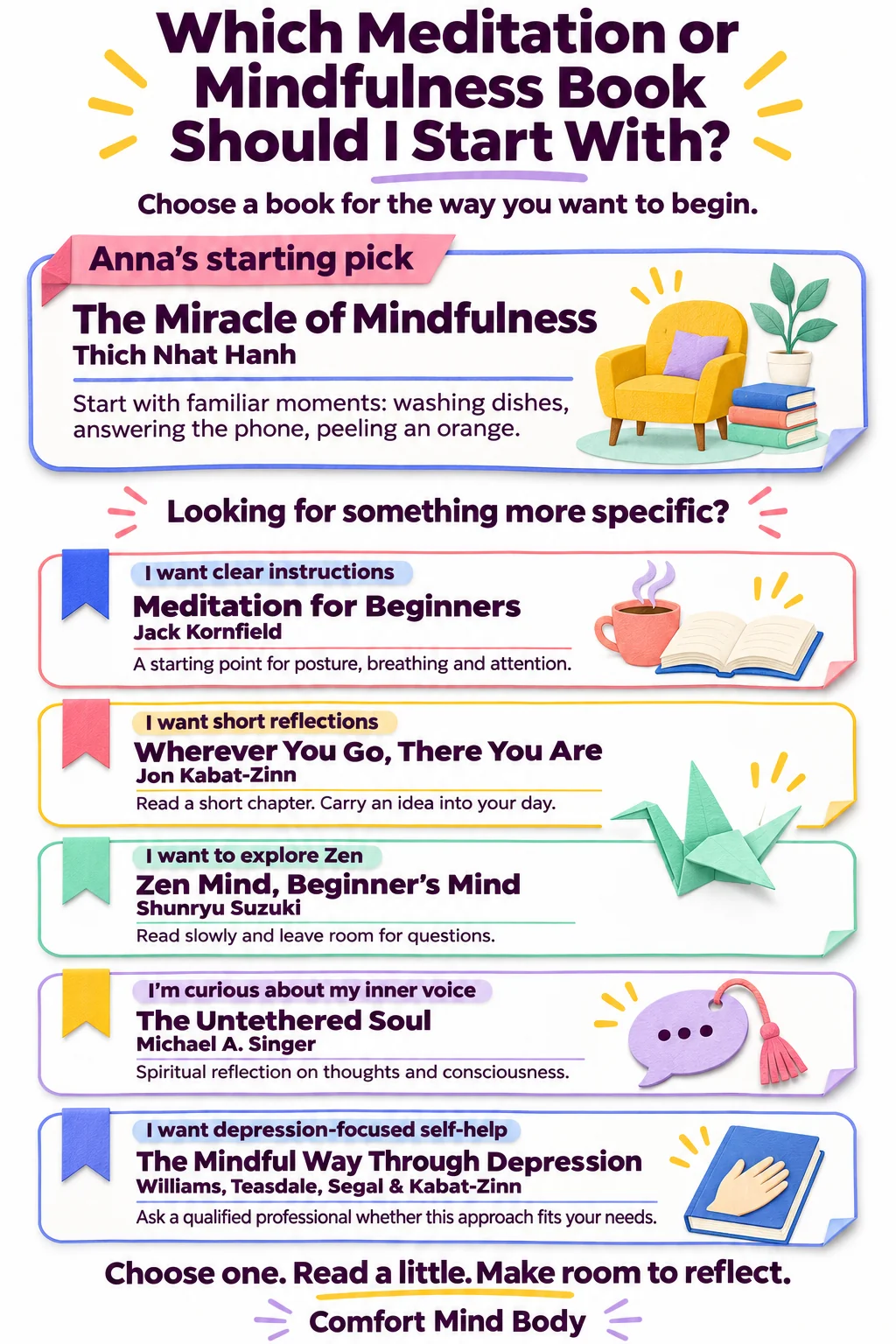
Read the infographic text
Which Meditation or Mindfulness Book Should I Start With?
Choose a book for the way you want to begin.
Anna’s starting pick
The Miracle of Mindfulness
Thich Nhat Hanh
Start with familiar moments: washing dishes, answering the phone, peeling an orange.
Looking for something more specific?
I want clear instructions
Meditation for Beginners
Jack Kornfield
A starting point for posture, breathing and attention.
I want short reflections
Wherever You Go, There You Are
Jon Kabat-Zinn
Read a short chapter. Carry an idea into your day.
I want to explore Zen
Zen Mind, Beginner’s Mind
Shunryu Suzuki
Read slowly and leave room for questions.
I’m curious about my inner voice
The Untethered Soul
Michael A. Singer
Spiritual reflection on thoughts and consciousness.
I want depression-focused self-help
The Mindful Way Through Depression
Williams, Teasdale, Segal & Kabat-Zinn
Ask a qualified professional whether this approach fits your needs.
Choose one. Read a little. Make room to reflect.
Comfort Mind Body
Choose a Book by What You Want From It
Start with the question you want a book to answer. Here is the route I recommend for each kind of reader.
“Explain how to begin.”
Choose Meditation for Beginners for an introduction to sitting. Pick Mindfulness in Plain English when you want fuller explanations, or The Headspace Guide for an accessible everyday introduction.
“Bring mindfulness into my day.”
Start with The Miracle of Mindfulness. Choose Wherever You Go, There You Are if you prefer reflective chapters, or How to Relax for very brief, illustrated teachings.
“Explore the ideas behind practice.”
Choose Zen Mind, Beginner's Mind for Zen teaching, The Power of Now for spiritual questions about presence, or The Untethered Soul for its focus on inner dialogue.
“I want to understand a depression-focused approach.”
The Mindful Way Through Depression is the focused choice here. Read its context below and discuss whether the approach fits your needs with a qualified professional when appropriate.
How I Chose These Books
I chose these books for the different ways they help a reader get started: clear instruction, thoughtful short readings, spiritual exploration or focused self-help. The recommendations below explain who I’d choose each one for and where its style or scope may be a poor fit.
Practical Books for Meditation and Everyday Mindfulness
These are my recommendations for bringing mindfulness into ordinary life or learning the basics of meditation. Begin with the kind of help you want from the book.
1. The Miracle of Mindfulness
By Thich Nhat Hanh · Paperback
If you're buying your first mindfulness book, this is where I'd start. Its appeal is how close the practice stays to ordinary life: washing dishes, answering the phone, peeling an orange. You have somewhere familiar to begin.
I'd give this to a friend who is curious about mindfulness but put off by elaborate routines. Thich Nhat Hanh's everyday anecdotes and exercises offer a welcoming way to bring attention to the day you already have.
Best fit: A first mindfulness book for readers who want everyday examples and a manageable starting point.
Why compare: Its familiar activities give the ideas somewhere concrete to land.
Watch: Buddhist teaching is part of its voice. If you want a detailed course in seated meditation, Kornfield or Gunaratana is a closer fit.
Compare Product2. Wherever You Go, There You Are
By Jon Kabat-Zinn · Revised paperback
This is my pick for someone who wants a few worthwhile pages without turning reading into another schedule. The short chapters leave you with an idea to consider as you move through your day.
I'd choose it as a companion to practice, especially for a reader who enjoys reflection. Kabat-Zinn explores the attitudes behind paying attention in everyday life. Read a chapter, put the book down, and look for a moment when the idea becomes relevant.
Best fit: Readers who want thoughtful, shorter chapters they can read at their own pace.
Why compare: The emphasis on attitudes and everyday application gives you something to consider between practice sessions.
Watch: The flexible structure leaves the pacing to you; it does not provide a prescribed weekly course.
Compare Product3. Mindfulness in Plain English
By Bhante Gunaratana · Paperback, 20th Anniversary Edition
I'd recommend this to the reader who keeps asking practical questions: How do I approach sitting? What do I do when attention wanders? Its value is the willingness to stay with the basics long enough to explain them.
The expanded guide covers the approach to meditation, common difficulties and loving-kindness within the Vipassana tradition. Choose it when you want a book you can consult about a particular practice question.
Best fit: Beginners who want fuller explanations of meditation and the difficulties that come with learning.
Why compare: It spends time on the practical questions that a brief introduction can leave unanswered.
Watch: It is a detailed Buddhist guide. Give the explanations time; readers wanting a light collection of reflections may prefer Kabat-Zinn.
Compare Product4. Meditation for Beginners
By Jack Kornfield · Paperback
If your main question is “What do I actually do when I sit down?”, I'd choose this book. Kornfield's introductory teaching gives you a clear place to begin with posture, breathing and attention.
I recommend it for the point when curiosity is ready to become practice. His guidance for newcomers also addresses distractions, so the introduction makes room for the busy mind you bring with you.
Best fit: Readers ready for a guided introduction to sitting practice.
Why compare: The focus on beginning and working with distractions makes it a direct choice for learning what to do.
Watch: Check the paperback's current audio-access instructions, especially with a used copy. Standalone audio and DVD versions also share this title.
Compare Product5. The Headspace Guide to Meditation and Mindfulness
By Andy Puddicombe · Paperback
This is my choice for a busy beginner who wants an approachable explanation of meditation. Puddicombe connects the ideas with everyday schedules, which gives a reader a familiar place to start thinking about practice.
I'd recommend it to someone who feels interested but keeps putting off the first step. The book's introductory approach makes it a useful starting point for learning the basics and deciding what you want to explore next.
Best fit: Busy beginners who want accessible explanations and an everyday approach.
Why compare: Its introductory scope keeps the starting point straightforward.
Watch: Readers looking for an extended exploration of Buddhist teachings or meditation research will want more depth.
Compare Product6. How to Relax
By Thich Nhat Hanh; illustrated by Jason DeAntonis · Paperback
I'd give this little book to someone who wants a kind invitation to slow down without a large reading commitment. A short passage is an easy place to begin when a substantial manual feels like one more thing on the list.
Choose it for a quiet reading break or a thoughtful small gift. The brief teachings and illustrations give you something to pause with, and the pocket-sized format suits reading a little at a time.
Best fit: Readers who want brief, illustrated teachings or a small mindfulness gift.
Why compare: Its short entries make it easy to choose one passage and leave space to reflect.
Watch: The small format has limited room for detailed instructions or troubleshooting practice questions.
Compare ProductA Book for Exploring Zen Practice
Zen Mind, Beginner’s Mind deserves its own introduction because the title can suggest a straightforward first lesson. Its teaching style is also part of what you are choosing.
7. Zen Mind, Beginner's Mind
By Shunryu Suzuki · Paperback, 50th Anniversary Edition
I recommend this when you're curious about the attitude behind Zen practice. “Beginner's mind” is a worthwhile invitation: approach a familiar experience with enough openness to notice something fresh.
I'd choose it for a reader who enjoys sitting with an idea and letting questions remain open for a while. Suzuki's talks on Zen practice bring posture, breathing and deeper teaching into the same conversation. Let the pace of the reading follow the ideas.
Best fit: Readers curious about Zen and willing to read slowly.
Why compare: It explores how you approach practice as well as its physical details.
Watch: Some Zen concepts are abstract. Expect reflection and rereading rather than a linear series of daily lessons.
Compare ProductBooks for Spiritual Reflection
The next two books explore presence, consciousness, and your relationship with thoughts. Their spiritual frameworks are central to the reading experience. Decide whether that is the kind of exploration you want before comparing them with a meditation manual.
8. The Power of Now
By Eckhart Tolle · Paperback
I'd recommend this to someone who enjoys big spiritual questions and is willing to spend time with unfamiliar language. The interesting question here is how closely you identify with the thoughts passing through your mind.
Choose it for that exploration of presence and identity. Tolle's spiritual framework uses ideas such as ego and Being, giving you plenty to consider about your relationship with thought and time. The linked Amazon copy is the standard paperback.
Best fit: Readers drawn to spiritual questions about presence, thought and identity.
Why compare: It gives sustained attention to a worldview that readers can examine and reflect on.
Watch: Terms such as Being and ego can feel abstract. If you want straightforward meditation instructions, start with Kornfield.
Compare Product9. The Untethered Soul
By Michael A. Singer · Paperback
If you're curious about the running commentary in your head, this is the book I'd point you toward. Singer makes your relationship with that inner voice the starting point for a wider spiritual exploration.
I'd choose it for a reader who wants questions to think about between chapters. The discussion of inner dialogue, emotions and consciousness invites you to consider how you relate to what is happening inside you. Leave space to think about the author's ideas as you read.
Best fit: Readers interested in inner dialogue and spiritual self-inquiry.
Why compare: Its focus on the inner voice gives the broader discussion of consciousness a recognizable starting point.
Watch: Spiritual language about energy and consciousness runs through the book; choose it with an interest in that framework.
Compare ProductA Depression-Focused Self-Help Book
This final title has a more specific purpose than the general introductions above. A book about depression belongs alongside a discussion of appropriate support, especially if symptoms are affecting your daily life.
10. The Mindful Way Through Depression
By Mark Williams, John Teasdale, Zindel Segal and Jon Kabat-Zinn · Paperback, Second Edition
This is the title I'd choose when the reading needs a clear focus on low mood and recurring thought patterns. It brings explanations and practices together around a question that deserves patient attention.
I recommend it for understanding this particular self-help approach and bringing more informed questions to a conversation about care. The second edition draws on mindfulness-based cognitive therapy and includes examples and downloadable guided meditations.
If you are currently depressed or your symptoms are worsening, ask a qualified health professional whether this kind of self-help fits your needs. Reading independently differs from taking part in a supported MBCT course. My guide to meditation for depression: evidence, limits and support explains that distinction in more detail.
Best fit: Readers who want to understand a depression-focused mindfulness self-help approach, with professional input where needed.
Why compare: Its specific focus on low mood and recurring thought patterns gives the reading a clear purpose.
Watch: The exercises ask for time and attention; this is a book to work through gradually.
Compare ProductBefore You Buy or Borrow a Meditation Book
Read a sample to see whether the author’s voice draws you in. You will be spending time with that voice, so choose one that makes you want to keep reading. Borrowing from a library is a useful way to explore an unfamiliar approach before making space for it on your shelf.
A few titles need an extra check: Kornfield’s Meditation for Beginners comes in different book and audio formats; The Untethered Soul also has a journal and card deck; and The Mindful Way Through Depression is separate from The Mindful Way Workbook and the professional MBCT manual. Check included audio access where it matters, especially with used copies.
Turn One Useful Idea Into a Small Practice
Let a chapter lead to something specific. After an everyday mindfulness example, you could put the book down and notice the sounds around you while washing a cup. After a clear introductory exercise, try following its instructions for a short, comfortable period. Keep enough attention on your surroundings to stay safe.
Then notice what needs explaining. Perhaps you understand the instructions but keep losing your place, or the wording leaves you unsure what to focus on. That is a useful reason to reread a section, try another teaching voice, or ask an appropriate teacher a question.
If movement appeals more than sitting, my walking meditation for beginners guide offers a simple way to explore attention while moving.
You can take your time with the reading. A few pages that lead to a clear understanding or a manageable practice are enough for one day. If an exercise feels distressing, pause it and use the support guidance below.
Frequently Asked Questions
Which meditation book is a good choice for a complete beginner?
My starting pick is The Miracle of Mindfulness for its everyday examples and exercises. If your main question is how to begin seated meditation, choose Meditation for Beginners by Jack Kornfield. Mindfulness in Plain English is the choice for fuller explanations of practice questions.
Are mindfulness books religious or spiritual?
Some are, and some use a more secular approach. Thich Nhat Hanh, Bhante Gunaratana and Shunryu Suzuki write from Buddhist traditions. The Power of Now and The Untethered Soul use broader spiritual frameworks. Check the contents and sample the language so the framing fits what you want to explore.
Do I need a meditation book if I already use an app?
A book is optional. It can give you room to reread an explanation, explore a tradition or think through a practice question. An app can offer guided sessions in another format. Choose a book when it answers something you want to understand; owning both is not a requirement.
Is an audiobook the same as included guided meditations?
An audiobook usually presents the book in spoken form. Companion meditation tracks are separate exercises, and a listing might include one, both or neither. Check the product description, access method and sample before choosing. If you will listen while moving, use material and a setting that let you remain safely aware of your surroundings.
Can meditation books replace therapy or other mental health care?
They can offer information and self-help material, but they do not replace an assessment or prescribed care. A structured course with a trained professional also provides support that a book cannot. If symptoms persist, worsen or affect daily life, seek qualified help rather than relying on reading alone.
Final Thoughts
Choose the book that matches the question you have today. Practical instructions, a short reflection and a spiritual teaching each ask something different of the reader. A clear sample and an honest description of the approach will help you decide where to begin.
Start with one title and give it some room. Read, pause, try an appropriate exercise if you want to, and notice which questions remain. Your next useful choice might be another chapter, a conversation with a teacher, or a different kind of support.
A few pages, a little practice, and room to find your own rhythm.
Take care of yourself,
Anna
Safety Notes
This guide helps adults compare books. It does not diagnose a condition, select treatment or establish that a book's promises are medically proven. Research on meditation programs varies, and some people report negative experiences.
If a practice increases distress, stop and discuss the experience with a qualified health professional. Do not delay care or change prescribed treatment because of a book. Persistent or worsening symptoms deserve professional attention.
In the United States, call 988 or text 988 for crisis support, or visit the 988 Suicide & Crisis Lifeline. If there is immediate danger, call 911. Outside the US, contact your local crisis service or emergency number.
Helpful Resources
- NCCIH: Meditation and Mindfulness—Effectiveness and Safety explains the general evidence, limitations and safety context.
- The publisher and author links beside each book explain its approach and the particular edition described. Use the selected retailer listing to confirm what you will receive.
- 988 Suicide & Crisis Lifeline offers US crisis support by call, text and online chat.