
Research-based guide | General information for adults
Welcome. Let’s make a little more room in your day for the things you want to be doing.
Perhaps you open a social app to check one message, then find yourself watching videos long after you meant to leave. Or you enjoy staying connected but feel tired of the constant checking, comparison, and pressure to respond.
A social media detox gives you an opportunity to change a specific habit and see what happens. You can pause selected feeds, reduce your time on one platform, or protect a part of the day from scrolling. The approach can fit around your job, relationships, and responsibilities.
Start by asking what you want more room for: an unhurried breakfast, time with someone you care about, or the chance to finish a task without opening another feed. That answer will help you choose a useful boundary.
For more ways to make room for yourself, explore our self-care ideas.
Quick Navigation
ToggleWhat Is a Social Media Detox?
A social media detox is a planned break from, or intentional reduction in, selected social media activities. You choose which apps or habits to change, how the boundary works, and when to review it. Sometimes called a social media cleanse, it can be as small as keeping feeds closed during meals or as extensive as pausing several platforms for a set period.
It focuses on social media use. A broader digital detox may also address email, games, streaming, or other screen activities. For this guide, the aim is to make your social media habits more deliberate while keeping the access and connections you value.
Could a Social Media Break Help You?
Look at how a habit affects your day before deciding how much time to cut. A long conversation with a distant friend can serve a different purpose from repeatedly checking a feed that leaves you feeling worse.
These questions can help you identify a starting point:
- Do I regularly stay on an app longer than I intended?
- Is scrolling pushing aside sleep, work, meals, or time I wanted for something else?
- Do certain accounts or topics repeatedly leave me upset or preoccupied?
- Am I checking because I have something to do, or because opening the app has become automatic?
- Which parts of social media give me useful information, enjoyment, or support?
Use your answers as reflection, without adding up a score. You do not need a particular number of checked boxes to try a boundary, and this is not an assessment of addiction or mental illness.
Cleveland Clinic psychologist Adam Borland recommends considering the effect social media has on you rather than looking for one universal daily time limit. Read Cleveland Clinic’s guidance on taking a social media break.
Choose the Approach That Fits Your Life
A useful plan starts with a clear decision about what will change. If you need a platform for work or an important community, you can keep that access and target a different part of your use.
Compare Three Ways to Change Your Social Media Use
On a small screen, swipe across to read the full table.
| Approach | Example boundary | When it may fit | What to plan for |
|---|---|---|---|
| Reduced use | Choose a manageable daily limit for one app. | You enjoy the platform and want less open-ended browsing. | Decide what you will do when you reach the limit. |
| Scheduled access | Check a feed during a planned window. | You need regular access but want fewer interruptions. | Keep a separate route for urgent or essential contact. |
| Temporary pause | Stay off selected feeds until a chosen review date. | You want to observe daily life without those feeds. | Arrange access to useful groups, messages, or work tasks beforehand. |
Comfort Mind Body Take: Choose a boundary that addresses the part of social media use you want to change. A smaller plan that preserves useful connection may fit your life better than a complete pause.
What Does Research Say About Social Media Detox Benefits?
The evidence offers reasons to experiment, with realistic expectations. A 2025 meta-analysis of randomized trials, covering 32 articles and 5,544 participants, found a small average improvement in subjective well-being when people restricted social media. Results varied, and the review did not consistently establish that one duration or approach worked better. Read the meta-analysis of social media restriction trials.
A separate 2025 review focused specifically on temporary abstinence. Its main pooled analyses did not find statistically significant changes in positive feelings, negative feelings, or life satisfaction. These findings do not mean that no individual benefits; they show why a break cannot promise the same result for everyone. Read the review of social media abstinence and well-being.
For your own experiment, choose something you can observe. You might want fewer interruptions during a meal, less time spent on one feed, or a bedtime you actually keep. Also notice any costs, such as missing a useful community or making communication harder. Your notes can guide a decision, although they cannot prove that a social media change caused a health improvement.
Does a Social Media Detox Reset Dopamine?
A break does not literally cleanse your brain of dopamine. Harvard Health explains that avoiding stimulating activities is not a way to fast from this naturally occurring brain chemical. Treat claims about resetting dopamine or rewiring your brain within a fixed number of days with caution. Read Harvard Health’s explanation of dopamine fasting.
How to Set Up Your Social Media Detox Plan
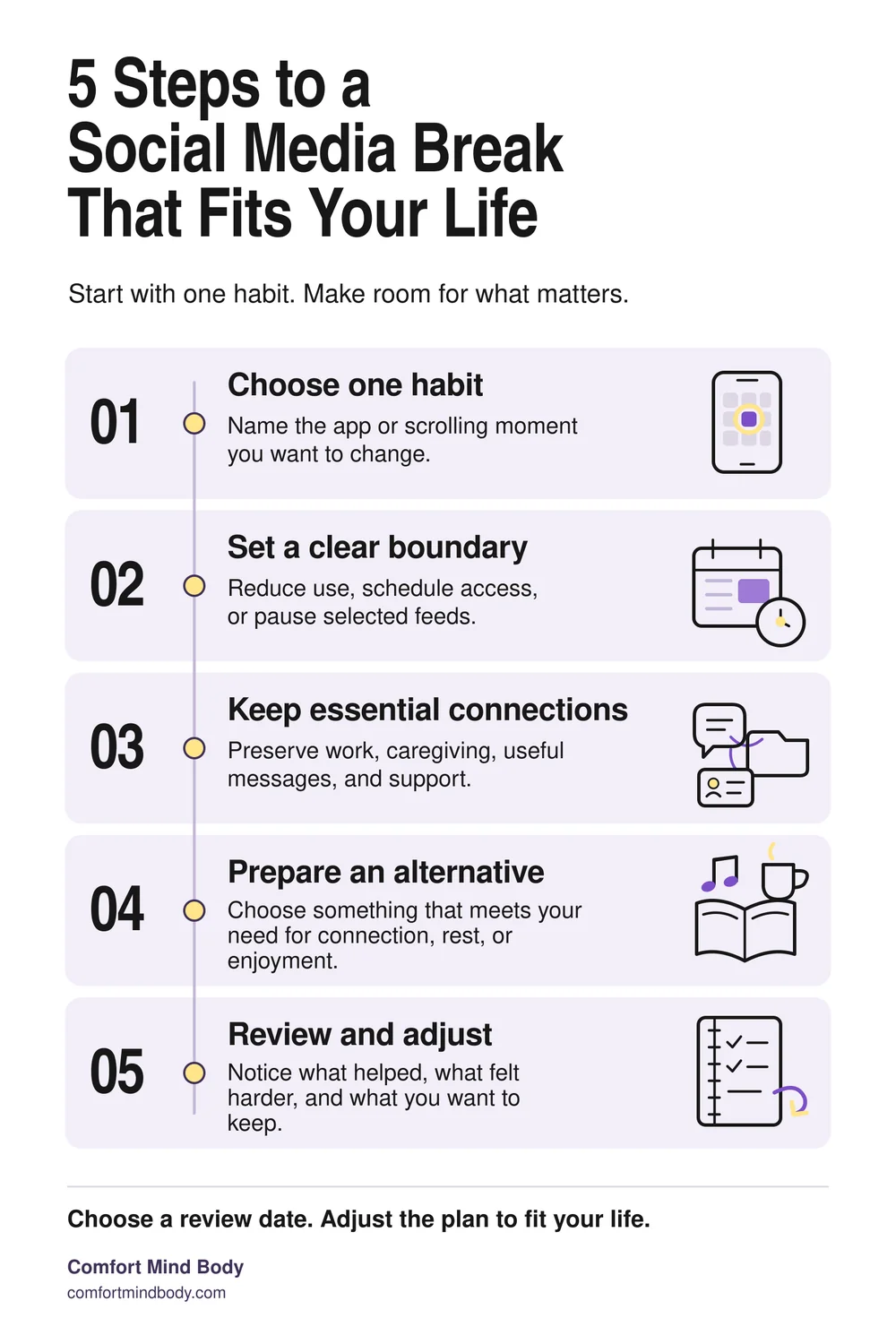
Give yourself a clear starting point, a rule you understand, and a way to review it. The following steps are practical planning suggestions rather than a tested treatment program.
Identify One Habit and Record Your Starting Point
Choose a situation you recognize: checking a feed during breakfast, browsing between work tasks, or watching short videos after you meant to go to bed. Write down what happens and what it interrupts.
If your device provides a usage report, you can note the recent time in the selected app. An estimate is also useful. Keep work, communication, and accessibility use in context rather than treating every screen minute as a problem.
Write a Boundary You Can Check
Turn “I want to scroll less” into a specific action. For example: “For the next week, I will keep Instagram closed during breakfast and check messages after I have eaten.”
Choose a review date at the same time. An evening, weekend, or week can be a manageable starting experiment, depending on what you want to learn. Research has not established a universally best duration, and you can adjust the plan earlier if it creates problems.
Keep Essential Access Available
Before changing notifications or removing an app, consider who needs to reach you and which functions you rely on. These might include work messages, caregiving arrangements, a support group, medical alerts, accessibility tools, or account sign-in.
Write down what stays available. If someone would otherwise worry about your absence, send a simple message: “I’m taking a break from this feed for a week. Please text or call if you need me.” You can tell the people who need to know without making a public announcement.
Change One Cue and Prepare an Alternative
Try one practical change: silence a nonessential notification, move a distracting shortcut, or log out after finishing a task. Check that the change still allows the contact you need.
Then plan for the moment when you would usually scroll. If you want connection, arrange a conversation or send a thoughtful message. If you want entertainment, have something enjoyable ready. If you want rest, you can rest; the time does not have to become another productive task.
Make the alternative easy to begin. A book within reach or a familiar playlist may be more usable on a tired evening than an ambitious new routine.
A Manageable Seven-Day Social Media Break
This example gives you a structure to adapt. Keep your chosen boundary while trying the daily action, and move or repeat steps as needed.
- Day 1: Record your starting point. Identify one app or habit, what it interrupts, and what you hope to make room for.
- Day 2: Set your rule and review date. Check that essential messages and services remain available.
- Day 3: Reduce one interruption. Adjust a nonessential alert or shortcut connected to your target habit.
- Day 4: Try a prepared alternative. Choose something that fits the reason you usually open the feed.
- Day 5: Notice a difficult moment. Write down what happened before an automatic check and what might help next time.
- Day 6: Practice on an ordinary busy day. Use a smaller version of the boundary if your responsibilities require it.
- Day 7: Review benefits and costs. Decide whether to continue, change the rule, return with limits, or stop the experiment.
A missed day gives you something to review. You can adjust the next attempt without restarting the week.
Continue With the Optional 21-Day Workbook
If a longer period of reflection would be useful, the companion workbook provides three weeks of flexible prompts, a daily tracker, and a page for choosing your next step.
The first week helps you notice the pattern. The second focuses on making your boundary fit daily life. The third helps you decide what to keep and how to return to selected feeds, if you choose.
Twenty-one days is a planning format, not a deadline for changing your brain or forming a lasting habit. You can complete fewer days, repeat a useful prompt, or use a notebook instead. The workbook is printable, with spaces for handwriting rather than interactive form fields.
FREE PRINTABLE PDF
Your 21-Day Social Media Break Workbook
Choose one boundary, record what you notice, and decide what to keep. Includes three weeks of flexible prompts, a daily tracker, and a final reflection page.
Open the 21-Day Workbook6-page PDF. Opens in a new tab. Print and complete by hand; this is not a fillable form.
Handle FOMO, Automatic Checking, and Difficult Days
When you feel pulled toward an app, ask what you are hoping to find. There may be a practical need, a wish for connection, curiosity, or a familiar way to fill a pause. That distinction can help you choose what to do next.
If you are worried about missing something important, decide how you will receive it. Ask a friend to text about plans, keep a necessary group available, or schedule a purposeful check-in. You can make space from a feed while staying connected to your relationships.
If you open an app outside your rule, pause when you notice. Consider whether a notification drew you in, the boundary was unclear, or you needed something the plan had left out. Adjust that part of the plan rather than making the whole challenge stricter.
Work can require a different approach. Before opening a platform, name the task: reply to a client, publish a post, or check a specific message. Choose a stopping point where your role allows it. If your work requires monitoring, discuss response expectations with the relevant people; your personal boundary needs to account for those responsibilities.
Supportive online contact matters too. If cutting access leaves you more isolated or removes help you depend on, change the plan. You can target a distracting feed while preserving a useful conversation or community.
Taking a Social Media Break After a Breakup
If you keep returning to an ex’s profile or find their updates difficult to see, choose a boundary around that specific habit. Depending on the platform, you might mute or unfollow an account, stop checking a profile, or pause a feed for a period you choose. You can make that decision privately.
Keep supportive friendships and any necessary channel for shared responsibilities available. Choose the boundary for your own needs; another person’s reaction is outside your control. Taking a break cannot guarantee that an ex will return or that a new relationship will follow. Review whether the change helps you spend your time as you intended, and adjust it if it increases isolation or makes practical communication harder.
Return With a Boundary You Want to Keep
Before resuming your usual access, look back at the reason you started. Did your chosen habit change? Was there more room for what you wanted to do? Did the plan have a cost you had not anticipated?
Choose your next step from those observations. You might keep notifications quieter, continue a feed-free meal, use one planned check-in, or bring back a platform you missed. Decide the purpose of that access and a stopping point you are willing to try.
Set another review date that fits your schedule. If the boundary works only on an unusually quiet day, make it more realistic. You are allowed to keep the useful parts and leave the rest.
FAQ
How long should a social media detox last?
Do I have to delete my social media accounts?
Can I take a break if social media is part of my job?
Can I keep messaging friends during a social media detox?
What if I feel restless or anxious when I stop checking?
What if taking a break does not make me feel better?
Final Thoughts
A useful social media detox helps you understand one part of your day more clearly. It can show you which interruptions you want to reduce, which connections you value, and what kind of boundary you are willing to keep.
Begin with a specific habit and give yourself room to adjust. A quieter breakfast, a task completed without a feed open, or an evening spent as you intended can be a worthwhile outcome on its own.
As you close this guide, choose one part of tomorrow you would like to make a little more spacious. Let that be your starting point.
Take gentle care of yourself,
Anna
Safety Notes
This guide offers general information and practical planning ideas for adults. It is not a diagnostic assessment or treatment for anxiety, depression, sleep problems, or compulsive behavior. Keep access to needed communication, medical alerts, accessibility tools, and supportive services. Seek qualified professional support for persistent or severe distress, or when your habits are affecting daily functioning.
Helpful Resources
- Cleveland Clinic: When and How to Take a Social Media Break — psychologist-led guidance on recognizing patterns and setting personal boundaries.
- Social media restriction: a meta-analysis of randomized controlled trials — the research review behind this guide’s discussion of small average well-being benefits and variation between studies.
- Social media abstinence, feelings, and life satisfaction — a review explaining why temporary abstinence does not consistently improve every outcome.
- Harvard Health: Dopamine Fasting — an explanation of common misconceptions about dopamine and taking breaks from stimulation.