Evidence check: Selected human NAD+ studies and safety guidance reviewed October 10, 2026. This comparison separates blood measurements from health outcomes. It is not a dosing guide.
Welcome. These four names can sound like different versions of the same thing. They are not. Let’s take them one at a time and see what the research actually tested.
A bottle labeled NR and a clinic offering NAD+ IV may both promise to “raise NAD+.” That shared phrase hides important differences. The ingredient, the way it enters the body, and the result measured in a study may not match what is being sold.
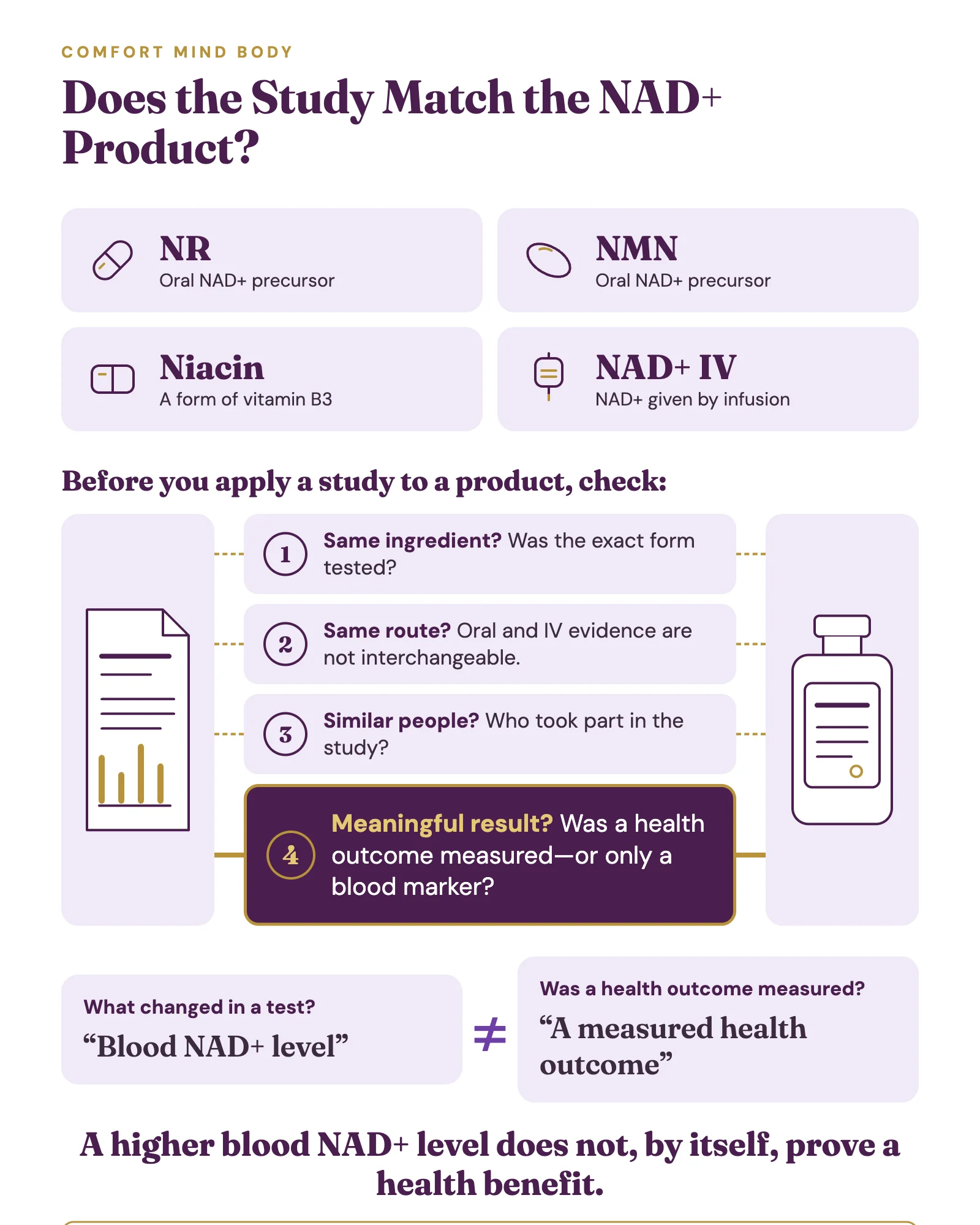
You do not need to memorize every NAD+ pathway to spot the problem. Start with four questions: Was it the same ingredient? Was it taken the same way? Who took part? Did the study measure a health outcome, or only a blood marker? Our guide to NAD+ benefits looks at the wider evidence. Here, we will keep the four options separate.
This is a research-based comparison, not a hands-on test of supplements or infusion services. It draws on human trials, a systematic review, NIH nutrient guidance, and FDA safety information. It does not rank brands or recommend a personal dose.
Quick Navigation
ToggleWhich is better: NR, NMN, niacin, or NAD+ IV?
For general wellness, human research has not established one of these as the best choice. Oral NR and NMN can raise blood NAD+ in studied groups, but that finding alone does not prove that people feel better or age more slowly.
Niacin has a separate nutritional and medical history. NAD+ IV has a different route and much less evidence for wellness claims. Match the exact claim to the exact study before choosing anything.
NR vs NMN vs Niacin vs NAD+ IV: What are you actually comparing?
NR, or nicotinamide riboside, and NMN, or nicotinamide mononucleotide, are compounds the body can use in NAD+ metabolism. They are usually studied as oral products. Niacin is a broader vitamin B3 term.
In this comparison, “niacin” means nicotinic acid when we discuss its established nutritional and lipid-related uses. Nicotinamide, also called niacinamide, is a different form. Read the exact form on a label.
NAD+ IV means NAD+ delivered into a vein. It is neither an oral NR nor an oral NMN study. A result from one form or route cannot simply be handed to another.
The guide to changing NAD+ levels covers the biology in more detail; this comparison focuses on what the human studies can support.
How do NR, NMN, niacin, and NAD+ IV compare?
What human evidence supports each option—and what remains unproven?
On a phone, swipe across the table to see every column.
| Option | Form and route | What human research shows | What it does not show |
|---|---|---|---|
| NR | Oral nicotinamide riboside | Blood NAD+ can rise in studied groups. Health outcomes have been mixed. | A blood rise alone does not prove broad wellness or anti-aging benefit. |
| NMN | Oral nicotinamide mononucleotide | Blood NAD+ can rise. A small trial found better muscle insulin sensitivity in women with prediabetes. A 24-week trial in older adults found no significant primary hearing or physical-performance benefit. | It has not been shown to be a general anti-aging treatment. |
| Niacin | Here: oral nicotinic acid, a vitamin B3 form | It has established nutritional uses and can change blood lipids at medical doses. | Those uses do not prove it is a better wellness NAD+ booster. High-dose use has important risks and needs medical oversight. |
| NAD+ IV | NAD+ given by infusion | A single-center trial in patients with a specific type of heart failure found a better heart-pumping measure at one month alongside usual care. | That narrow result does not establish a benefit for healthy people buying wellness infusions. Injection safety needs separate scrutiny. |
The rows answer different questions. They are not a scorecard. A 2026 review of 33 human intervention studies found that oral NR and NMN often engaged the NAD+ pathway, while meaningful wellness outcomes remained mixed or inconclusive.
Its search ended in October 2025, so newer trials also matter. (2026 systematic review).The studies discussed below are a selected set, not a complete review, so they show how to read the evidence rather than settle every question.
Results were not all null. In a 10-week trial of 25 postmenopausal women with prediabetes who were overweight or obese, NMN improved muscle insulin sensitivity. It did not improve several other metabolic measures. In a six-month trial of 90 people with peripheral artery disease, NR improved six-minute walking distance compared with placebo.
That result met the trial’s prespecified one-sided threshold (P = 0.08), which was less strict than the usual two-sided P < 0.05 standard. Both findings are limited to the groups and outcomes studied. They do not prove a general wellness benefit. (NMN insulin-sensitivity trial; NR walking trial)
What can oral NR and NMN studies tell you?
A useful head-to-head study followed healthy adults for 14 days. NR and NMN raised whole-blood NAD+ by similar amounts in that study. It was open-label, had 65 people in the modified analysis, and measured blood chemistry rather than whether people lived longer or felt better.
The third active group received nicotinamide, not nicotinic acid. It would be a mistake to call that arm “niacin” and transfer its result to a nicotinic-acid product. (2026 NR/NMN/nicotinamide trial)
Longer follow-up does not automatically turn a marker into a benefit. In a 24-week placebo-controlled trial, adults aged 65 or older taking oral NMN had higher blood NAD+-related measures. The trial did not find a significant improvement in its primary hearing outcome or in physical performance measures.
That result is about the people, product, and outcomes studied. It is not proof that every NMN product fails, but it limits broad claims drawn from the blood result. (2026 NMN trial in older adults)
NR offers a similar lesson. In a 12-week pilot trial, 42 older adults with mild cognitive impairment completed follow-up. Blood NAD+ roughly doubled in the NR group, but the trial did not find better cognition, its primary outcome, compared with placebo.
The trial was small and studied a specific group. It shows why a blood change and a clinical result must be reported separately. (2026 NR cognition trial)
There is another reason to read blood claims carefully. A 2026 analysis of seven human cohorts found that whole-blood NAD+ did not steadily fall with age, even though it could change after NR supplementation. This finding is about whole blood.
It does not settle what happens in every tissue. It does challenge the idea that one blood reading is a simple “youth meter.” (2026 whole-blood NAD+ study) For a closer look at anti-aging promises, use our NAD+ “youth molecule” claim check.
Where does niacin fit?
Niacin is not a cheaper stand-in for NR or NMN. Nicotinic acid and nicotinamide are different vitamin B3 forms. At medical doses, nicotinic acid can change cholesterol measures. Large trials have not shown that adding it to modern cholesterol treatment reliably prevents cardiovascular events, and side effects matter.
The NIH Office of Dietary Supplements distinguishes these uses and cautions. (NIH niacin fact sheet)
This distinction matters at the shelf. A label may say “niacin,” “nicotinic acid,” or “niacinamide.” Do not assume those names lead to the same effects or safety profile. High-dose nicotinic acid can cause flushing and, with prolonged use, more serious problems such as liver injury or worsened blood-sugar control.
A sustained- or extended-release label does not remove that concern. NIH says liver injury may be more likely with extended-release nicotinic acid. Treat high-dose use as a medical decision, not a do-it-yourself shortcut to raising NAD+. (NIH safety guidance)
Does NAD+ IV have stronger evidence because it goes straight into a vein?
No. A direct route does not answer the question that matters most: did the treatment improve a relevant health outcome for people like you? A randomized trial studied IV NAD+ alongside usual care in 180 adults with heart failure caused by ischemic cardiomyopathy.
A heart-pumping measure improved more in the NAD+ group at one month. The study was single-center and involved patients with a defined disease. It cannot establish that a wellness infusion benefits otherwise healthy adults. Other clinical-event results in that study did not meet the usual statistical threshold. (heart-failure trial)
A 2026 retrospective pilot compared IV NAD+ with IV NR in a commercial setting. That is not the same comparison as oral NR versus NAD+ IV, and the groups were not randomly assigned.
People receiving IV NAD+ reported infusion-time symptoms, including stomach symptoms, faster heart rate, and chest pressure. The pilot cannot settle long-term safety or wellness effectiveness. (IV tolerability pilot)
The FDA has separately warned that food-grade NAD+ ingredients are not suitable for sterile injectable products without appropriate processing. It has received reports of severe reactions after NAD+ injections. These are injection-specific concerns; oral supplement studies do not resolve them. (FDA sterile-compounding alert)
For a fuller personal-safety checklist, see how to use NAD supplements safely.
How can you check a NAD+ claim in under a minute?
Treat the cited study like a receipt for the claim. First, match the exact ingredient on the product label. Next, check whether it was swallowed, injected, or infused. Then look at the people studied and the follow-up time.
Finally, ask what changed compared with the control group. A blood marker is a real measurement, but it is not the same as a measured improvement in health.
For example, an oral NR study cannot establish that an NAD+ IV session improves energy or is safe. The ingredient and route differ before you even reach the outcome. If a product combines several ingredients, ask whether the cited trial tested that same blend.
If the answer is unclear, the study may still be interesting, but it is not proof for that product.
Comfort Mind Body Take: Match the study to the ingredient, route, people, and result. If one of those changes, the promise needs fresh evidence.
If you move from checking evidence to comparing bottles, our NAD supplement buyer guide lists products. Its rankings do not prove that any product improves health. Apply the same four checks to each claim you see there.
Products to Check Against the Research
These are product examples, not ranked picks or products we have tested. We chose them to show how different labels need different evidence. A listing does not prove a health benefit. Check the current label against the ingredient, route, people, and outcome in any study cited for it.
Affiliate disclosure: As an Amazon Associate I earn from qualifying purchases. If you buy through the links below, we may earn a commission at no extra cost to you.
- NR: Tru Niagen Pro. This is oral NR. Check the current serving amount. NR trial findings do not prove this bottle improves health.
- NMN blend: ProHealth Longevity Liposomal NMN Pro Complete. The listed blend includes NMN, resveratrol, and TMG. A single-ingredient NMN trial does not prove this blend has the same effects. Check the full formula.
How to Vet a Bottle Before You Trust a Label
A label tells you what a product claims to contain. These checks help you look for evidence that the contents match the label. They do not show that the product improves health.
- Look for a third-party seal or an openable test report. USP, NSF, and Informed Choice are examples of independent programs. Otherwise, look for a current certificate of analysis tied to the batch number on your bottle, and check that you can open it.
- Be wary of proprietary blends. If the label does not state the actual amount of NR or NMN, you cannot compare it with any trial.
- Treat "liposomal" and "bioavailability" claims as marketing unless a trial tested that exact product.
- Do not use star ratings as proof of quality. Reviews cannot verify what is in the capsule.
- Check independent lab testing. ConsumerLab's NAD booster review tests products for label accuracy. Full results require a paid membership.
Final Thoughts
The names in this comparison share a connection to NAD+ biology, but they are not interchangeable choices. The most repeatable human result for oral NR and NMN is a change in NAD+-related blood measures. Health outcomes remain less certain. Niacin has a different medical context, and IV NAD+ has a different evidence and safety question.
You can keep the decision simple. Check the form, the route, the people, and the outcome. If a claim skips one of those steps, pause before treating it as a reason to buy.
I hope this gives you a calmer way to read the next NAD+ claim you see. Check what was tested before deciding what the result means for you.
With care,
Anna
Safety Notes
This guide is general information, not personal medical advice or a dosing plan. If you are considering high-dose niacin, an infusion, or a supplement while managing a medical condition or taking medication, discuss the exact product and your situation with a qualified clinician or pharmacist. No oral study here establishes the safety of NAD+ IV.
Helpful Resources
- 2026 systematic review of NAD+-related interventions — the broad human-evidence context, with a search ending in October 2025.
- 2026 NR, NMN, and nicotinamide comparison — a short blood-marker trial, not a niacin or IV comparison.
- 2026 NMN trial in older adults — blood-marker change and prespecified health outcomes.
- NIH niacin fact sheet — form distinctions and high-dose cautions.
- FDA injectable NAD+ safety alert — concerns specific to sterile compounding and injections.